
The short answer
Yes, leadwork can go on in winter provided the roof is dry and conditions are safe for working up high. Lead sheet is shaped by hand and has no curing time, so cold alone does not stop it. Rain, ice, frost and strong wind do, because they make a roof slippery and sheet hard to handle.
Why cold weather is not the problem
Lead is a soft, heavy metal that is rolled into sheet and then shaped on the roof with hand tools. Nothing in that process needs warmth. There is no adhesive to cure and no coating to dry, so a flashing or a valley lining formed on a cold, dry day is the same piece of work as one formed in July. The thickness is the same too: rolled lead sheet is made to BS EN 12588 in codes 3 to 8, and code 4, for example, is 1.80 mm thick. Which code goes on which detail comes from the job's specification, not from the season. Winter does not call for a heavier or lighter sheet, and it does not alter how the lead is dressed into a corner, over a roll or up a wall.
What changes in winter is the setting around the lead. Daylight is short, decks and ladders can hold damp, and a breeze that would hardly matter in summer can take hold of a large sheet. Those are questions about working safely at height and about keeping the roof dry underneath the new metal, not about the metal itself.
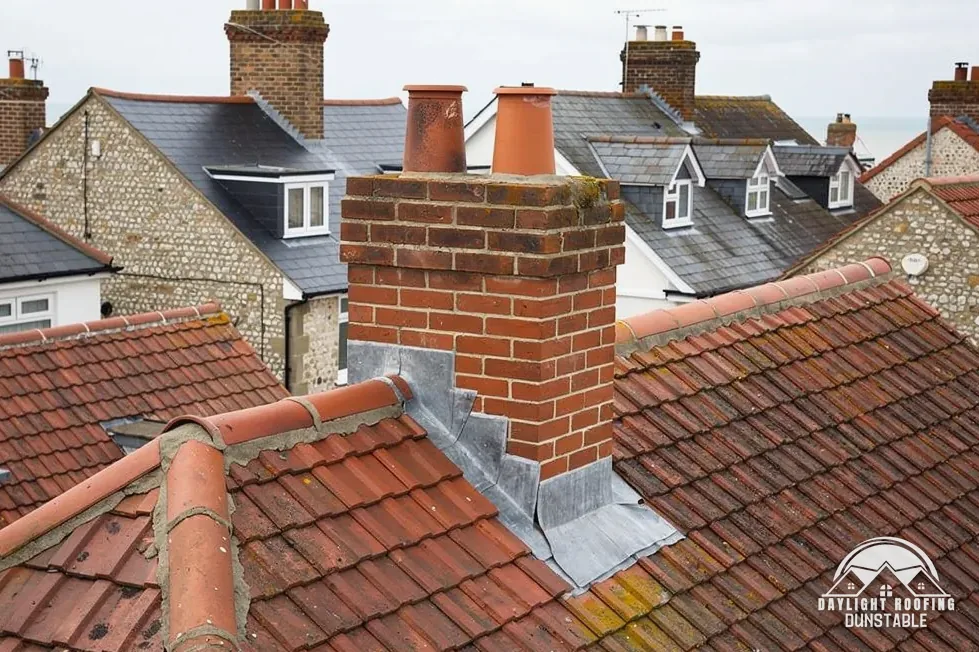
So the honest question to ask of any winter lead job is whether the roof can be worked on safely and kept dry that day. If it can, the job can go ahead. If it cannot, the sensible course is to wait for a better spell. The lead roofing page sets out the kinds of leadwork a survey looks at, from flashings to valleys and bay roofs.
What winter does stop on a roof
A few conditions, not the calendar, decide whether lead can be laid. Each of them is something a roofer can see from the ground or from the ridge.
- Rain falling on open work. Water that lands on bare boards or on the roof structure under a flashing can be sealed in once the lead goes down.
- Ice or frost on slopes, scaffold boards and ladder rungs, which leaves nowhere safe to stand.
- A wind that can pick up a flat sheet, since a sheet of lead presents a broad surface and is awkward to hold on a pitch.
- Fresh mortar in a raggle or a bedded joint, which a hard frost can ruin while it is still soft.
- Poor light as a short day closes, when edges and fixings are hard to see properly.
No single one of these shuts the roof for the whole season. A cold, still, dry January morning can suit lead work better than a warm, gusty afternoon in June. What settles it is the day and the roof itself, which is why a firm date months ahead is not something a careful roofer promises for a winter job.
Planning a winter leadwork job
The survey comes first, whatever the season. It looks at the lead that is there, the pointing and wedges that hold it, the deck beneath and how the roof is reached. What we quote after it is one total price, so no separate seasonal line sits in it to compare. How the cost of leadwork is built up is covered in the lead roofing costs guide.
Access matters more in winter. Where scaffolding stands on the pavement or road, the highway authority issues a scaffold licence; we arrange the licence with our scaffolder. A scaffold with wet or icy boards is no use to anyone, so the access is part of what is judged on the day.
If lead has already failed and water is coming in, do not wait for spring to find out how bad it is. Look at the ceiling and the loft timbers after rain, photograph any staining, and message a clear picture to the WhatsApp number 07880 284133. Whether damage to lead calls for a patch or a new strip is covered in repair or replace lead flashing.