
The short answer
Sometimes. Zinc sheet is a recognised roofing metal and can take the place of lead where a detail suits a folded, seamed material, such as a flat or low-pitched roof. Lead is easier to dress into awkward junctions, so the detail itself decides which metal goes on.
How the two metals behave on a roof
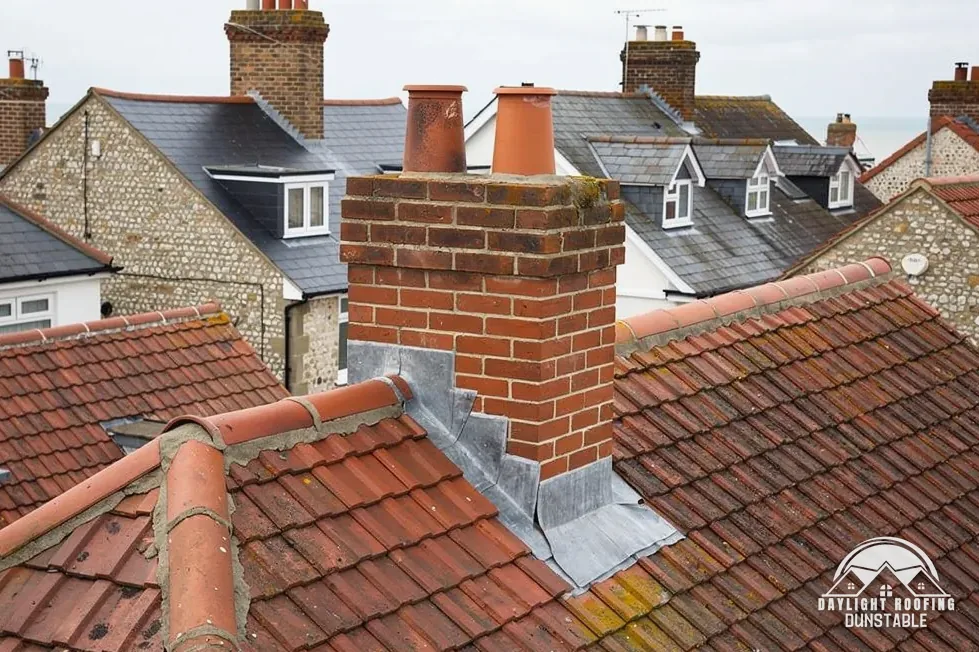
Lead and zinc are both sheet metals, but a roofer handles them in very different ways. Lead is soft and heavy. It can be bossed with a mallet into a corner, stretched into a stepped line against brickwork, and turned over a roll or down a drip, and it stays where it is put. That is why lead is the metal people picture when a chimney flashing or a valley is mentioned.
Zinc is firmer. It is cut to size and then folded and seamed, or soldered at the joints, and it is made up from measured panels instead of being pushed into shape on the spot. Tight, irregular corners are harder to make cleanly in a metal that folds along straight lines. On a long, plain run, such as a flat roof or a dormer cheek, the same firmness is an advantage, because the panels hold a crisp, even line.
So the question is not one of better or worse in general. It is a question of which metal suits the junction in front of you. The lead and its alternatives guide looks at the choices side by side for flashings, valleys and upstands.
Where zinc can stand in for lead
Lead is not the only metal that sheds water. Zinc can be a sensible alternative on details that are long, regular and not too tightly shaped. It may also be asked for where a roof already carries zinc, so the new work matches what is beside it. Large, simple areas are where long panels and straight folds do their finest work, and where the case for zinc is strongest.
- Flat or low-pitched roofs with straight edges.
- The top of a bay window or a porch, where the plan is simple.
- Dormer cheeks and roofs, where long panels run in a straight line.
- Parapet or box gutters, which are formed as long troughs.
Lead is the safer pick for the awkward places: the stepped line up a gable wall, the soakers and aprons around a stack, a small valley with sharp turns, and anywhere that metal has to be persuaded round an odd shape. A listed home needs listed building consent for work that touches its special architectural or historic interest, so a change of metal on its roof belongs in a conversation with the council before anything is ordered. In a conservation area, check with the council in the same way. Its answer is for that building, and it will not carry over to the house next door.
Lifespan and how the choice is made
The lifespan statements that exist come from different sources, each about its own metal. VMZinc, the maker, says: "When correctly designed and installed a zinc roof can last in excess of 100 years." MyJobQuote says correctly installed lead flashing can last for over 80 years. They come from different bodies and speak of different things, so neither is a promise for a roof in Dunstable, and neither should be read as a league table.
Neither metal can be called the cheaper one in general, since a price for either turns on the particular junction rather than on the metal. What a job costs depends on the length of metal, how awkward the junctions are and how the roof is reached. Our own price waits for a survey of the roof, after which it comes as a single written total.
That survey is also where the choice between metals is made: at the roof, with the detail in view. If you would like an opinion on a particular junction, a clear photograph sent to 07880 284133 on WhatsApp gives a starting point, and the lead roofing page sets out the other leadwork we look at.