
The short answer
Yes, lead is the better material for a roof joint that has to last. A lead flashing is shaped to carry water over the junction and held in place mechanically, whereas sealant is a bead that fills a gap and relies on sticking. Sealant can serve as a short-term holding measure, but it is not a substitute for a proper flashing.
How each one works at a roof joint
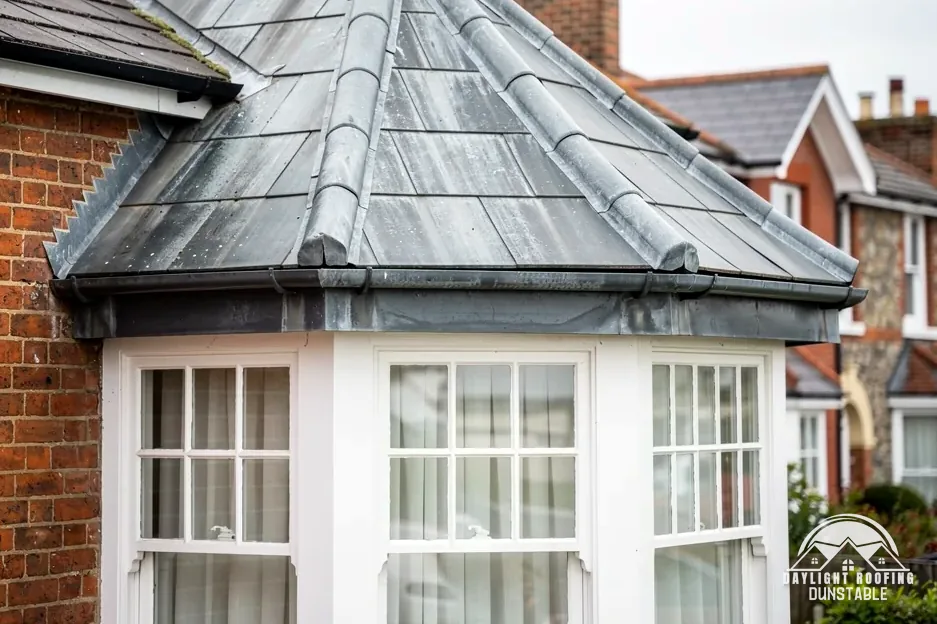
Wherever a roof runs into a chimney stack, a gable wall or a dormer cheek, there is a gap that rain would otherwise reach. A flashing closes that gap by being shaped to it. Lead is dressed over the roof covering at one edge and turned up the wall at the other, with its top edge held in a cut joint in the masonry by wedges and pointing. Rain trickling down the brickwork drops onto the lead and is carried out over the covering below. The seal comes from the shape and the fixing, and nothing depends on glue.
Sealant does a different job. It is a bead pressed into a gap, and it works by sticking to the surfaces either side and filling the space between them. Take away the grip, or let the gap move, and the seal is gone. There is no overlap, no fall and no fixing apart from the bead's own adhesion.
That difference is why the two are not interchangeable. One is a shaped barrier, and the other is a filler. The lead and its alternatives guide places sealants and mortar fillets next to the metals so the choices can be compared.
Why sealant is a stopgap on a flashing
A bead of sealant across a split or along a lifted edge can look neat from the ground and still leave the cause untouched. A flashing moves as the roof warms and cools, and a bead has to stretch and shrink with it. Where it cannot, it can crack or let go of one side.
- It grips only clean, dry surfaces, so a bead laid in damp weather or over dust may bond poorly.
- It sits in the gap and has no overlap, so once it parts, water has a direct path.
- It can cover a split or a lifted edge, so the fault stays hidden while damp works behind it.
- Sun, frost and movement can all wear a bead, and a worn one is hard to see from below.
- Old sealant has to be cleared before a proper repair, which can add work.
None of this means sealant is never used. It is a short-term measure, a way to hold a joint while the real repair is arranged. The risk comes when it is treated as the repair itself, because a bead that fails quietly can leave timber and plaster wet for a long time before anyone notices.
Weighing lead against sealant for your roof
On lasting power, there is one sourced figure for lead: MyJobQuote says correctly installed lead flashing can last for over 80 years. A bead of sealant has no such figure to set beside it, because its life depends on the product, the surface, the movement of the joint and the weather it faces. A sealed joint is something to watch and, in time, replace.
On cost, MyJobQuote gives chimney leadwork figures only: a patch repair at around £200 and a full replacement at around £570, as typical averages for chimney flashings. They do not cover other joints. Whichever joint it is, the price we give is a single written sum that follows the survey and takes in the repair chosen.
The sensible order is to find the cause, mend the flashing and keep sealant for holding duty. Where the lead around a joint is sound, mending the lead itself may be all that is needed. If it has failed along its length, the repair or replace lead flashing guide explains how a renewal is judged. The lead roofing page lists the details a survey looks at.