
The short answer
Lead is a toxic metal, so lead flashing should be handled with care. Wash your hands afterwards, keep food and drink well away, and avoid breathing dust or fumes from cutting or heating it. Flashing fixed in place on a roof is not touched in daily life, and disturbing it is a job for a roofer.
What makes lead a health concern
Lead is a heavy metal that harms the body when it is taken in. The routes of concern are swallowing it, for example from unwashed hands, and breathing in dust or fume from it. A sheet of lead flashing sitting on a roof does neither of these things to the people below. The care that matters starts when someone cuts, bends, scrapes, moves or heats the metal, because those actions can free fine particles or fume.
That is why the guidance for working with lead centres on simple habits and not on fear of the material. Roofers and plumbers handle lead sheet in the course of building work. The habits are the same each time: keep it out of the mouth and the food, keep dust down, and wash before eating, drinking or smoking.
This page gives general handling care only. Questions about a person's health, or about exposure that has already happened, belong with a GP, and the Health and Safety Executive publishes its own guidance on working with lead. The lead roofing page describes the leadwork that a roof can carry.
Sensible care with sheet and offcuts
The points below are plain hygiene for anyone who has lead in their hands, whether on a roof or in a garage.
- Wash hands and forearms after handling, before food, drink or a cigarette.
- Do not eat or drink while working with lead, and keep food and drinks away from the work.
- Do not heat, burn or melt lead sheet at home, since fume from heated lead is a particular concern.
- Avoid sanding or scraping old lead, which can throw off dust; wipe it with a damp cloth instead.
- Keep offcuts and scraps out of reach of children and pets, and do not leave them lying in a garden.
- Change out of work clothes before sitting down in a living room, and wash them separately.
Weathered lead carries a dull grey surface layer, and that layer can come off on skin or gloves as a pale powder. It is part of the normal look of old lead, and it is the reason hands are washed after contact even when nothing has been cut. Gloves can keep the powder off the skin, and they are then washed or thrown away with the same care as the hands.
Lead on your own roof
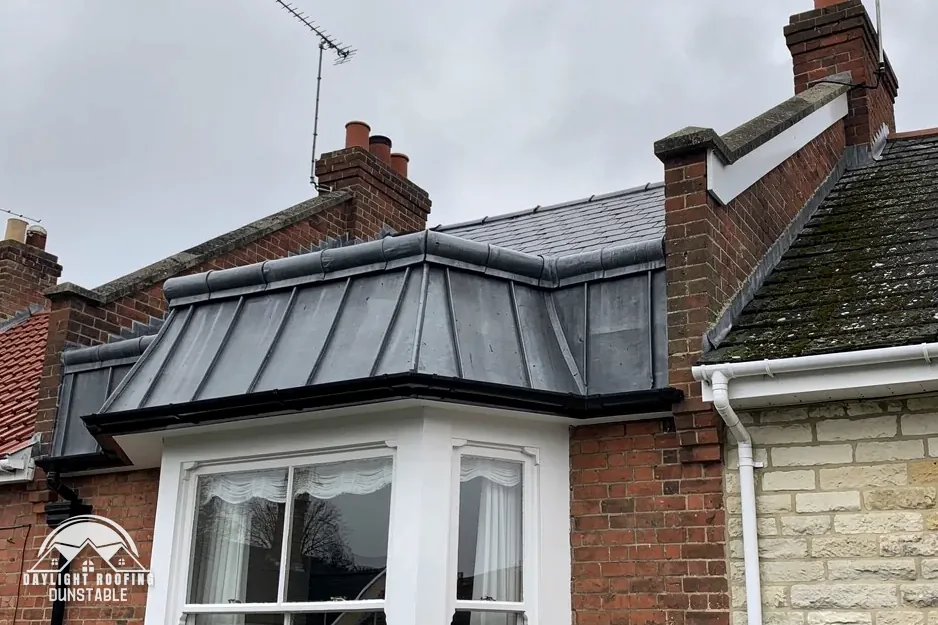
For a household, the question is whether the flashing around the chimney or the lead on a bay roof is something to worry about. Fixed in place, it is not handled, and the practical step is simply not to climb up to it. Lead sits at height, on a pitch, where a fall is a greater danger than the metal. Rain, frost and moss make a slope slippery, and a flashing at a chimney stack is at the very edge of the reachable roof.
When lead has to be repaired or renewed, the work is for a roofer, who deals with the old sheet and the offcuts. A photograph of the flashing sent to 07880 284133 on WhatsApp gives a first look. Our price follows a survey and is one written total, and the repair or replace lead flashing guide explains how a repair is judged.
If lead has been stolen or damaged, keep clear of any scattered pieces, photograph the area and tell your insurer. Pieces that have fallen into a gutter or on to a path are picked up with gloves, kept out of reach of children and left for the roofer to deal with, so nobody is tempted to use them elsewhere. The lead theft and insurance guide sets out the steps in order.