
The short answer
A lead apron flashing is a strip of lead fixed across the front face of a chimney or wall, where the roof slopes down away from it. Its top edge is tucked into the masonry and its lower edge lies over the tiles or slates, so water running down the brickwork is carried safely out over the roof covering.
What an apron is and where it sits
Wherever a sloping roof runs into a vertical face, there is a joint that rain can reach. On a chimney stack, the face that looks down the slope is the front, and the strip of lead covering the joint along that face is the apron. The same word is used for the lead on a wall that stands above the roof, such as a party wall or the side of a dormer, where the roof falls away from the wall.
The apron is one of several flashings that together seal a stack. Along the sides, stepped flashings follow the rise of the brickwork, and at the back, on the uphill side, a different detail guides water round the stack. The apron has the simplest outline of the set, a single strip, but it takes the water that comes down the whole face of the brickwork above it.
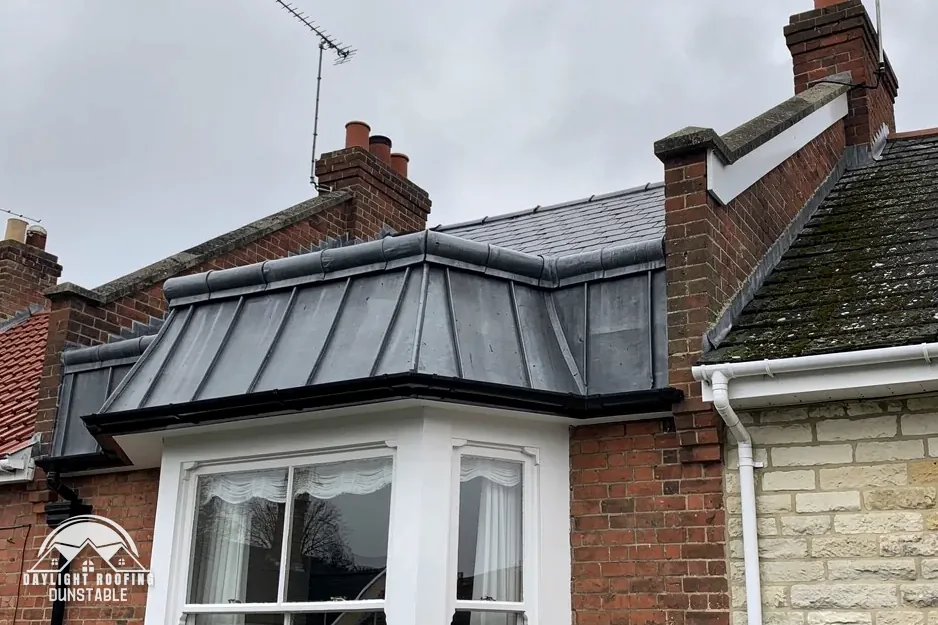
Because it is a lead detail, the apron sits within the leadwork described on the lead roofing page, alongside valleys, bay roofs and stepped flashings, and its look and fixing are the same as any other lead flashing.
How an apron is fixed
The top edge of the lead is turned into a cut joint in the brickwork, called a raggle, and held there by small lead wedges, with the joint then pointed over them. From that line the lead is dressed down the face of the stack. At the foot it is turned out over the roof covering, so it overlaps the tiles or slates below and lets water pass on to them.
That order of overlap is the point of the detail. Water that runs down the brickwork meets the lead, travels down it and leaves over the covering, and at no stage is there an open gap for it to enter. The seal is made by the shape, with no help from sealant.
- Top edge: tucked into the raggle, wedged and pointed.
- Face: lead dressed flat against the brickwork.
- Foot: lead laid over the roof covering, so water leaves over it.
- Ends: joined to the stepped flashings along the sides of the stack.
Thickness comes from the specification, which gives each detail its code: BS EN 12588 covers codes 3 to 8, and code 4 is 1.80 mm thick. A flashing of this kind is cut to the width of the stack and a little beyond, so that the ends can be joined to the metal on either side.
How an apron fails and what then
An apron can fail in a few ways. The pointing in the raggle can crumble, and the top edge then has nothing gripping it. A wedge can slip, letting the lead sag away from the wall. The lead itself can split along a fold, or lift at an end where it meets the stepped flashing. Any of these lets water behind the strip, and the sign indoors is damp on the ceiling or the chimney breast after rain.
A fault in one place does not always mean the whole apron has gone. The signs of failed leadwork guide describes what to look for, and the repair or replace lead flashing guide explains how a patch is weighed against a new strip.
MyJobQuote says correctly installed lead flashing can last for over 80 years, which is a reason to repair a sound apron instead of replacing it. A price comes only after a survey, and it is a single written sum. A photograph of the chimney taken from the garden, sent to 07880 284133 on WhatsApp, gives a first look at the apron before anyone climbs up. If you cannot see the apron clearly, say so in the message.