
The short answer
A lead soaker is a small bent piece of lead laid under the roof covering at the point where a slope meets a wall. One goes in with each course of tiles or slates, with one edge under the covering and the other turned up the wall, where the cover flashing laps over it to keep rain out.
What a lead soaker does under the tiles
When a slope stops at a vertical face, the join between the covering and the wall has to be sealed against rain running down the wall as well as across the roof. A soaker is the piece that does the first half of that work. It is a rectangle of lead, folded along its length into an L. One arm of the L lies flat under the tile or slate, and the other turns up the wall surface.
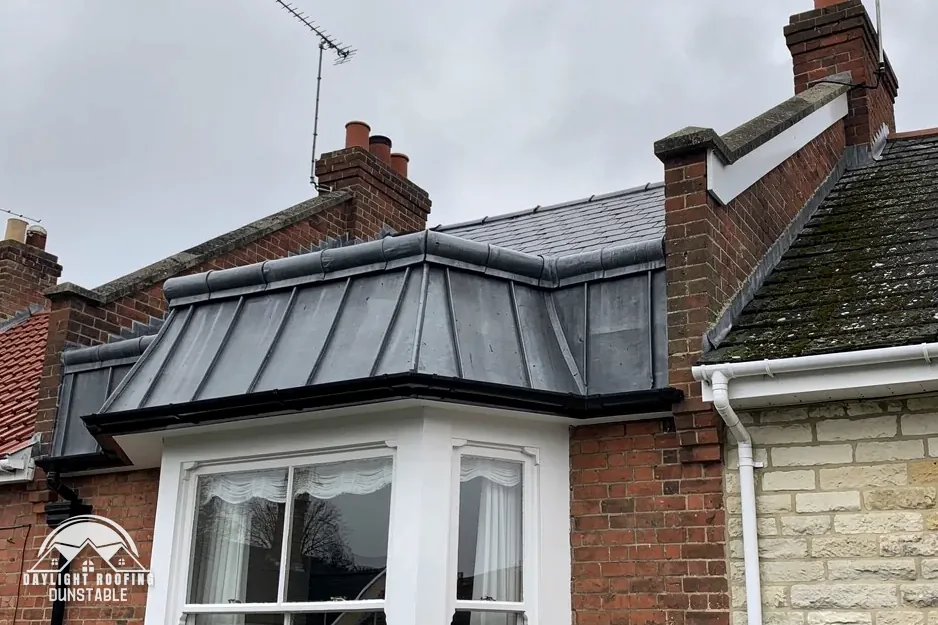
A soaker is cut for each course of covering, so there is a column of them climbing the slope beside the wall, each one overlapping the one below it. Because they are interleaved with the tiles, they cannot be seen from outside once the roof is complete. What shows along the wall is the flashing that covers the turned-up arms, and that flashing is stepped if it follows the slope, or straight if the abutment is level.
The two parts depend on each other. The soaker carries water that gets under the edge of the covering out onto the next course down, and the cover flashing keeps water running down the wall from reaching the soaker's turned-up edge. Either part can be sound while the other has failed, and a roof can leak from a fault in only one of them. The lead roofing hub covers the full set of leadwork details.
Soakers, stepped flashings and cover flashings
The three terms are easily mixed up, so the table separates them by position and by whether a person standing in the garden can see them.
| Piece | Where it sits | Visible |
|---|---|---|
| Soaker | Under each tile or slate, turned up the wall | No, it is covered |
| Stepped flashing | Along the wall, in steps that follow the slope | Yes |
| Cover flashing | Over the turned-up edge, tucked into the wall | Yes |
A cover flashing that has lifted or split lets rain run behind it, and the soaker beneath can then take more water than it was meant to carry. Replacing only the visible flashing may therefore leave a damaged soaker in place, still passing water into the roof. A survey looks at both pieces, and the one that has failed decides what is replaced. Leaving that hidden lead unchecked is how a new flashing can end up sitting over a leak that carries on. The guide to lead and its alternatives for flashings compares the materials a flashing can be made from for a roof like this. Where no soakers are fitted at all, the junction is built a different way, and the survey says which way it was done.
Thickness, lifespan and renewal
Rolled lead sheet is made to BS EN 12588 in codes 3 to 8, and code 4, for example, is 1.80 mm thick. The specification names the code that the soakers are cut from. No lifespan is published for soakers as such. MyJobQuote says correctly installed lead flashing can last for over 80 years, which is a statement about flashing and cannot be read across to the pieces hidden beneath the tiles.
A soaker can be reached only by lifting the covering beside it. For that reason, when a slope is stripped and re-covered, the soakers along its walls are looked at while the tiles are off, and a soaker that has split, corroded or slipped can be replaced then at little extra access. If only the flashing is being repaired and the tiles stay down, the soakers stay unseen.
A stain on an inside wall, a damp patch beside a chimney breast or a drip in the loft after rain can all point to this junction. Shine a torch along the loft timbers beside the chimney or wall once the rain has stopped, photograph any wet wood and send the pictures to 07880 284133 on WhatsApp. The page on signs of failed leadwork sets out what else to check.