
The short answer
Yes, one tile can be lifted out and replaced where a matching tile can be found and the batten beneath it is sound. For between one and six broken or missing standard tiles, Which? Trusted Traders give £75 to £400 excluding VAT (November 2025). A survey shows whether one tile is the whole fault.
How one tile comes out and goes back
A roof covering is a set of overlapping courses. Each tile hooks over its batten by a nib, and the course above sits partly over it. Taking a single tile out means easing up the tiles that cover its top edge, sliding the damaged one clear and hooking a new tile into its place. Where the course is nailed or clipped, those fixings are dealt with at the same moment.
The job sounds small, and in the right conditions it is. A tile that cracked in a frost or took a knock from a branch leaves a gap in the lap, and a replacement closes it. The surrounding tiles stay where they are, and no scaffold-wide strip-out is involved.
The weak point is the neighbours. Lifting tiles that have sat in position for years can crack them, particularly where their edges have bonded to moss or old mortar. A careful hand lifts only what has to be lifted, so a few spare tiles are worth having to hand.
A new tile has to hook onto a sound batten. If the lath beneath is soft or split, the new tile will not hold, so the batten is checked as part of the swap and repaired where it fails.
When one tile is not the whole fault
A lone cracked tile is a one-off. Several tiles slipping out of line, or a patch that keeps losing tiles, points at something beneath them, so the cause needs finding before the tile is replaced. The table pairs each pattern with a possible meaning.
| Sign on the roof | Possible meaning |
|---|---|
| One cracked tile | A knock, a frost or a falling branch |
| A row of slipped tiles | Failed nails or a weak batten |
| Many tiles flaking | A covering approaching the end of its life |
| Damp below one tile | A worn underlay or nearby flashing |
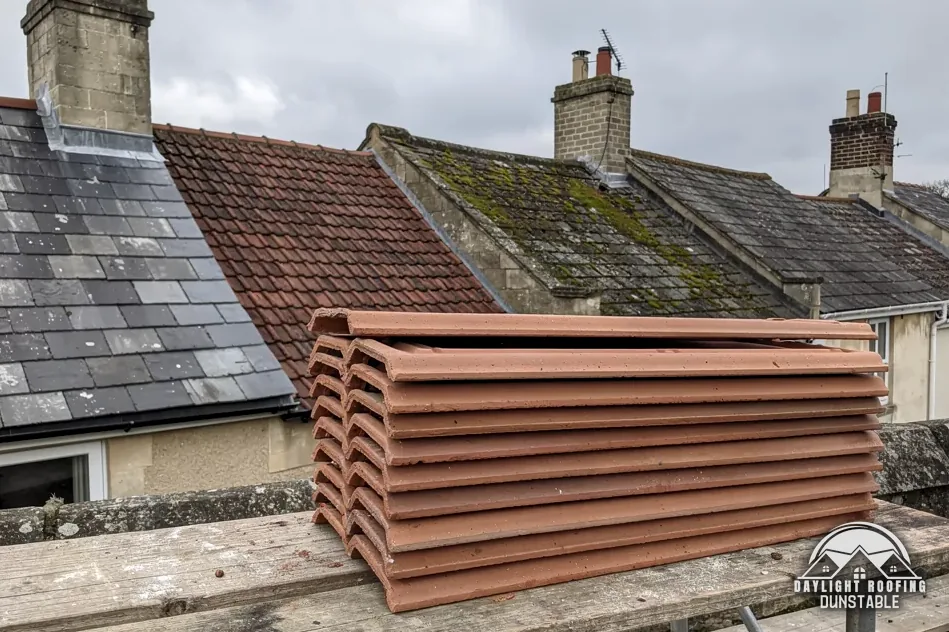
Matching is the other issue. A tile has a size, a profile, a colour and, for some products, a maker's name. A new tile of the wrong profile will not sit at the right lap, and one in a fresh colour stands out from weathered neighbours. A matching tile may come from a merchant, from spare tiles left over from an earlier job or from reclaimed stock.
Where no match exists, the choice is between a visible mismatch and a wider job. A survey of the roof shows which is the better route, and the pitched roof problems guide describes the faults that sit behind a lost tile.
What replacing a tile costs and needs
Two third-party sources put figures on this, and they cover different things, so they are given separately. Which? Trusted Traders, surveying 11 traders in November 2025, give £75 to £400 for one to six broken or missing standard roof tiles; the figures include labour and materials but exclude VAT. MyJobQuote, on a page last updated on 6 October 2026, quotes around £215 for replacing roof tiles on average, and prints no VAT basis.
Neither number is a price for any one roof. Height, access, the tile and the number of tiles all push the final figure around, and our written price is one total after a survey. Where scaffolding on the pavement or road is needed, we arrange the licence with our scaffolder.
Does one tile trigger Building Regulations? Under the Planning Portal's guide, re-roofing does not normally need a building regulations application if it affects less than 25 per cent of the building envelope and less than 50 per cent of the roof. A single tile is far below both limits. The pitched roof costs guide sets out the wider range of jobs.