
The short answer
Yes, mortar can still be used on ridge tiles, but not on its own. Marley says the 2015 amendments to BS 5534 made clear that mortar "could no longer be relied upon as the only means of securing the roof covering". BS 5534 itself "isn't required by law", and ridge tiles are fixed mechanically as well.
What the wording actually says
The idea that ridges can no longer take mortar grew from a change in a British Standard, not from any ban. Marley's explanation of BS 5534 says: "The 2015 amendments made it clear that mortar could no longer be relied upon as the only means of securing the roof covering." The key words are "the only means". Mortar can stay in the build-up. It cannot be the sole thing between a ridge tile and a gust.
The same Marley page says that installing to BS 5534 "isn't required by law". BS 5534 is a code of practice for slating and tiling, listed by BSI as current in its 2014+A2:2018 edition. It is not an Act or a set of regulations, so calling mortar illegal fails on both counts: the standard is not law, and it does not rule the material out.
What the standard changed is the expectation on a roof's fixings. A ridge bedded in mortar and nothing else falls short of that expectation, because the fixing is expected to be backed up. The sentence has a precise meaning and is worth reading closely before accepting any shorter version of it from a leaflet or a forum thread. Reading the original also shows what it leaves alone, which is the choice of materials.
How a ridge is held today
A ridge has two jobs: it caps the join between two slopes, and it has to stay put in wind. Mortar does the first job well while it is sound. The second job needs something that does not depend on a bed that can crack, shrink or lose its grip.
Marley adds that ridge or hip tiles "should be mechanically fixed to resist the calculated wind uplift force", in all cases. A mechanical fixing can be a clip, a bracket, a strap or a screw into a batten or a ridge board, chosen to match the specification for the roof. The table compares the approaches.
| Method | What holds the tile |
|---|---|
| Mortar bed only | The bond of the mortar |
| Mortar plus mechanical fixing | The fixing, with mortar kept as bedding and a seal |
| Dry-fixed system | Manufactured parts, no mortar bed |
BS 8612:2018, which BSI lists as current, covers the dry-fixed alternatives at the top and edges of a roof. The first row of the table is the one the 2015 wording rules out when used as the sole method. The other two both put a fixing between the ridge tile and the wind.
Tile fixings follow a specification for the site, and a ridge is part of that. The pitched roof costs guide covers what moves the price of a roof job.
When mortar fails, and what repair costs
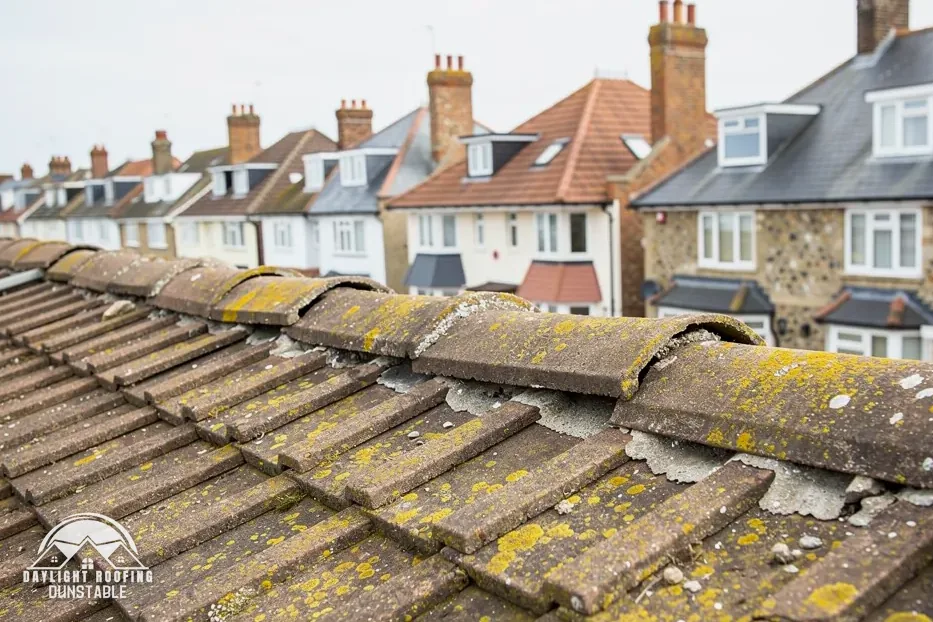
Mortar on a ridge can crack, powder or come away in lumps, and tiles can rock where the bed has gone. Gaps at the ends of the ridge or a line of moss growing in a crack suggest the bond is not what it was. A ridge that moves when touched is a fault, not a quirk, since an unsecured tile can slide off and fall.
A repair means taking the failed bedding out, resetting the tiles and fixing them mechanically as well. Two third-party sources give figures. Which? Trusted Traders, surveying 11 traders in November 2025, put a new ridge tile at £80 to £300, with VAT left out. MyJobQuote gives an average between £225 and £550 for ridge tile replacement in 2026, with no VAT basis printed. The two describe different jobs and are kept apart.
Hips are not priced in either source, so hip work waits for a survey, and a ridge job is quoted as one written total. Where the ridge forms part of a full re-cover, Building Regulations approval is expected, and the re-tiling and Building Regulations page explains the limits.
The pitched roof problems guide shows what a failing ridge looks like from the ground.