
The short answer
Interlocking roof tiles have grooves and ribs along their sides that lock each tile to its neighbour, so a course lays as one layer, called single-lap, where plain tiles are double-lap. Marley's minimum pitches are 17.5° for Edgemere and Modern-Duo, and 15° for Mendip.
How the interlock works
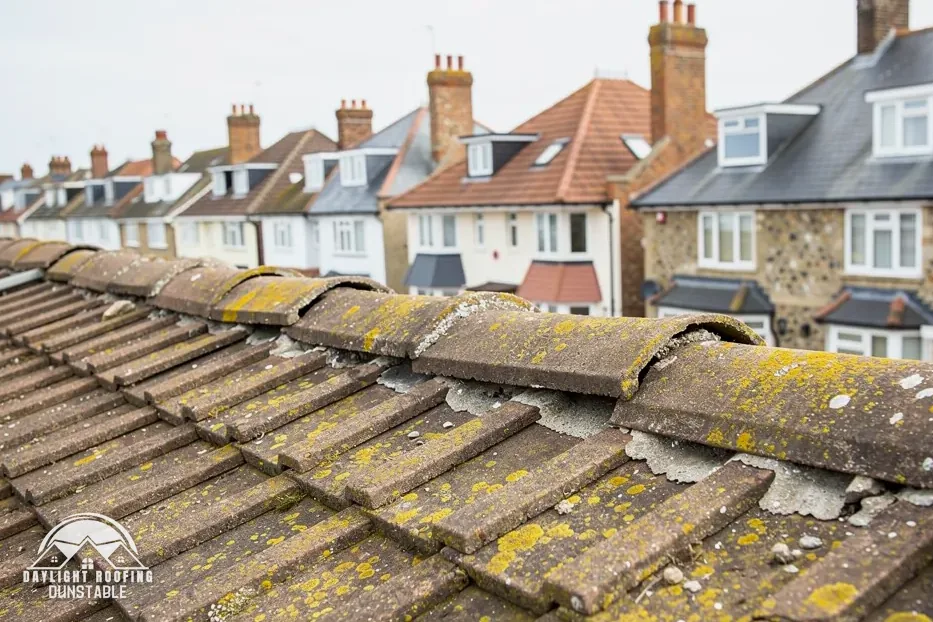
Run a finger down the side of an interlocking tile and you feel a groove on one edge and a matching rib on the other. When tiles are laid side by side, rib meets groove and the pair lock together, forming a seal against water running sideways between them. The tile's profile, whether flat or curved, channels water down the surface.
Because the sides lock, the tiles do not need a second full layer behind every joint. Each course overlaps only the one beneath it by a headlap, and the result is a single-lap roof: one thickness of tile across the slope. Single-lap and double-lap are the two main ways tiles are laid, and the difference is the heart of the question.
| Feature | Interlocking | Plain tile |
|---|---|---|
| Laying | Single-lap | Double-lap |
| Side joint | Locked by groove and rib | Covered by the course above |
| Water path | Channelled by the profile | Shed by overlap and pitch |
A plain tile is small and flat and is covered at least twice over, so it leans on a steep slope and a deep lap. An interlocking tile is larger and relies on its profile and its side lock, so the same area is covered with fewer pieces. Both are weatherproof when specified and laid to suit the roof, and the clay and concrete tile comparison covers the materials.
What pitch interlocking tiles allow
A tile's minimum pitch depends on its design, and the interlock changes the figures. Marley publishes a minimum for each product, and three of its interlocking concrete tiles show the range: 17.5° for Edgemere, the same for Modern-Duo, and 15° for Mendip. Marley also lists a Mendip 12.5 tile at 12.5°.
Those angles are lower than Marley's figure of 35° for its Plain concrete tile and for its Ashdowne clay tile. Lower is not better in every respect, since a tile that works at a shallow angle is working with little margin, but it does explain why interlocking designs appear on low-pitched roofs.
Edgemere, Modern-Duo and Mendip are product names. They are not places, and the figures belong to Marley's tiles alone, so another maker's interlocking tile has its own published minimum. Check the maker's table, then check the roof's real pitch, which a survey measures rather than estimates.
Whether a tile suits a slope is settled in the roof's own specification. Exposure, slope length and fixing method all enter that decision, and the minimum pitch for roof tiles page lists Marley's full set of figures.
Fixing, weight and choosing one
An interlocking tile still has to be held against wind. Fixings follow the site's fixing specification under BS 5534, which BSI lists as current, and Marley notes that installing to BS 5534 "isn't required by law". The interlock stops water getting between tiles, but it does not hold them down, so nails or clips are part of the specification all the same.
Because the tiles are larger, the weight of a covering per square metre depends on the product's data sheet, and not on whether it interlocks. When an old covering is replaced with a new one that is 15 per cent or more heavier, the Planning Portal's guide says Building Regulations approval is needed. The re-tiling and Building Regulations page sets that out.
Choosing between interlocking and plain tiles starts with the roof: its pitch, its shape and what the neighbouring roofs show. A swap from one to the other changes the battens, since a large tile has a longer gauge, so it is a re-covering job rather than a repair.
Before any price comes a survey, then one written total. Ask for the tile's data sheet and the pitch it needs, so that nothing is chosen blind, and hold back a spare tile or two from the delivery: a broken tile in the middle of a slope has to be freed from its neighbours, which means lifting the tiles around it with care.