
The short answer
Plain roof tiles are small, flat tiles with a slight curve, laid double-lap so each tile is covered at least twice. They come in clay or concrete. Marley lists a minimum pitch of 35° for both its Plain concrete tile and its Ashdowne clay tile.
What makes a tile plain
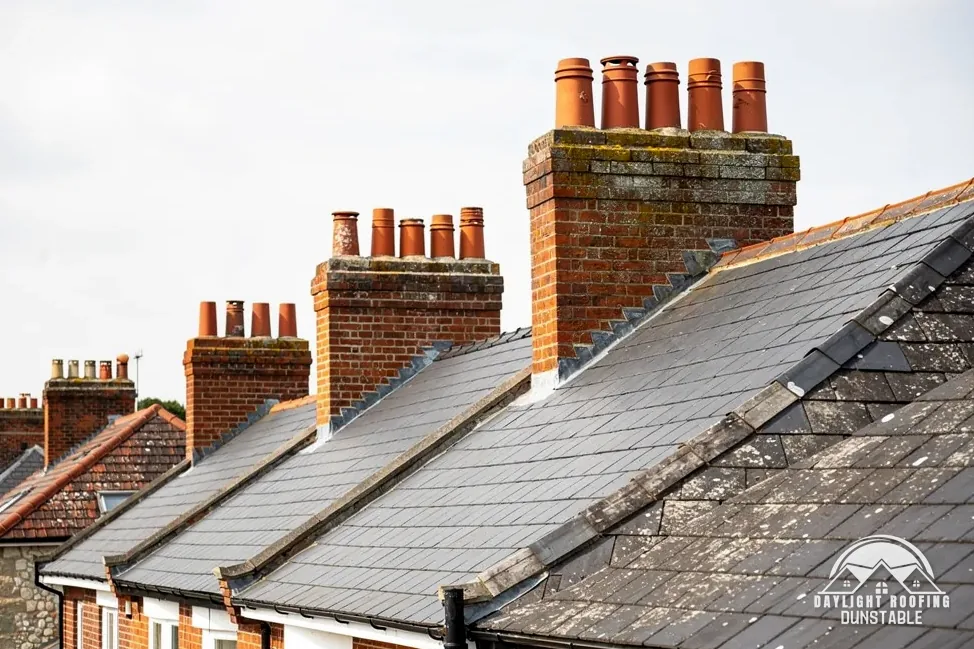
A plain tile is a small rectangle, thin and almost flat, with a gentle curve across its length. Two nibs on the top edge hook over the batten, and a couple of holes take the nails. Because the tile is small, a whole roof takes a great many of them, laid in rows with each row offset from the one below, like brickwork.
The laying pattern is what gives the type its name and its character. Plain tiles are double-lap: the courses overlap so that every point on the roof sits under at least two thicknesses of tile. A joint between two tiles in one course is covered by the tile in the course above, so rain that passes the gap meets another tile before it reaches the underlay.
Double lapping asks for pitch. Water has to run down the face of the tile and across the overlap, and it will do that reliably only on a slope that is steep enough. The minimum Marley lists for its plain products, 35°, is higher than for several interlocking designs, which rely on a side lock and a profile instead.
The tile's slight curve, called camber, helps water run off and keeps the tails of the tiles from sitting flat against one another. A hand-made clay tile can have a surface that is slightly uneven, which gives a roof its texture and its changing light.
Clay or concrete, and how long each lasts
Plain tiles are made in clay and in concrete. The two look alike from the ground when new, but they differ in how they are made and how they age, and the lifespan figures that sources give are not the same either.
| Material | Figure | Source |
|---|---|---|
| Clay tiles | 60-80 years, approximate | HomeBuilding |
| Plain concrete | 40-50 years, approximate | HomeBuilding |
| Roof tiles | Typically around 60 years, not a guarantee | Marley |
| Clay tiles | 60 years, minimum life expectancy | BRE, via Marley |
Marley's wording is: "Typically, roof tiles are expected to last for around 60 years", followed by "This is not a guarantee or warranty of its longevity." The BRE figure applies to clay tiles alone. The sources sit side by side here and are not blended into one number.
Pitch is the same for the two plain products Marley lists, 35° for its Plain concrete tile and 35° for its Ashdowne clay tile. Ashdowne is a Marley product name, not a place. The how long roof tiles last guide covers lifespans in full, and the clay and concrete tile comparison sets the two materials side by side.
Cost, the Chilterns and choosing a tile
HomeBuilding's page, updated 30 September 2025, treats a three-bedroom semi whose 65m² roof carries plain concrete tiles as a job that "may cost between £10,000 and £15,000". That figure is for one kind of house and one kind of tile, and it is not a quote for any roof. Which? Trusted Traders surveyed 11 traders in November 2025 and gave £7,000 to £21,000 for an average three-bedroom house, VAT left out, when the whole roof is replaced. The two are not merged.
Plain clay tiles have a place in the Chilterns design record. The Chilterns Conservation Board's roofing note calls plain clay tiles "universally predominant" on the Chilterns' traditional buildings. Treat that as the Board's design guidance for the Chilterns. It says nothing about a house outside that area.
Choosing a plain tile starts with the roof's pitch, which must reach the minimum for the product, and the structure, which must carry the covering. A new covering that is 15 per cent or more heavier than the old one needs Building Regulations approval under the Planning Portal's guide, and the minimum pitch for roof tiles page lists the figures.
Once the survey is done, the written quote gives a single total. Ask what pitch the chosen tile needs and compare it with the angle your roof actually has, since a plain tile has little tolerance below its minimum and the covering is laid to suit the slope.