
The short answer
Cover for ridge tiles turns on the policy and the cause: tiles lost in a storm may be covered, while tiles loosened by ageing bedding may meet an exclusion. The Financial Ombudsman Service says a storm "usually involves violent winds, usually with rain, hail or snow". Check the wording and photograph the ridge before anything is moved.
A gale, or a ridge that aged
A policy pays for the risks it names and leaves out the ones it excludes, so the starting question is the cause. A ridge tile blown off in a gale sits in a different place from a tile that has slipped because the bedding beneath it has crumbled. The first may count as storm damage. The second may run into an exclusion for wear and tear, or for gradual deterioration of the bedding, and insurers word those exclusions in their own ways. Some policies also set a different excess for storm claims, so the schedule that came with the cover is worth reading alongside the main wording.
The Financial Ombudsman Service explains what it treats as a storm when it settles disputes: "a storm usually involves violent winds, usually with rain, hail or snow". It adds that "Rain, hail or snowfall by itself can constitute a storm", and the Beaufort Scale of wind strength comes into its thinking too. A policy's own definition of a storm may be tighter than that, so the policy is read first.
| Cause | How cover may treat it |
|---|---|
| A storm moves tiles | May be an insured event |
| Bedding weathers over time | May be excluded as wear and tear |
| A poor earlier repair | Depends on the policy wording |
The cause frames the question, and the insurer makes the decision on a claim, working from its own policy wording, not a roofer. How a ridge comes to be loose in the first place is set out in why ridge tiles come loose.
Evidence to gather while the ridge is untouched
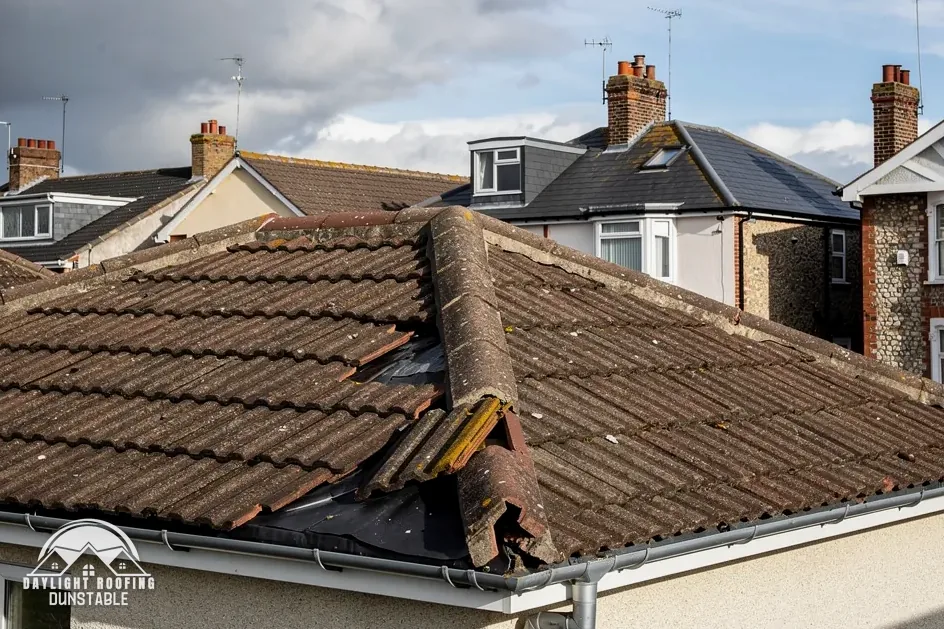
If a ridge tile has fallen, the evidence is the ridge and the tile where it landed. Take pictures of the ridge from the ground, of each fallen piece in place, and of any damage to a car, a fence or a conservatory beneath. The Ombudsman says it will "usually look at expert reports and photos", so clear images taken early carry weight.
Let the insurer know about the damage and find out what it wants from you. Write down the date of the weather event and keep receipts. A make-safe to stop tiles dropping or rain entering may be needed before the insurer has seen anything, and the emergency roof repairs hub explains what that means.
Stay off the roof for the pictures, as a fall from a ridge is a bigger loss than any tile. A phone held at full zoom from the pavement, a bedroom window or a neighbour's garden, with permission, is enough. A photo sent to 07880 284133 on WhatsApp lets a roofer see where the tile came from and how the ridge looks either side of the gap.
If cover is refused, and the repair itself
Daylight Roofing surveys a roof and gives one written total price afterwards. A roofer can say what is wrong with a ridge and what a repair involves, though the insurer alone decides a claim, working from the policy wording and what actually caused the damage. On exclusions, the Ombudsman says that "The insurer has to prove that the exclusion applies - for example, with an inspection report."
If a claim is declined and you disagree, complain to the insurer in writing. The Ombudsman says: "For most complaints, a business has up to 8 weeks to consider a complaint." Its own 6-month window runs from the date printed on the final response, a separate clock. The Financial Ombudsman Service is on 0800 023 4567.
Where cover is not available, or the excess is close to the cost of the job, the repair can be priced on its own as one written total. Whether the work is a re-bed with fixings or a switch to dry-fix is compared on the re-bedding versus dry ridge page, and the wider subject is under ridge and verge repairs.