
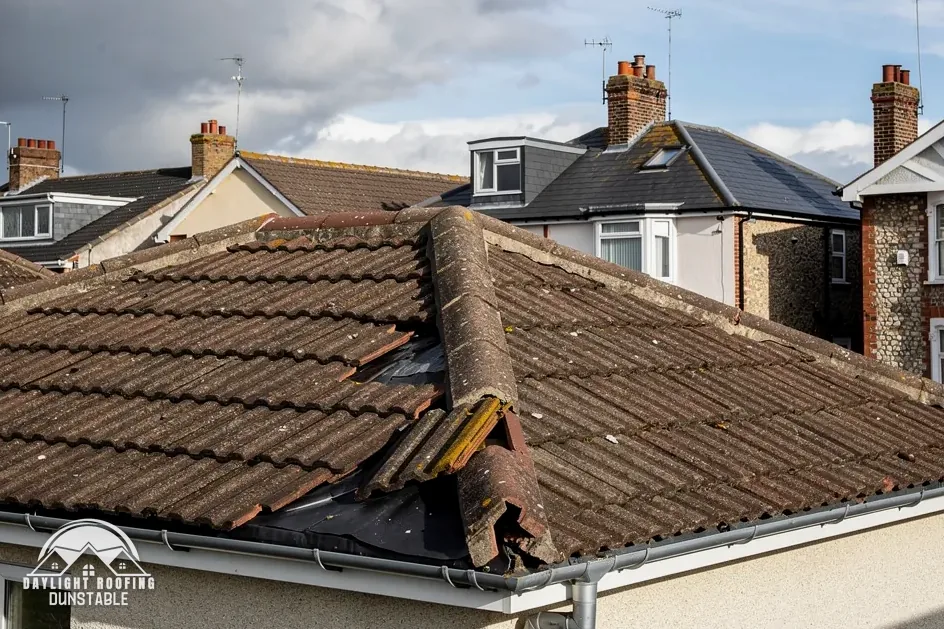
How a mortar verge is built
A mortar verge finishes a pitched roof at a gable wall. The last row of tiles on each course runs out past the face of the wall, and those edge tiles are set on a bed of mortar spread along the head of the wall. The mortar is struck off and pointed to a neat line, which is the strip of grey or sand-coloured material that can be seen from the road along the slanting edge of the roof. The roof verge page covers the terms.
Under the edge tiles there is a second layer, the undercloak. It is a course of material, which can be a strip of tile, slate or a board made for the purpose, that projects slightly beyond the wall and gives the verge tiles a level surface to sit on. The undercloak also stops water running into the cavity or down the face of the gable wall, and it is the part that cannot be seen from the ground.
The tiles, the mortar and the undercloak work as a unit. The mortar holds the edge tiles to the undercloak and fills the gap against the wall. If any one of the three has failed, the repair has to deal with it, and that is why a verge is looked at as a whole and not only along the pointing.
Why mortar cracks along a gable
Mortar is a rigid material laid in a thin band, and a verge exposes it from several sides at once. Rain soaks into it from above and from the side. If the water freezes inside the joint, it expands, and repeated cycles can break up the surface and push pieces out. Sunlight dries it again, and the shrinking and swelling can open fine cracks that let water in the next time.
A gable wall also moves a little with temperature and moisture, and the roof structure moves independently of it. Mortar laid between the two takes that difference as stress. Once a crack forms, moss or plant growth can root in it, and the roots widen the gap. Pieces of mortar then fall into the gutter or onto the ground, and the tile they were holding loses its bed.
A mortar verge does not fail overnight, and a hairline crack is not a failed verge. The point at which repair is needed is when the bed under an edge tile has gone, because the tile can then shift, and a shifted edge tile is a fixing question as well as a pointing one. Marley says the 2015 amendments to BS 5534 made clear that mortar "could no longer be relied upon as the only means of securing the roof covering", so a verge held by mortar alone is a case for a closer look.
Signs that a verge needs attention
A verge can be read from the pavement or the garden with a phone camera at full zoom. Nobody needs to climb to the edge of a roof to find out, and a ladder against a gable is a poor place to judge mortar. The table links what shows from the ground to what it may mean.
| Seen from below | Possible cause |
|---|---|
| Mortar pieces in the gutter or at the wall foot | Pointing breaking up along the edge |
| A dark gap between tile and wall | Bed lost, with water able to enter |
| An edge tile sitting crooked or lifted | Bond gone under that tile |
| Green growth along the edge | Cracks holding moisture |
Two or more of these on one gable suggest the edge has been deteriorating for some time and that the damage is not limited to the surface. Photos taken from the garden can go to WhatsApp on 07880 284133, and Daylight Roofing will look at them before a visit is arranged. Say which gable and which end of it concerns you, since the two sides of one roof can differ. If an edge tile has slid or dropped, stay out from under it until the tile has been secured.
Repointing: when it is enough
Repointing a verge means raking out the loose or crumbling mortar, cleaning the joint and filling it again so the edge is closed and weatherproof. It makes sense where the bed under the tiles is sound and only the surface has weathered. In that case the repair renews the exposed face and leaves the structure of the edge alone.
It is a smaller job than a conversion and keeps the traditional look of a pointed edge, which matters on an older home or in a conservation area. Whether repointing alone is enough depends on what lies behind the surface, and that cannot be judged from a photograph of the pointing. Hollow-sounding or loose edge tiles, a failed undercloak or a gap behind the mortar all point to a larger repair.
A repair that renews only the surface will not add a mechanical fixing, so the verge stays held by mortar. That is a legitimate repair where the existing build is sound, and the choice is the reader's. Where the roof is exposed to wind along the gable, the better question is whether a fixing is worth adding while the edge is open, since fixing now avoids opening the edge up a second time. The page on BS 5534 and mechanically fixed ridges and verges sets out the reasoning.
What a proper repair involves
Where the edge needs more than repointing, the work follows the order of the build, from the undercloak outward.
- Remove the failed mortar and any loose edge tiles.
- Check the undercloak and replace any section that has cracked or rotted.
- Reset sound tiles and replace broken ones, so the edge is level.
- Rebed the edge tiles on fresh mortar, with a mechanical fixing for each tile where the specification calls for one.
- Point the joint to a clean, weathered finish.
Because the work follows the edge, access is part of the job. A low gable can be reached from a ladder alone, while a tall one needs scaffold, and scaffolding on the pavement or road needs a scaffold licence from the highway authority, and we arrange the licence with our scaffolder. Where a job needs scaffold, it belongs inside the single written price.
Between the first and last of those steps sits the part that decides how long the repair lasts: whether the bed under each tile is solid before the tile goes back. A tile laid into a fresh bed on a rotten undercloak has the same fault as before. That is why the edge is opened up and looked at properly, and why a photograph of the pointing alone cannot tell the whole story.
When to convert to dry verge
Converting to a dry verge replaces the mortar bed with manufactured edge units fixed mechanically to the roof. It can suit an edge whose bedding has given up along a long stretch, one with several loose tiles, or one on a roof getting a new covering, since the edge is open anyway at that point. The page on dry verge systems describes the parts and the standard, BS 8612:2018, which BSI lists as current.
Conversion has costs as well as benefits. A dry verge removes the reliance on a bond that the weather can break, but its cap has a different profile from pointed mortar. A listed home raises the wording "in any manner which would affect its character as a building of special architectural or historic interest", and listed building consent is needed there for work that would affect that character. A conservation area can carry an Article 4 direction that removes permitted development rights, so check with the council.
BS 5534 is guidance rather than an Act: Marley says installing to it "isn't required by law". A mortar verge is therefore not unlawful, and a conversion is not compulsory. The decision turns on how the edge is performing, how exposed it is, and what the owner wants from the roof over the coming years.
A middle course exists. An edge that is largely sound can be repaired in mortar with mechanical fixings added to each edge tile, so the bed no longer works alone. That keeps the pointed look, adds the fixing the 2015 wording points towards, and is a smaller job than a full conversion.
What mortar verge work costs
A verge repair is priced after a survey. How long the edge runs, how many gables there are, how high they stand and what state the undercloak is in all vary between houses, so no one figure fits every verge until it has been seen. A job on a low single gable and a job along two tall gables are different sizes of work, even when the mortar looks alike.
The published range most relevant to a conversion comes from MyJobQuote, whose 8 October 2026 update of its dry verge page puts the cost at an amount that "usually falls between £500 and £2,000". The range covers dry verge work only, carries no VAT basis, and does not describe repointing. The ridge tile repair costs guide lists the remaining published ranges, each credited to its source.
The price for mortar verge work arrives as one written total, whatever the extent of the repair. If a survey finds that the undercloak needs replacing or that tiles are loose, the written price reflects that, and the reader is told plainly what was found. A quote from any firm should say what happens to the undercloak, whether edge tiles are fixed mechanically, and what the pointing is made of, because those three answers show how thorough the repair is meant to be.