
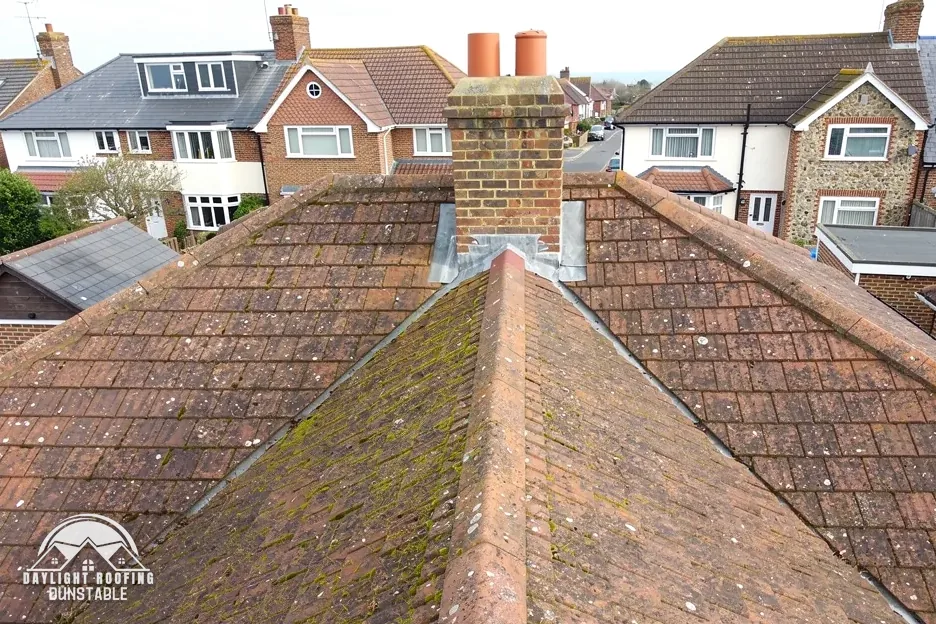
What keeps a ridge tile in place
A ridge tile is light, and the force wind can put on it is large by comparison. For a long time the thing resisting that force has been a bed of mortar. The tile sits in a ridge of mortar along the summit, the mortar grips the tile and the tiles beneath it, and the grip stands against the sideways push of weather and the upward pull of air passing over the roof.
A more recent build adds a second holder, a mechanical fixing: a clip, strap, bracket or screw that ties the tile to a batten or ridge board. Marley's guidance sets out the expectation in these words: "In all cases, ridge or hip tiles should be mechanically fixed to resist the calculated wind uplift force." The fixing exists so that the tile does not depend on mortar alone.
Seen this way, a ridge tile comes loose when whatever holds it has failed, and the cause depends on what that was. A bed can crack or crumble. A fixing can be missing, too small or corroded. The structure beneath can shift. Each cause has its own fix, and the right repair depends on which of them has happened on the roof in question.
Mortar that cracks, shrinks and lets go
Mortar is a rigid, porous material laid in a narrow band on the exposed top of a roof. It takes rain from above, sun from one side and cold from the other. Over the years it can shrink away from the tile, craze into fine cracks, or break down at the surface until it turns to powder. Every one of these weakens the grip that keeps the tile where it was laid.
Water does the damage. A crack lets rain into the bed, and the bed holds it. If the temperature then falls below freezing, the water inside expands as it turns to ice, which can push the bed apart from within. The cycle repeats through winter after winter, and each pass loosens the bed a little more, until the tile only rests on it instead of being gripped.
Moss and plant growth add to the harm. Roots find a crack and widen it as they grow. Fragments of bedding then drop to the gutter below, and that is a sign worth noticing: once mortar is landing there, the bed on the tile above has already lost some of its grip.
Marley says the 2015 amendments to BS 5534 made clear that mortar "could no longer be relied upon as the only means of securing the roof covering". A ridge held by an ageing bed with nothing else behind it is the case that wording describes.
Wind and the fixing specification
Wind lifts a ridge. Air flowing across a roof creates suction along the summit, and ridge tiles are the first part of the covering to meet it. A bed in good order and fixings that are properly specified resist that lift. A bed that has weakened, with no fixing behind it, cannot, and the tile can shift or be pulled free.
Tile fixings are set by a site-specific fixing specification under BS 5534, which allows for how exposed the roof is. Marley says the standard's minimums "will always be superseded by the generation of a Fixing Specification, which is site specific". In other words, the uplift force is calculated for the roof in question, and a roof that is more exposed needs a fixing pattern that reflects it.
Wind values for a roof come out of the calculation for that site, so they cannot be read off a guide or taken from a town name, since two roofs in one street can be set differently. Two outcomes are worth telling apart. A ridge that comes loose in ordinary weather suggests the bed has failed or the fixings were never adequate. A ridge that survives years of weather and then loses a tile in one gust may have met a force beyond what its fixings were set for, and the specification is the place to look.
Roof movement under the ridge
A roof is not rigid. Timber takes up and gives off moisture and swells and shrinks as it does. The structure flexes under load and warms and cools through each day and each season. Even small movements open and close the joints along a mortar bed, so a bed that has to stay intact through all of that has a hard life.
Timber at the apex that has rotted or split makes movement worse, because the tiles lose the firm base they were laid against. Rafters that have shifted can leave the ridge line uneven, with a sag or a kink that stresses the joints between tiles. Cracks that follow a line along the ridge, or that reappear in the same place after a repair, point to movement beneath.
That is the reason for lifting a few tiles at survey and looking at the timber, and the reason a ridge repaired in mortar before can slip again. If the cause is the base and not the bed, fresh mortar over the same base repeats the failure. The cause has to be put right for the repair to hold, whether that means replacing a rotted batten or fixing the ridge to something sound.
Movement is not a reason for alarm. Roofs move and a sound ridge copes with it. It becomes a cause of failure when a rigid bed is the only thing between the tile and the movement.
Signs a ridge is coming loose
A ridge can be read from the street or from the back garden, and a phone camera at full zoom helps. Nobody should climb up to test a tile by hand. The table links what is visible to what it may mean.
| Visible | Possible meaning |
|---|---|
| Cracked or crumbling bedding | Bond weakening along the run |
| Gaps between tiles or at the ends | Joints opening, tiles moving |
| Fragments of mortar below the eaves | Bedding breaking away |
| A tile that rocks or sits crooked | Bed gone beneath that tile |
None of these signs is a verdict on its own, but each is a reason to look further. A single one is enough to justify a closer view, and it costs nothing to take a photograph and compare it with a later one. Two or three together, such as cracks with fragments on the ground, suggest the bed has weakened along a length of the ridge and not at a single tile. A tile that has moved is a tile that can fall, so children, animals and parked cars should be kept away from the ground beneath a ridge that looks disturbed, and the matter treated as urgent. Cracks wider than a hairline, a visible gap where a tile has lifted from its neighbour, or a line of tiles that no longer follows a straight edge all belong in that category.
Why a repaired ridge slips again
A ridge that keeps slipping is telling the owner that an earlier repair dealt with the symptom. One route to a repeat is a repair that reset the tiles on fresh mortar and added nothing else, leaving the ridge held by the same kind of bed that failed the first time. The fault is the reliance on mortar alone, and the 2015 wording on mortar speaks to exactly that.
A second route is a weak base. If the ridge board or batten is rotted or loose, new mortar over it cannot hold, and the tiles move again with the timber. A third is a missing fixing, where tiles were bedded with no clip or screw, so nothing resists the lift when wind arrives. A fourth is an old repair that mixed tile profiles or sizes, so the joints never lapped as they should.
The remedy follows the cause. It may be a re-bed with mechanical fixings, a conversion to a dry-fixed system under BS 8612:2018, or work on the timber first. The page on re-bedding or dry ridge weighs the two main routes, and the guide to BS 5534 and mechanically fixed ridges and verges explains the fixing expectation in more detail.
Steps for a worried homeowner
Anyone who suspects a loose ridge has a few simple steps open to them. They are written as advice to the reader, whichever firm is called, and none of them involves going onto the roof.
- Look up from outside, with binoculars or a zoom lens if one is to hand, and note which end of the ridge worries you.
- Stay out from under any tile that looks displaced, and keep children and animals away from the spot.
- Photograph what can be seen, including fragments of mortar on the ground, before they are swept up.
- Ask the firm what will hold the tiles on once the repair is done, apart from mortar.
Daylight Roofing examines the roof before it quotes and gives a single written total, with what the survey found put in plain terms. Photos can be sent to WhatsApp on 07880 284133 first. For a sense of scale, the ridge tile repair costs guide lists outside price ranges, each credited to its source.
A loose ridge does not mend itself, and winter weather keeps working on it. Having it looked at when the first sign appears leaves a choice of repair, while leaving it narrows that choice, because a bed that has failed along a long run can no longer be patched tile by tile and calls for the whole line to be dealt with.