
What the published figures are
Two outside sources give ranges that bear on ridge and verge work. Which? Trusted Traders publishes a cost guide built from a survey of 11 of its traders, gathered in November 2025, and its prices include labour and materials but exclude VAT. MyJobQuote publishes a cost page for each kind of job, every page carrying a last-updated date, and it prints no VAT basis on the ridge and verge pages.
These are third-party ranges. They show the order of magnitude that other firms and surveyed traders report, and they are not quotes for any house. The only figure that applies to a particular ridge is the one written once the roof has been inspected, and it arrives as one total.
The table gathers the figures with the job each describes. Read each range on its own, since the two sources describe different jobs on different bases.
| Source | Job described | Range | Date and basis |
|---|---|---|---|
| Which? | A new ridge tile | £80 to £300 | Nov 2025, excl. VAT |
| Which? | One to six standard roof tiles | £75 to £400 | Nov 2025, excl. VAT |
| MyJobQuote | Ridge tile replacement, average | £225 to £550 | 2026, page of 1 Oct 2026 |
| MyJobQuote | Dry verge installation | £500 to £2,000 | Page of 8 Oct 2026 |
What Which? reports for a ridge tile
In its cost guide, Which? lists the job "Put in a new ridge tile (along the top of the roof)" at £80 to £300, excluding VAT. The figure comes from the November 2025 survey of 11 Which? Trusted Traders, and it covers labour and materials for putting in a single ridge tile.
A second line in the same guide covers replacing "one to six broken or missing standard roof tiles" at £75 to £400. That is a separate job from the ridge tile line. It describes tiles on the main slopes, and it should not be read as a ridge price or merged with the ridge figure.
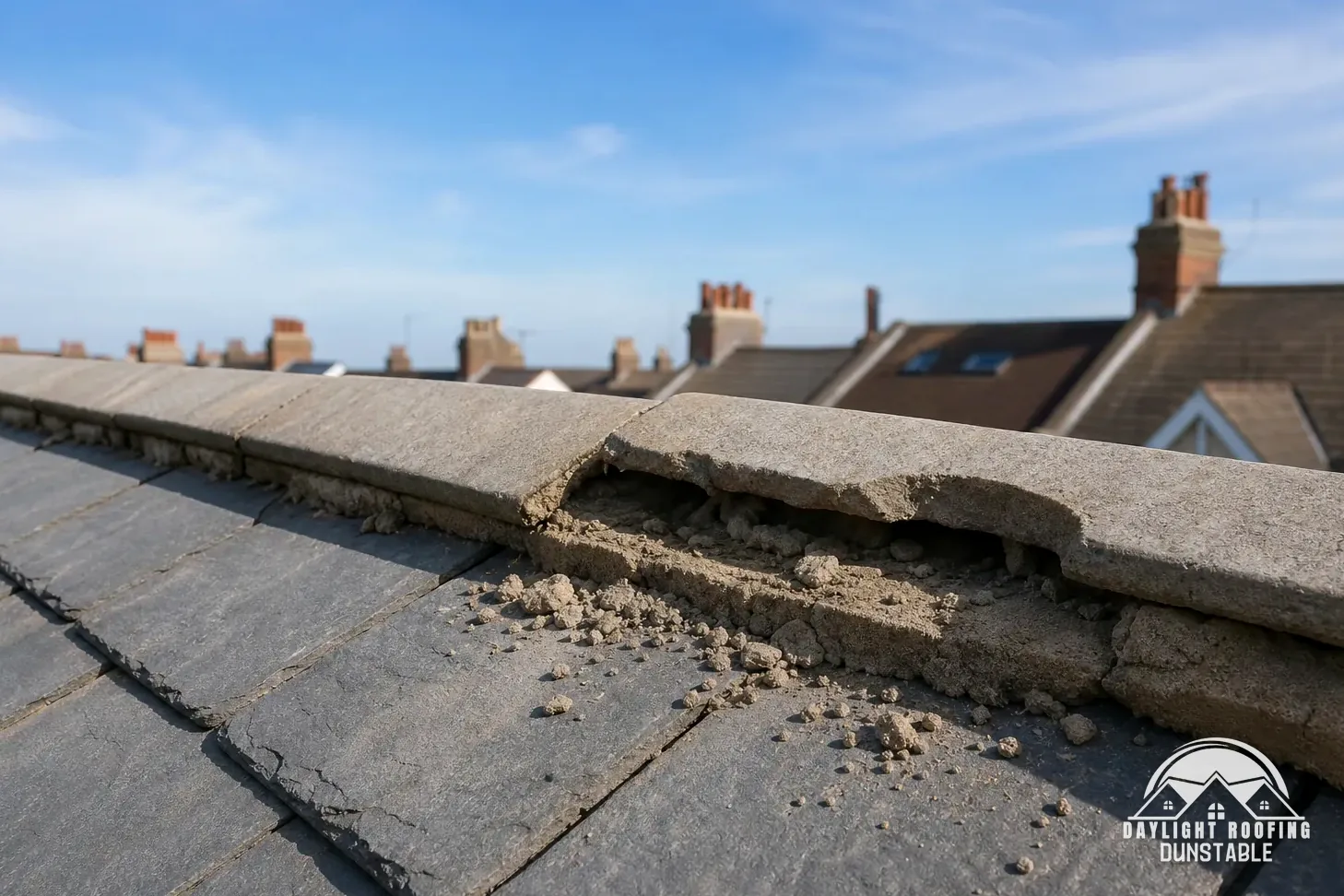
Both lines describe small jobs. A single ridge tile replaced is a different quantity of work from re-bedding a whole ridge, and the Which? range is not a guide to a longer run. A ridge whose bed has failed along its length is a larger repair than one loose tile, and the survey, not the table, shows which case applies.
The range is wide, so it shows scale rather than a price for any roof. What narrows it for a real roof is the access, and the work on either side of the tile being replaced, which later sections cover. The range indicates scale only, and a quote that lands above or below it is not wrong for that reason alone, since the roof in front of the surveyor is what sets the figure. Ask what is included and judge it from there, because a published range cannot see the roof.
What MyJobQuote reports for ridge and verge
MyJobQuote's page on replacing ridge tiles, last updated 1 October 2026, says: "In 2026, the average ridge tile replacement costs between £225 and £550." The page gives no VAT basis, so ask what any quote set against it includes. It is a published average for the job, not a figure for a particular roof, and the length of the ridge, the access and the fixing method all move a real price either side of it.
Its dry verge page, updated on 8 October 2026, says the cost "usually falls between £500 and £2,000". That is the site's own wording and its own range, for dry verge work only. It does not describe repointing a mortar verge, and it is not a ridge figure.
MyJobQuote also publishes wider roof repair averages. Its roof maintenance page, updated 6 October 2026, gives the average roof repair as around £650 for 2026, and its page on replacing roof tiles, updated on 6 October 2026 too, gives an average of around £215. These describe roof repair in general, so they sit outside the ridge ranges and are not combined with them.
The ridge and verge figures from this source and the figures from Which? differ in what they describe. Set side by side, they show the spread that a quote for ridge or verge work can be held against, and the questions on reading a quote, set out lower down, help to place a figure within it.
What moves the price of a real ridge
A ridge price is set by the roof, and several things move it. The list sets out the main ones, each of which the survey looks at.
- How long the ridge is, and how many ridges the roof has.
- What it takes to reach the ridge, whether a ladder, a tower or a full scaffold.
- The state of the old bedding, and whether the batten or board beneath is sound.
- Whether the repair is mortar with mechanical fixings, or a dry-fixed system.
- Whether hips or verges are repaired at the same visit.
None of these can be judged from the ground with any confidence. A ridge can look sound from the pavement and have a failed bed behind its pointing, and one that looks dreadful can have firm timber beneath. That is why the written price follows the survey instead of preceding it.
A high ridge may need scaffold, and a licence is required where scaffold obstructs the highway, so we arrange the licence with our scaffolder. The cost of all that is carried in the one written total. The survey is where the need for any of this is established, and it is the reason the price is written afterwards.
Hips and other work that waits for a survey
Hip work gets its price after the roof has been examined. The ridge ranges above belong to ridge tiles. They are not hip figures, and a hip's price comes from the hip itself. The page on hip tile repairs explains what sets the work, including the iron at the foot of each run.
The same goes for work at the ends of a ridge, at the junction of ridge and hips, and at chimney stacks or abutments that sit along the line. Each of these adds its own detail, and none is covered by a published ridge range. A survey that finds problems beyond the ridge says so plainly, and the written price covers what was found.
A conversion from a mortar ridge to a dry-fixed system is also a survey matter. For a conversion, the cost of the parts, the batten and the labour depends on the length of the ridge, the covering and the state of the ridge board underneath. The page on re-bedding or dry ridge sets the two routes side by side without putting a price on either.
Leaving a loose tile does not make the price fall. A tile that has already dropped may have damaged what sits below it, and the cost then widens to cover that damage as well. A ridge that has stood open for a season can let water into the roof space, so a look from the loft hatch after rain, for damp timber or wet insulation, is worth doing before the survey.
Reading a quote for ridge work
Quotes for one ridge can differ a good deal, and the difference lies in what each covers. A figure that looks lower may leave out the fixings, the clearing of old bedding, the batten or the access. Putting the same questions to each firm makes the quotes comparable.
- Does the work include mechanical fixings, and what are they?
- Is the old bedding cleared, or is new mortar laid over it?
- Are the ridge ends and any hip junctions included?
- Is the batten or board beneath checked, and replaced if it is not sound?
- Is access covered, with scaffold where needed, and is the whole job one written total?
Daylight Roofing examines the roof first, describes what it found in plain words, and gives one written total. That leaves a single figure to hold beside other quotes, with the same questions put to every firm about what its figure includes. Pictures of the ridge taken from the street can be sent over WhatsApp on 07880 284133 for a first look.
Put the answers side by side in writing. A firm that can name its fixings, say what happens to the old bedding and explain the batten check has thought about the job, and one that cannot is leaving the reader to find out later.
Cost and the standards
A price question brings a standards question with it. BSI lists BS 5534 as current in its 2014+A2:2018 edition, and Marley says installing to it "isn't required by law". Marley adds that since the 2015 amendments mortar "could no longer be relied upon as the only means of securing the roof covering". A cheap quote that leaves a ridge held by mortar alone may fall short of that expectation.
Marley's fixing guidance says: "In all cases, ridge or hip tiles should be mechanically fixed to resist the calculated wind uplift force." A quote that names the fixings is describing a better-specified repair than one that does not, and the difference can be worth paying for. BS 8612:2018, listed by BSI as current, is the standard that dry-fixed parts are made to.
The page on BS 5534 and mechanically fixed ridges and verges goes through the wording. For the cost question the conclusion is simple: compare quotes on what holds the tiles on, and not on the headline number alone, because the number alone says nothing about the fixing. Two quotes at the same figure can describe a repair that holds and one that is likely to need doing again, and the questions in the list above are how the reader finds out which is which.