
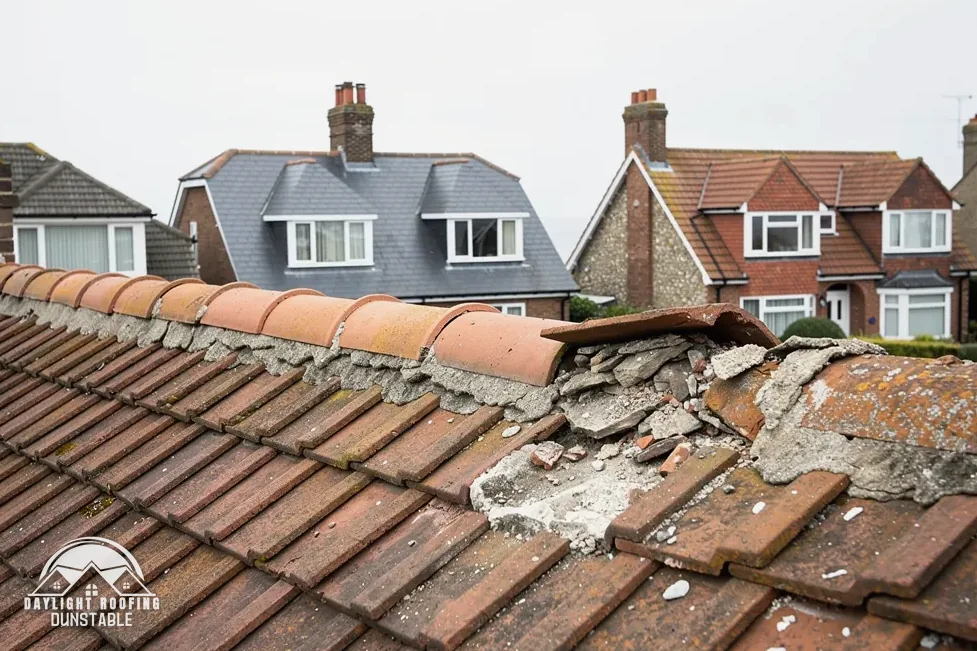
What a ridge tile has to do
A ridge tile caps the line where two roof slopes meet. Along that line the main tiles of one slope stop and the main tiles of the other begin, which leaves a gap that must be covered against rain. The ridge tile bridges it. Each ridge tile overlaps its neighbour end to end, and the whole line has to throw water down onto the slopes on either side.
That job explains why the profile matters. A ridge tile is a shaped unit, and its shape determines how it sits on the tiles below, how its edges meet the slope, and how the joins between neighbouring ridge tiles are closed. Pick the wrong profile for a roof and the ridge looks wrong, but worse, it may not seat properly, leaving gaps where rain can get in.
Ridge tiles are also a set of related parts, not a single tile type. A run includes the main ridge tiles, an end piece at each finish, and fittings at the junction with any hips. A repair to one tile sits within that set, and the set has to hold together. Half-round, segmental and angled are the three profiles, and each has to suit the covering it sits on.
Half-round and segmental: the curved profiles
A half-round ridge tile is shaped like a section of pipe cut lengthways, an arch that rises from both slopes. Seen from the end it makes a semicircle. It is a traditional profile for clay and is also made in concrete by several manufacturers. The curve gives a rounded line along the summit that is easy to recognise from the street, even from a distance, which helps when the profile has to be identified without climbing up.
A segmental ridge tile is also curved, but its arch is a shallower arc than a full semicircle, so it stands lower and sits wider for its height. Where a half-round tile gives a distinctly raised ridge, a segmental one gives a flatter profile. The names are used by makers and merchants, and their exact dimensions are the manufacturer's to state, so no single measurement defines either one.
Both curved profiles are bedded on mortar or fixed on a dry-fix batten. Because they are rounded, the join between two tiles is a socket or a lapped end, and the quality of that join depends on how well the tiles were laid. A cracked half-round or segmental tile is replaced by one of the same profile, and the survey identifies which of the two is on the roof before anything is ordered.
Angled ridge tiles
An angled ridge tile is made of two flat faces meeting along a sharp apex, like a tent seen end-on. It sits on the roof as an inverted V. The faces lie roughly parallel to the slopes below, so the ridge reads as a crisp straight line and not as a rounded roll.
The angle of the apex is built into the tile. Roofs have different pitches, and an angled tile is made to suit a range of them, so a tile from a different range can leave a gap under one face or ride up on the other. Checking the angle against the roof's pitch is part of choosing a replacement. The manufacturer's data states the pitches each angled tile suits.
Angled tiles are made to go with certain coverings. They suit a roof whose main tiles are flat or profiled in a way that gives the ridge a clean straight junction, and the match between ridge tile and main tile affects how well the joint sheds water. A mismatch of profile can look acceptable from the ground and still let rain under the edge in a storm.
Like the curved profiles, an angled ridge tile may be bedded or dry-fixed. The page on re-bedding or dry ridge weighs the two ways of holding a ridge on.
The profiles side by side
Set side by side, the three differ in shape, and the maker's literature gives the dimensions for a particular product.
| Profile | Shape | Check when matching |
|---|---|---|
| Half-round | Full semicircular arch | Diameter and socket join |
| Segmental | Shallower arc, lower and wider | Rise, width and fit on the slope |
| Angled | Two flat faces, sharp apex | Apex angle against the pitch |
Two things follow from the table. First, a profile is not interchangeable with another just because both are called ridge tiles. Second, the match has to be checked on the roof, because the dimensions that matter are the ones of the tile already there.
A photograph of an intact ridge tile, taken from the ground with a long lens or zoom, gives a first idea of the profile. A survey then confirms the profile, the material and the size, which a photograph cannot settle.
The profile also affects the fittings around the ridge. End pieces, hip junction pieces and the ridge ends at a gable are made to suit one profile, and a part for a half-round ridge does not fit an angled one. A repair that changes the profile has to change those parts too, and it alters how the roof looks from the street, which matters on an older home.
Ridge tiles on clay, concrete and slate roofs
Ridge tiles are made in the same families of material as the main coverings: clay, concrete, and for slate roofs various forms of ridge in slate or other materials. Which a roof has depends on the house, its age and any earlier re-covering, and it is read from the roof itself. What matters for a repair is the covering already on the roof.
Clay ridge tiles are fired from clay, and the durability of clay as a material has published figures. Marley reports that the BRE determined a minimum life expectancy of 60 years for clay roof tiles, and HomeBuilding's cost guide, last updated 30 September 2025, gives clay tiles an approximate lifespan of 60-80 years. Those figures describe clay tiles as a class. Neither figure is a promise for one roof.
Concrete ridge tiles are moulded and cured, and they are made to go with concrete main tiles. Slate roofs have their own ridge arrangements, and the page comparing clay and concrete roof tiles covers the two tile materials side by side. Whatever the material, a ridge repair is matched to the covering and not chosen in isolation.
Marley's guidance on fixing applies across materials: "In all cases, ridge or hip tiles should be mechanically fixed to resist the calculated wind uplift force." The material and profile are chosen for the look and the fit, and the fixing is chosen for the wind.
Matching a ridge tile on a repair
A repair has to match four things, and the list sets them out in order. A tile of the right profile but the wrong size will not lap its neighbours properly, and one of the right size in the wrong colour will show against an older ridge.
- Profile: half-round, segmental or angled, and the same one as the tiles already up there.
- Material: clay or concrete, to go with the main covering.
- Size: length and width that lap the neighbouring tiles.
- Colour: close enough to weather in beside the old ridge.
Colour can be hard to match. An older ridge has weathered, and a new tile of the same nominal colour can look different beside it for some time. Reclaimed tiles can bridge the gap, since they have aged already, though their supply depends on the profile. Where a ridge is being re-bedded as a whole, sound old tiles can go back on, with only the broken ones replaced.
If the whole run is being replaced, the new ridge tiles are chosen to suit the main tiles, and the aim is a consistent line along the summit. A mixed ridge, where several profiles meet, can show where earlier repairs used whatever tile was available, and a rebuild can restore the consistency.
At the survey, the profile and the material are identified on the roof itself. A reader who has a spare ridge tile left over from the original roof can mention it, since an intact original is the most useful pattern for a match, and it saves guesswork about the dimensions.
Fixing, standards and cost
Profile and fixing are separate decisions. BSI lists BS 5534 as current in its 2014+A2:2018 edition, and Marley says installing to it "isn't required by law". Marley adds that since the 2015 amendments mortar "could no longer be relied upon as the only means of securing the roof covering". Whatever the profile, a ridge repair expects a fixing besides the mortar, and BSI lists BS 8612:2018 as current for the dry-fixed alternatives.
Some dry-fixed systems are made for particular ridge profiles, so converting a ridge from mortar to dry-fix may call for a system that suits the profile already on the roof. The page on BS 5534 and mechanically fixed ridges and verges goes into the wording.
Cost depends on the roof, not on the profile alone. The ridge tile repair costs guide gives published ranges for a new ridge tile and for replacement, each with its source and date. Daylight Roofing gives one written total once the roof has been surveyed. Whichever firm quotes, the reader can ask which profile is being supplied and how each tile will be fixed, then compare the answers with the ridge as it stands. A quote should name the profile it assumes and the fixing it will use, so that two quotes for the same ridge can be set against each other on the same terms.