
The choice in plain terms
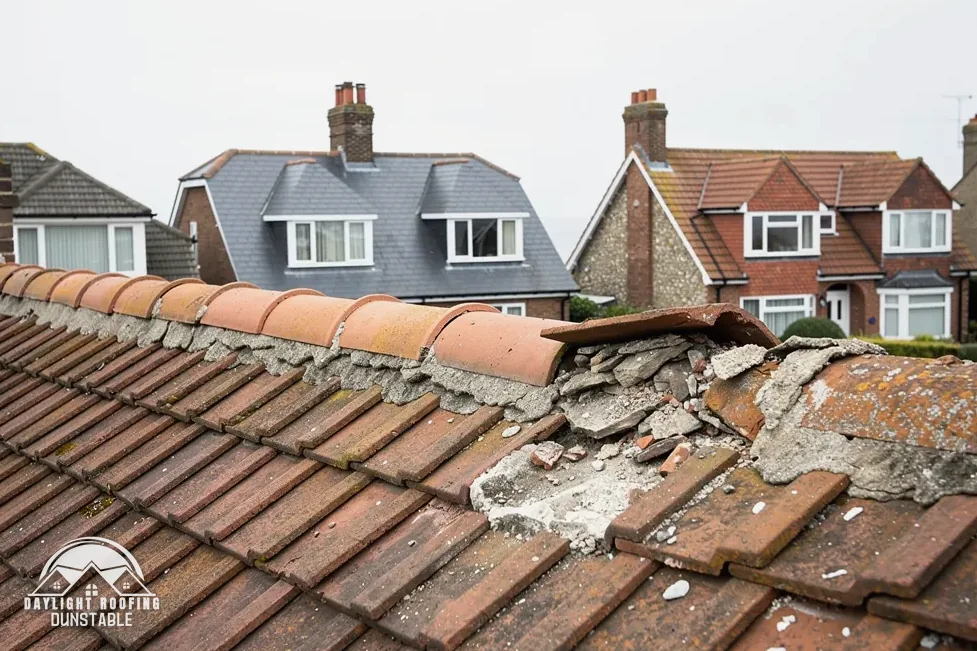
A loose or failing ridge leaves two main repairs. Re-bedding takes the ridge tiles off, clears the old mortar, and lays the tiles again on a fresh bed. A dry ridge swaps the bed for manufactured parts, with a batten along the summit and clips or screws that hold each tile down. Both finish with a ridge that sheds water, and both can be done to a standard that suits the wind. Neither is a shortcut, and neither is an upgrade for its own sake. Both start by removing whatever has failed, because new tiles laid over loose old bedding inherit the same fault. A repair that leaves the ridge sound and properly fixed does its job whichever route it takes.
The difference is in what the roof relies on. A re-bedded ridge relies on mortar, ideally with mechanical fixings added. A dry ridge relies on its fittings and has no mortar bed. Everything else in this guide follows from that difference: how each repair fails, how long each might be expected to hold, what each looks like, and what the standards say about them.
The decision is not between a right and a wrong method. It is a choice between two sound routes, each suited to certain roofs. The dry ridge system page describes the dry-fixed route in more detail, and a quote for either can be judged on how it fails, how long it holds and what the standards say.
What Marley and BS 5534 say about mortar
BSI publishes BS 5534 as the code of practice for tiled and slated roofs, and lists its 2014+A2:2018 edition as current. A code of practice is guidance on method and not law: Marley says installing to BS 5534 "isn't required by law". Mortar has not been outlawed either. What changed was the expectation about what mortar can be asked to do alone.
Marley's explanation is that the 2015 amendments made clear that mortar "could no longer be relied upon as the only means of securing the roof covering". Read closely, that sentence leaves mortar in place as a bed and a seal, and asks for something else to carry the wind load. The short answer on whether mortar is still allowed on ridge tiles deals with the wording in full.
Marley's fixing guidance adds: "In all cases, ridge or hip tiles should be mechanically fixed to resist the calculated wind uplift force." For this choice, the practical reading is clear. A re-bed that leaves the tiles held by mortar alone is the version the wording moves away from. A re-bed with mechanical fixings, and a dry ridge, both give the tile a fitting to resist uplift. BS 8612:2018, which BSI lists as current, is the standard the dry-fixed parts are made to.
Re-bed and dry ridge compared
The table sets the two repairs against four points. It describes the method in general terms, and the condition of the ridge in front of you decides which column fits.
| Point | Re-bed | Dry ridge |
|---|---|---|
| What holds the tiles | Mortar bed, with fixings added | Batten, clips or screws |
| What can fail | Bond of the mortar over time | A fitting, if one is wrongly fixed or damaged |
| Look from the ground | Pointed mortar line | Mortar line replaced by system parts |
| Standard behind it | BS 5534 for the covering | BS 8612:2018 for the parts |
Neither column is free of faults. Mortar can crack, shrink and let go. A dry-fixed system can fail where a fitting is wrongly placed or damaged, or where the batten under it has rotted. The point of the comparison is to ask what the repair relies on, so that the weak point of each is known before the work is agreed.
A further point sits outside the table. Both repairs lean on the timber beneath the covering. A ridge board or batten that has rotted, or rafters that have moved, will undermine either repair, and the survey looks at that structure as well as at the tiles themselves. A cheap repair laid on weak timber can fail sooner than a dearer one laid on sound timber, so the condition underneath belongs in the comparison.
When re-bedding makes sense
Re-bedding suits a ridge whose tiles are sound and whose problem is the bed. The cracked or powdering mortar comes out, the tiles are cleaned and relaid, and the ridge ends and any junctions are made good. Where the ridge board or batten under the tiles is in good condition, the structure beneath needs no change. A re-bed can also be done in stages, tackling the worst length first and leaving a sound stretch alone, which suits a ridge that has failed in one place and not in another.
It keeps the traditional finish at the summit, which can carry weight where the look of the roof is protected, and it leaves the rest of the ridge detail as the original builder made it. A pointed mortar line is the established ridge detail, and a manufactured system, though made to blend, has its own profile. Where a home is listed, the wording to bear in mind is "in any manner which would affect its character as a building of special architectural or historic interest", and listed building consent is required before work that would do that.
The condition attached to re-bedding is the one from Marley's wording. Mortar should not be the sole fixing, so a re-bed that follows the 2015 change includes mechanical fixings for the tiles. A roofer's quote should say so. If it says only that the ridge will be re-bedded, ask what else holds the tiles, because the answer shows whether the repair has been priced to current expectations.
When dry ridge makes sense
A dry ridge suits a roof where the bed has failed along the whole run, where tiles have loosened repeatedly, or where the ridge is being rebuilt as part of a larger re-roof. Since the system does not rely on a bond, it does not depend on mortar curing in the right conditions, and a repair can be carried out when the weather would make mortar work awkward.
It also suits a roof where the owner wants the fixing to be explicit. Each part has a stated function and a specification the manufacturer supplies, and a quote can name the system and the standard, BS 8612:2018. That gives the reader something to check against the paperwork, and it gives a later surveyor something to read.
Three cautions apply, and the list sets them out.
- A dry ridge needs a sound batten or board under it, and that is checked before anything else.
- The look of the roof changes, since the cap profile replaces the pointed line.
- Ventilation can be affected, because some dry ridge systems include a ventilated section and others do not.
On the last point, the page on ridge ventilation covers what that does and does not do.
Hips, verges and the whole roof
A ridge is one location among several. The hips of a hipped roof and the verges at a gable end are held by their own fixings, and a roof can be treated in parts: a dry ridge with mortar verges, or a re-bedded ridge with dry-fixed hips. The roof as found, place by place, settles the matter. The standard for the dry-fixed parts, BS 8612:2018, covers all three.
That is also a reason to look at the whole roof edge when a ridge is open. If the ridge is being lifted and the verges are also cracked, doing both in one visit can avoid a second set-up of access. The BS 5534 and ridge fixing guide explains how the standard treats each location.
Tile fixings are set by a site-specific fixing specification, which allows for how exposed the roof is. Whichever route is chosen, the fixings should match that specification, and no town or street fixes the answer in advance. A quote that names fixings gives the reader the chance to ask who set them. Where nothing is said about fixings, the question is worth putting in writing before any work is agreed, because the answer is part of what the price buys.
Pricing the two routes
Third-party figures exist for ridge work, with their limits. Which? Trusted Traders, in a survey of 11 traders gathered in November 2025, put a new ridge tile at £80 to £300, excluding VAT. MyJobQuote's page on ridge tile replacement, last updated 1 October 2026, gives an average between £225 and £550 for 2026, with no VAT basis printed. The two sources measure different things, so the figures stay separate.
Neither range is a price for converting a ridge, and neither compares the two methods. The ridge tile repair costs guide gives them with their sources. What moves the price of a particular ridge is how far it runs, what it takes to get up to it, what state the bedding is in, and whether the batten below is sound. A ridge on a bungalow with a single slope each side and a ridge on a large detached house with several ranges are different quantities of work.
Whichever route is chosen, the quote is one written total, produced only after the roof has been inspected. A photo of the ridge can go to WhatsApp on 07880 284133 first. Daylight Roofing will say plainly what the survey found, and the reader can compare the one figure with other quotes by asking each firm what holds the tiles on.