
The short answer
Ridge tiles are repaired by lifting the loose ones, clearing out the old bedding and laying them again on fresh mortar with mechanical fixings, or by converting the ridge to a dry-fix system. Both are done from the roof at height by a roofer, and not as a repair for a homeowner on a ladder.
The repair from start to finish
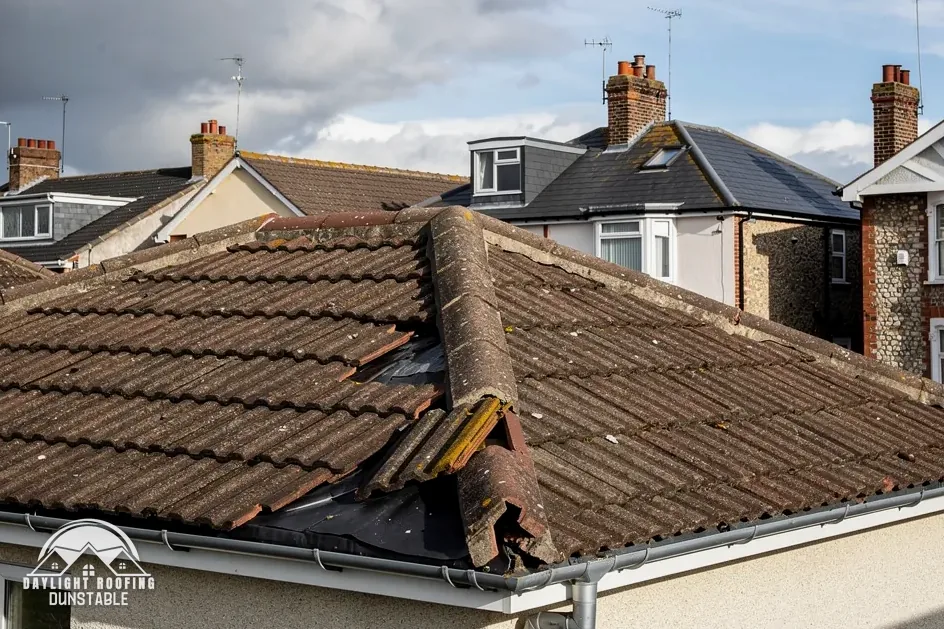
A ridge repair starts with a look at how far the problem runs. A single tile that has slipped is one job. Bedding that has crumbled along its length is another. The roofer works along the apex, lifting any tile that is loose or has lost its bed and checking the ones beside it, since weak bedding in one spot may continue further along the line.
- Loose ridge tiles are lifted off and set aside.
- Old, broken bedding is cleared from the apex and from the tile ends.
- The sound tiles are checked and any cracked ones are put to one side for replacement.
- Tiles are bedded again, with mechanical fixings added, or laid on a batten with dry-fix fittings.
- Joints and ends are finished so the run is closed and tidy along its whole length.
The mortar route and the dry-fix route share the first steps. They part company at the fixing: one uses a fresh mortar bed with clips, screws or brackets as well, and the other drops mortar from the load-bearing role and leaves the fittings to hold each tile.
The 2015 amendments to BS 5534 are the reason a repair adds fixings: in Marley's words mortar "could no longer be relied upon as the only means of securing the roof covering". A repair that put ridge or hip tiles back on mortar alone would fall short of that.
Re-bedding, dry-fix and what is replaced
Re-bedding keeps the mortar ridge and strengthens it. Dry-fix converts it. The choice depends on the tiles, the extent of the failure and the roof's exposure, and the re-bedding versus dry ridge page compares them. BS 8612:2018 is current and sets the specification for dry fixing.
| Fault | Repair |
|---|---|
| One loose tile, sound bedding | Refix that tile |
| Bedding crumbled along a stretch | Re-bed that stretch with fixings |
| Bedding failed along the whole ridge | Re-bed it all, or convert to dry-fix |
| Cracked or missing tiles | Replace those tiles |
Repairs at the ends of the ridge and where it meets hips get separate attention. Ridge ends are the places where an end tile or cap can work loose, and each hip ends against the ridge in a junction that has to be sealed and held. Those points are examined along with the long run of the ridge, because a price set from the middle of the ridge alone would miss them, and an end tile or a hip junction can let rain in on its own.
A ridge repair is also the moment to look at the verge ends, if the roof has gables. The why ridge tiles come loose page explains the causes the repair is meant to put right.
Safety, cost and who does the work
The ridge is the highest part of the roof, and working on it means being at height on a slope. It needs a roofer with proper access and fall protection in mind, and a ladder from the garden is no substitute. If tiles look loose, watch from the ground, keep people clear of the area below, and photograph what you can see. A tile that has already fallen should be left where it landed until the insurer, if one is involved, has seen the picture, and picked up with care, as broken edges are sharp.
For a sense of scale, a Which? Trusted Traders survey of 11 traders in November 2025 gave £80 to £300 for putting in one ridge tile, with VAT excluded. Separately, MyJobQuote gives £225 to £550 as its average for replacing ridge tiles, on a page updated on 1 October 2026. Neither describes a given ridge, because its length, access and the method chosen all move the figure.
The ridge tile repair costs page goes into what sets the price. After a survey, Daylight Roofing writes one total for the work, and a WhatsApp photo to 07880 284133 is a useful start. The whole subject sits under ridge and verge repairs.