
The short answer
There is no fixed lifespan for ridge mortar, because it varies with the roof's exposure, the quality of the mix and how much the roof moves. The tiles themselves can outlast the bedding, so cracks, gaps and loose tiles are the signs that matter. Mortar is also no longer relied upon alone to hold a ridge.
Why there is no set number
A lifespan for the mortar that beds a ridge is not something a roofer can read off a chart. A figure does exist for the tiles. Marley, the tile maker, says that "Typically, roof tiles are expected to last for around 60 years", and adds that "This is not a guarantee or warranty of its longevity." That describes the tile and not the bed beneath it, and a bedding can fail while the tile above it is sound.
Three things shape how long a bed holds. The first is exposure, because the ridge is the topmost line of the roof and takes rain, sun and frost from every direction. The second is the mix: a bed made with the wrong proportions, or poor sand, weathers sooner. The third is movement, since a roof flexes with temperature and moisture, and a rigid bed can crack as it does.
| Factor | Effect on the bed |
|---|---|
| Exposure | Weathering from rain, sun and frost |
| Mix and workmanship | A weak mix cracks and crumbles sooner |
| Roof movement | Hairline cracks open at the joints |
Because of this, a roofer assesses the bedding on the roof in front of them and does not quote a number of years. An old bed may still be sound, and a newer one that was poorly made may not be, which is why age alone settles nothing.
Signs the bedding is failing
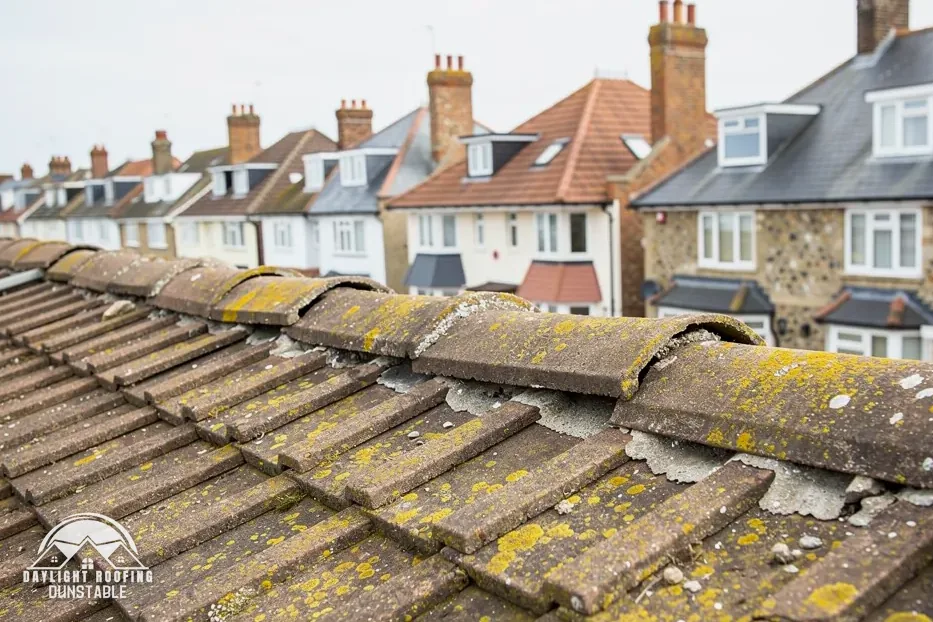
The signs can be read from the pavement or garden, helped by binoculars. Run an eye along the ridge for tiles that sit out of line or tilt sideways, for pale grit from the bed lying in the gutter, and for a visible gap between a tile and its bed. Cracks along the mortar joints are an early sign that the bed is losing its hold on the tiles.
Indoors, a brown stain on a ceiling or a damp rafter near the apex can point to water entering at the ridge. Peer up through the loft hatch while it is raining, rather than going out onto the roof. A tile that has already dropped is a plainer warning than any crack. Where the ridge sits against a gable, check the verge line beside it as well, since the same weathering acts on the mortar there and the two are worth looking at together.
None of these tells you how many years are left, and no roofer can state that from the ground. They tell you a survey is due. The why ridge tiles come loose page covers the causes, and the ridge and verge repairs hub gathers the repair routes.
Mortar alone and what replaces it
How long the mortar lasts is only part of the picture, because it no longer carries the ridge unaided. Marley says that since the 2015 amendments to BS 5534 mortar "could no longer be relied upon as the only means of securing the roof covering", and that installing to BS 5534 "isn't required by law". A bed that is still holding may nonetheless be backed up with mechanical fixings when the ridge is next worked on.
When bedding does fail, there are two routes. The ridge can be re-bedded on fresh mortar with mechanical fixings added, or changed over to dry-fix under BS 8612:2018, which is current. The re-bedding versus dry ridge page compares them, and which suits a roof is settled by the covering and the ridge as found.
Dry-fix holds the tiles with fittings and no bed, so the bedding question does not arise in the same way. A mechanical fixing is still looked over from time to time, as any fixing is. After surveying, Daylight Roofing writes a single total price for the work. For a first step, WhatsApp a picture of the ridge to 07880 284133.