
The short answer
You can look after the parts you can reach from the ground, such as low gutters, and check the roof with binoculars. Going up to scrape or wash the tiles is a different job: a fall from a roof can cause serious injury, tiles crack underfoot, and a tile maker does not recommend high powered jet washes.
What you can do from the ground
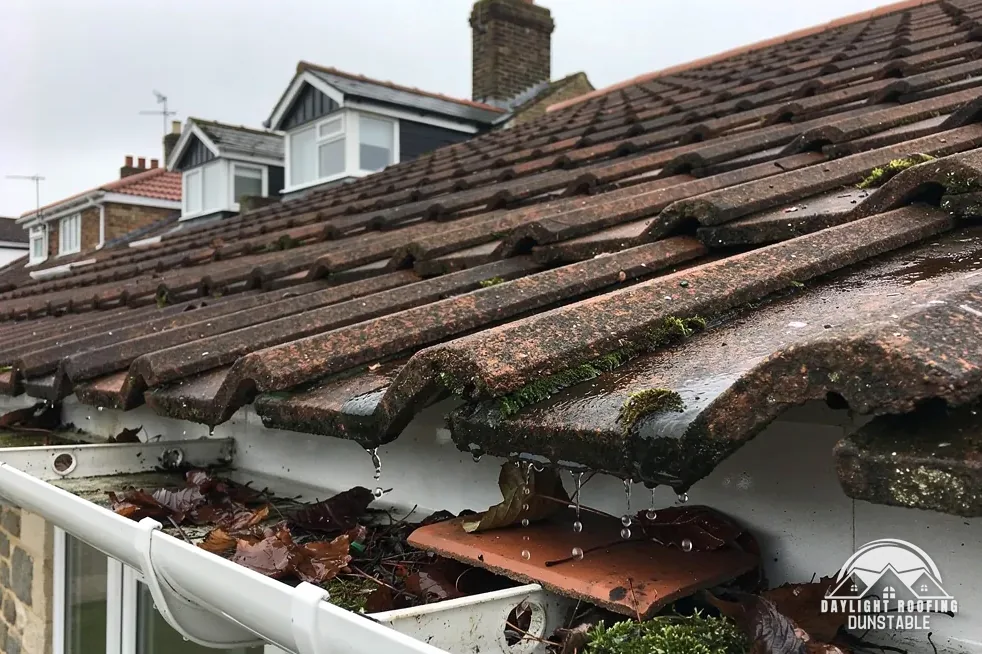
Plenty of useful roof care happens with both feet on the ground. A pair of binoculars shows moss in the laps, slipped or cracked tiles, a lifted ridge and staining on the walls below the eaves, and all of it can be written down or photographed from the garden. A photo sent on WhatsApp to 07880 284133 will be looked at, which gives you a second opinion before you decide anything.
Gutters at the lowest level can be cleared with a stable ladder and a scoop, as long as the ladder is footed on firm, level ground and you do not stretch sideways. Moss that has dropped into a gutter holds water and can block an outlet, so clearing it stops it backing up into the fascia. Keep an eye on where the debris goes, because moss thrown from a ladder lands on paths, plants and the drive.
- Scan the slopes through binoculars
- Photograph anything that looks lifted, slipped or cracked
- Clear low, reachable gutter runs from a footed ladder
- Note staining or damp on walls under the eaves
Our guide to moss, lichen and algae on roofs shows what each growth looks like, which helps when you are checking from below.
Why climbing up is a different job
A pitched roof is steep, wet moss is slippery, and the ground a fall ends on is hard. Tiles are not made to be stood on. A concrete or clay tile can crack under a boot, and a cracked tile that goes unnoticed can let water in later, so a do-it-yourself clean can create the problem it was meant to prevent. Walking a roof can also loosen mortar at ridges and shift tiles that were sound.
Method is the next problem. Marley says that "the use of high powered jet washes is not recommended as it can damage the surface of the slate or tile, thus reducing its expected life considerably". Scraping with a hard tool can leave scars on the surface that hold water and let new growth settle faster.
There is also the question of what you are washing off. A treatment that kills moss runs down into gutters, drains and borders. The label for any product sets out how it should be used, and following it on a roof, on a ladder, with a hose, is harder than it sounds. The guide to roof cleaning and tile damage covers how damage happens and how it is avoided.
When it should not be touched
Some roofs are no place for a trial. HSE's guidance reads: "If the building was built or refurbished before 2000, assume that there is asbestos in it." Its A14 guidance adds that "AC roofs are always fragile", meaning asbestos cement sheeting. A garage or outbuilding with old sheet roofing is a case for reading HSE's guidance before anyone steps near it.
Roofs that are very steep, high, or fitted with rooflights, glazed panels or a flat-roofed section are risky to cross, because a rooflight can look like part of the surface. A flat roof's membrane can be damaged by a scraper or a boot. If you cannot say what the covering is, that is itself a reason to wait.
Working at height brings its own responsibilities, and a ladder that is not tied or footed is a hazard on its own. For work that does need doing up there, the roof is surveyed first, and a quote follows as one written total. The roof cleaning methods compared guide shows what each approach involves, and the roof cleaning hub brings the rest together.