
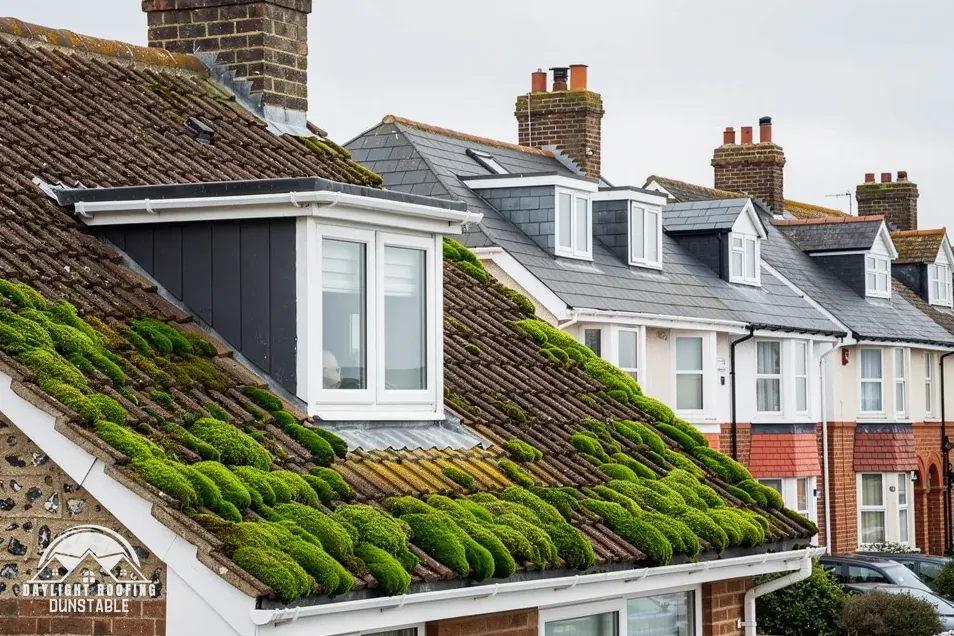
Two materials, one job and different limits
Concrete tiles are cast from cement and sand in a mould. Clay tiles are shaped from clay and fired in a kiln. From the ground the two can look alike, since both come in plain, interlocking and pantile profiles, but they are built differently and they age differently. The aim of cleaning is the same on both: to take off the growth and leave the covering sound.
The difference lies in what cleaning can wear away. A fired clay tile is hard throughout. A concrete tile is a cast product, and the face that the weather and the cleaner both meet is a thin outer layer of the tile. Take that layer away and the body of the tile is open to water, so what looks like a thorough clean can start a slower kind of decay.
What the roof is made of therefore comes before the method. Some owners cannot say which they have, and the two are easy to confuse from a distance. A broken tile in the garden, a spare in the loft or the tile maker's name on the back settles it, and a roofer can tell on a visit. The answer decides which methods are sensible and how the quote is worded.
Slate is a third case altogether, since it is a natural stone split into thin sheets. The way slate is cleaned is set out in how to clean a slate roof, and this page stays with tiles. The wider group of cleaning guides sits under roof cleaning.
Surface wear on concrete tiles
Marley, a maker of concrete and clay tiles, says of jet washing: "The use of high powered jet washes is not recommended as it can damage the surface of the slate or tile, thus reducing its expected life considerably". The warning names slate and tile without exception, and on concrete the surface is the part that does the protecting.
A worn face is also rougher. A rough face holds spores and a film of water better, so a roof that has been cleaned hard can grow moss again more quickly than the roof it replaced. This is a reason to choose a gentler method on a roof that is already weathered, even where it takes longer or leaves some staining behind.
Colour is part of the same question. Some concrete tiles are coloured through the body and some carry a coloured surface layer, and a cleaning method that takes off the layer takes off the colour with it. A patchy roof after cleaning can be a sign that the surface has been disturbed, and that cannot be undone once it is done. Ask what method is planned and what it does to the surface, and ask for it in the quote.
- Brush and scrape by hand, working with the lie of the tile
- Rinse at low pressure, from a safe distance, without driving water uphill
- Leave stubborn staining alone rather than chase it with force
- Treat the finished surface only with a product made for concrete
The keyword in all of this is restraint. Cleaning concrete roof tiles is a job where doing less can leave the roof in better shape than doing more.
Clay tiles and how long they last
Clay has the longer record. Marley reports that, for clay roof tiles, "the BRE determined a minimum life expectancy of 60 years". That is a figure for clay alone. HomeBuilding gives an approximate lifespan of 60-80 years for clay tiles, and 40-50 years for plain concrete tiles.
For concrete tiles Marley says: "Typically, roof tiles are expected to last for around 60 years", followed by "This is not a guarantee or warranty of its longevity." The two sources give different figures for concrete, and both are shown below without any attempt to reconcile them. Read down the table to see which source says what.
| Tile | Source | Figure |
|---|---|---|
| Plain concrete | HomeBuilding | 40-50 |
| Roof tiles | Marley | Typically around 60 expected, not a guarantee |
| Clay | HomeBuilding | 60-80 |
| Clay | BRE, via Marley | Minimum life expectancy 60 |
A cleaning decision is easier when you know where the roof sits on that scale. A roof in its second half is a roof where every extra stress counts, and a clean that removes surface or loosens a bedded ridge can shorten what is left. Age is also why one neighbour's roof and yours can need different handling on the same street, and why the tile maker's name, where it can be found, is worth noting down before any quote is agreed. The methods guide sets the options out side by side.
Moss, algae and water held in the tile
Both materials collect moss, and on both the moss does the same thing. It holds water against the tile and keeps the surface damp well after the rain is over. On a plain tile roof the moss packs into the gaps between courses, which is where the water would otherwise run off.
Moss lifts as well as holds. Growth that builds up under the edge of a tile can raise it a little, and on an interlocking tile it can sit in the channel that carries water down the roof. The effects are covered in the guide to moss, lichen and algae on roofs, and the question of whether to treat it for a leak is taken up in can moss cause a roof to leak.
A tile that stays wet through a cold night is under more strain than a dry one, since water in a porous body can freeze and push at the surface. That is a general point about porous materials, and it is one more reason a damp, mossy slope is worth looking at before winter. It is not a sign that every mossy roof is failing.
Algae is a different matter. The black or green streaks that run down a slope are cosmetic in the short term, and they show up more on a pale tile. The streaks themselves sit on the surface, though a stained roof that is left alone can go on collecting growth because it stays damp.
Methods and what suits each tile
Hand scraping, soft washing, high pressure and steam each sit differently with concrete and clay tiles. That is a general picture, since the condition of an individual roof can change the answer, and a survey settles the individual case. The entries are cautions rather than rules, because a sound clay roof and a tired concrete one sit at opposite ends of the same table.
| Method | Concrete tiles | Clay tiles |
|---|---|---|
| Hand scraping | Light touch only | Suits a sound roof |
| Soft wash | Suits if rinsed gently | Suits if rinsed gently |
| High pressure | Risk to the surface | Risk to joints and glaze |
| Steam | Check with the tile maker | Check with the tile maker |
Whatever the method, the work involves walking a roof, and a tile that has been standing for decades can crack under a boot. Treading on the lower third of each tile, where it laps the course below, spreads the load, and a roof ladder or crawl board spreads it more. A tile that cracks is worth replacing at the time, and that is a repair rather than a cleaning job.
A biocide can follow, and the label governs where and how. What to ask is covered in the biocide treatments guide. Run-off, water butts and the covering all come into the questions, and so do the lead flashings and painted fascias below.
Ridges, hips and the bedding beneath
Along the lines of the roof run the ridge and hip tiles, fixed with mortar bedding or with dry-fix fittings. Both are exposed to cleaning, because a brush or a jet works along them. Mortar that has gone soft or cracked will flake when it is brushed, and a ridge tile that moves under a hand is already loose.
Marley says: "The 2015 amendments made it clear that mortar could no longer be relied upon as the only means of securing the roof covering." The point for a cleaning visit is that a ridge or hip secured by mortar alone is an older detail, and a roofer who sees one while on the roof can say so. The standard BS 5534 is a code of practice, not law, according to Marley, and BS 8612:2018 is the standard for dry-fixed fittings along ridges, hips and verges.
Verges are a second weak point. The mortar that finishes a gable edge weathers faster than the tile beside it, and a cleaner who knocks it loose has made a small job larger. Pointing and bedding are repairs, and they are covered under roof repairs, but they are worth looking at before anyone reaches the ridge with a brush.
Slipped, chipped or missing tiles are the other thing a clean can uncover. A tile that sits a little proud, a missing tile in a course or a split through a fixing hole becomes visible once the moss has gone, and a short list of these is worth having before the written price is set. Which of those need refixing is a question about the roof, and it is answered by a close look rather than by the cleaning method.
Clean, treat or replace: choosing
Three questions settle most of the choice. Is the covering sound, with no cracks, delamination or loose fixings? Is the growth heavy enough to keep the tile wet? Is the roof within its working life? A roof that fails the first test is a repair or replacement job, and one that passes all three is a good candidate for a clean.
A coating is a fourth option that some firms sell. The limits of a coating are a subject of their own, set out in the guide to roof coatings. Tile makers' own guidance on coating their products is the first thing to read before agreeing to one.
On cost, one cost guide quotes a range for roof cleaning by the square metre, and that range is looked at in the guide to roof cleaning prices. Do not turn that range into a total for your house, because access, the covering and what the roof needs all change the work. The written quote is one total price after a survey.
A re-roof is a larger step. Under the Planning Portal's guide, re-roofing does not normally need a building regulations application if it affects "Less than 25 per cent of the total 'building envelope'" and "Less than 50 per cent of the roof is affected". A whole new covering is beyond the 50 per cent roof limit, so check the Building Regulations route with the council's building control team before work starts.