
What a biocide is, and what it is not
A biocide is a product made to kill living things. On a roof the living things are moss, lichen and algae, which are covered one by one in the guide on moss, lichen and algae on roofs. The product is sprayed or brushed onto the covering, left for the contact time on its label, and the dead growth then loosens and weathers away. Some labels call for a rinse afterwards and some do not.
That is the whole job of a roof biocide treatment: to stop growth, not to repair anything. It does not stiffen a loose tile, bed a ridge, seal a hairline crack or cure a leak. A roof with a slipped tile, a failed mortar joint or a rotted batten is the same roof after treatment, only cleaner to look at. Repairs belong to a different part of the work and are covered under roof repairs.
A biocide is also not a coating. A coating forms a film on the surface, and what a coating can and cannot do is a separate subject, taken in the guide to roof coatings. A biocide leaves no film you can see. It works through the chemistry of the product, and what is left on the tile is thin enough that the tile looks as it did, only without the growth.
Treatments are sold under many trade names, and the label on the container is the document that counts. It carries the active ingredient, the dilution, how it is applied, how long it needs, what it can harm and what to do with the leftover. A page like this one cannot stand in for that label, so no product is recommended here and no result is promised.
Where treatment sits after the growth is off
Cleaning and treating are two separate jobs that can be sold as one visit. Cleaning takes the growth off the covering. Treating tries to keep it from coming straight back. The cleaning methods themselves, scraping, soft wash, pressure and steam, have a side-by-side comparison in the methods guide, and the treatment is an extra step layered on top of whichever one is used.
The order of work belongs to the product label. Some products are made for application to living growth, which then dies in place and is brushed or washed off later. Others are made to follow a clean. If a quote does not say which of the two is meant, ask, because the order changes what the roof looks like in the weeks after the visit and what is sent down the gutters in the meantime.
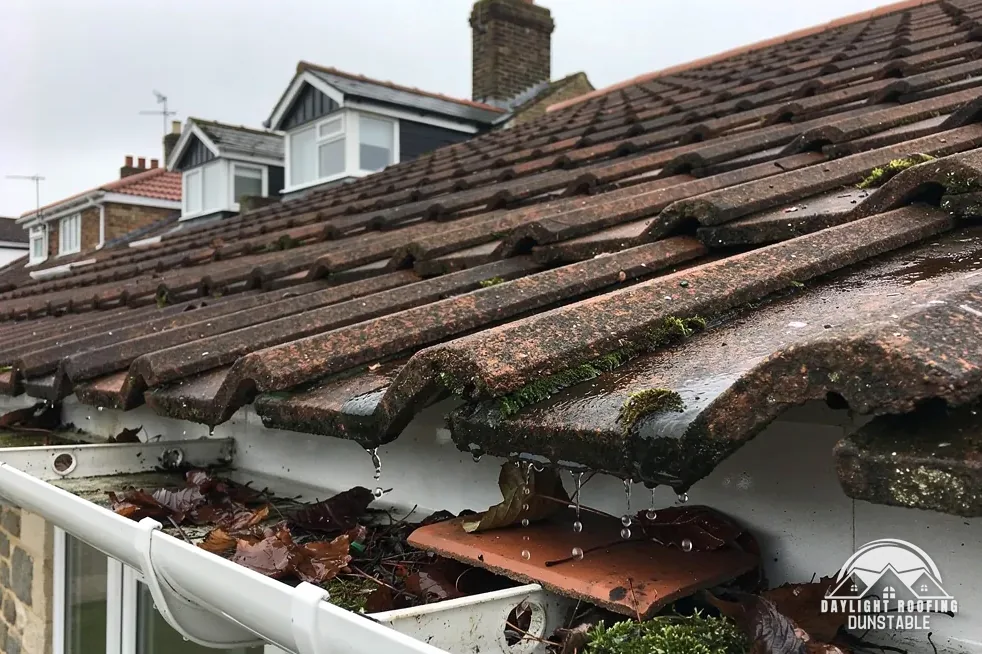
Dead moss does not vanish the moment a product touches it. It can sit on the tiles for a period, brown and crisp, before rain and wind move it. The roof can look worse before it looks better, and the gutters and downpipes collect what falls. That is why gutter clearance after a roof clean is a question in its own right, and it is covered in the guide to gutter cleaning and winter.
Treating a roof that is already clean is possible, and it is a choice some owners make for a roof that has been scraped by hand. Treating a roof that is heavily grown over is a larger task, because a thick mat can hold the product away from the tile surface. Whether a mat has to come off first is for the product label, and for the person quoting, to settle in writing.
How long does a treatment last?
A single figure for every roof does not exist. Anyone who gives one without asking about the roof is selling a number rather than describing a result. What sets the answer is the site: shade, nearby trees, pitch, the tile surface, the product and spores from neighbouring roofs.
| Factor | Why it counts |
|---|---|
| Shade | Slopes in shade stay damp longer, which suits growth |
| Trees nearby | Leaf litter and drip hold moisture on the covering |
| Pitch | A shallow slope drains slowly and holds debris |
| Tile surface | A rough or worn face gives spores more to hold on to |
| The product | Active ingredient and rate are set by its label |
| Spores from neighbours | Growth on adjoining roofs and walls can seed yours |
A product's own datasheet may give a period, and where it does, the datasheet also gives the conditions that period applies to. A figure with no conditions attached is not a figure to rely on, and a roofer who writes a number into a quote is stating something that has to be backed up in writing.
Shade and moisture carry real weight in the table. A slope that gets sun through the day dries out quickly, while a slope under a tall tree stays damp, so two roofs on one street treated together can stay clean for very different lengths of time. A sensible quote talks about the roof in front of it, not an average.
Run-off to plants, ponds and gutters
What goes onto a roof comes off it again, and a roof sheds into the gutters, the downpipes and, from there, either a drain or the garden. A biocide label states what the product can harm. Plants, pond life, fish and pets can be among them, and the label also says what to do about water that carries the product off the roof.
Before treatment the questions to put are practical ones. Where do the downpipes discharge? Is there a water butt on any of them? Is there a pond, a stream or a neighbour's greenhouse within reach of the run-off? Is the drain a surface-water drain, which can lead to a watercourse, or a foul one? The answers decide whether a downpipe needs to be diverted, capped or covered for the visit, and whether the work should wait for a different day.
A water butt is easy to forget. Water stored for the vegetable patch and treated run-off should not meet, so disconnect a butt fed from the roof before the work, and reconnect it only once the label's precautions allow. Plants below the eaves can be watered before and after, and covered where the label calls for it.
Pets and children stay clear of the ground below the eaves for as long as the label says. Wash the paths and patio only in line with the label too, because rinsing a path onto a lawn or flower bed just moves the product somewhere else. None of this is difficult, and all of it is easy to miss when the visit is brisk.
Matching a product to the covering
Roofs are covered in different materials and a product is made for some of them and not others. Concrete and clay tiles are one group, natural slate another, and flat roofs, including felt, EPDM and GRP, are different again. A product that is fine on a tile may not be intended for a membrane, and the label is the place that says so.
- Concrete and clay tiles: the two surfaces differ in how they weather
- Natural slate: see how to clean a slate roof
- Flat roofs: membranes need a product made for them
A chemical treatment is one way people try to avoid the damage that a hard jet of water can do to a tile face, but a chemical has its own limits. A strong product on the wrong surface can mark, stain or dull it, so the question to put is whether the product is made for this covering and what the label says about it.
Painted or factory-coloured tiles, lead flashings, painted fascias, powder-coated aluminium and uPVC fascias and gutters are all within reach of overspray and run-off. The label should say how a product behaves on them. An older roof with a worn tile face is a different case again, and the label's warnings carry more weight there.
Safety, ladders and doing it yourself
Biocide is sold to the public, and some owners apply it from a ladder or a garden hose-end sprayer. The risk is not the product so much as the height. A roof edge reached from a ladder, a wet slope and a spray bottle in one hand is the setting for a serious fall, and a tile that cracks under a boot starts a leak. A product that works from the ground, with a long-handled applicator, shifts that risk, but the label governs what it may be used for.
Roofs built or refurbished before 2000 may carry asbestos cement sheeting. HSE's advice is: "If the building was built or refurbished before 2000, assume that there is asbestos in it." HSE also says "AC roofs are always fragile", so no one can trust it to take a person's weight, and a roof like that is not a do-it-yourself job at all. Garage and outbuilding roofs are worth a look at before anyone climbs up.
Labels can call for gloves, eye protection and clothing that can be washed, along with a note on keeping the product off skin and out of eyes. A treatment should not be mixed in a bucket from two products or stronger than the label allows, in the hope that it will work harder, and leftover liquid should not go down a surface-water drain.
A roofer working at height brings the access, the ladders or scaffold and the know-how that go with them. Where the roof edge sits over a pavement or road, a scaffold licence is needed, and we arrange the licence with our scaffolder. That is part of why the written quote is one total price and not a figure for the spray alone.
Questions to put before you agree a treatment
Treatment is easy to add to a quote and hard to judge afterwards, because the roof looks the same whether the product was strong, weak or watered down. The protection is in what is written down. These are the points worth asking about, and a clear answer to each is a good sign of a careful job.
- What is the product called, and can I see the label and the safety data sheet?
- Is it applied to living growth, or after cleaning, and why?
- What does the label say about plants, ponds, pets and water butts?
- Where will the run-off go, and are any downpipes to be covered?
- What are the coverings on the house, and is the product suited to each?
- What does the quote say about how long the result may last, and under what conditions?
A quote that names the product and its label answers most of these in one line. One that says only "biocide treatment" leaves every point open. The cost side of the question, including the range one cost guide gives for roof cleaning, is covered in the roof cleaning prices guide, and the quote itself comes as one written total.
To start with a photograph instead, send one of the roof and the gutters on WhatsApp and the roof can be looked at from there. The wider picture of cleaning work lives on the roof cleaning page, which links on to every guide in this set.