
Can roof cleaning damage tiles?
It can. Cleaning is work done on a covering that was built to shed rain, not to be walked on, scrubbed or soaked in chemicals. A sound roof cleaned with care comes through well. A tired roof cleaned hard can end up worse than it began, with cracked tiles, a worn surface and a leak that was not there before.
The risk is not even across a roof. A brittle tile near the end of its life is at risk from a footstep. A concrete tile with a thin surface layer is at risk from a hard jet. A painted or factory-coloured face is at risk from a strong product. Each of those is a separate problem, and a method that deals with one can leave another untouched.
That is why the question to put to anyone who quotes is not whether they clean roofs but how they clean this one. A roofer reads a roof before cleaning it, looking at the age of the tiles, the state of the bedding, the ridge line and the surface. A cleaner with one method for every roof is working from the method rather than from the roof.
- Weight: boots, ladders, scaffold boards and dropped tools
- Force: a jet or a hard scrape on the surface
- Chemistry: products that mark, dull or strip
- Age: a tile near the end of its life takes less of all three
Age makes each of the other three more likely to do harm. Where the damage has already happened, the repair route is under roof repairs.
Boots on brittle tiles
Walking is one cause of tile damage during a clean, and an obvious one, since every method of cleaning a roof from above starts with somebody standing on it. A tile is strongest where it is supported, which means over a batten and on the overlap with the course below, and weakest in the open span between.
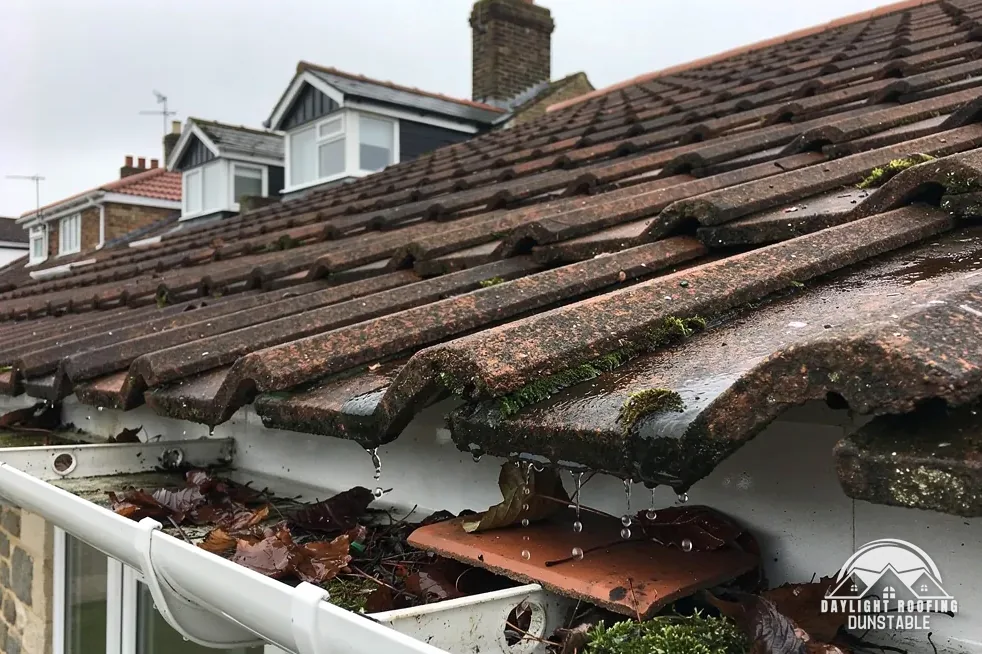
Old tiles are the ones at greatest risk. A clay or concrete tile that has been through many winters can have fine cracks that do not show until weight is put on it. Moss makes this worse, because it hides cracks and because a wet mossy slope is slippery. A foot that slides can also drag a tile out of position as it goes.
Good practice on a roof is simple to describe. Tread on the lower third of each tile, over the batten line. Spread the load with a roof ladder or crawl board where the pitch allows. Keep tools in hand or in a bag rather than set down on the slope. Stop at any tile that moves. Work down the slope rather than along the ridge line.
A broken tile found after a clean is hard to date. Was it cracked before, or did a foot do it? Only a survey beforehand can settle that. A roof that is already carrying cracked tiles is better repaired first, and the tile and slipped-course repairs are covered under roof repairs as well. The two tile materials wear differently, and the guide on concrete and clay tiles covers that.
Pressure, water and the tile surface
Marley, a tile and slate maker, says: "The use of high powered jet washes is not recommended as it can damage the surface of the slate or tile, thus reducing its expected life considerably". That warning from a maker frames the whole question of pressure.
A jet works by force. It removes moss because it is strong enough to tear it off the tile, and the same strength can remove whatever is under the moss. On a concrete tile that is the outer layer. On a clay tile it can be a glaze or a fired face, and on a slate it can be the edge of a thin sheet. Force is also directed upward at the joints between courses, which are places the roof was not built to be struck.
A lower-pressure rinse is a different thing from a jet. The distinction is one of pressure and distance, and the label of a pressure washer does not say which side of the line a nozzle is on. A quote that gives no pressure, nozzle or distance says very little. Ask which it will be and how far from the tile the lance is held.
Steam and hot water are sold as gentler, and they can be, but the maker's guidance on a tile is the thing to check, not the sales claim. The various methods are set side by side in the guide to roof cleaning methods compared, with the risk against each one.
| Cause | What you may see afterwards |
|---|---|
| Foot traffic | Cracked or slipped tiles |
| Hard jet | Pale, rough, worn tile faces |
| Strong product | Patchy colour, marked lead or paint |
Chemicals and what they can mark
A biocide is the other route, and it moves the risk from force to chemistry. A product that kills growth works by being strong enough to harm living things, and a strong product can also mark the materials around the growth. Lead, the paint on fascias and bargeboards, coated aluminium and uPVC can all take a stain from overspray or run-off.
The tile is not exempt either. A product made for concrete may not suit clay, and one made for tiles may not suit a felt or rubber flat roof next to them. The label says what the product is made for, and a quote that names the product lets you read it. What sits behind the question is set out in the guide to biocide treatments.
Dilution matters as well. Mix a product beyond the strength its label gives and the chance of marking goes up. Rinsing guidance matters too, since some products are meant to be rinsed off and others to be left to weather. Ask which applies to the product named in the quote.
Checking afterwards is simple. Look at the paint, the lead and the gutters from the ground in good light. A new patch of discolouration, a white bloom on lead or a dull streak on a coloured fascia is easier to deal with if it is raised soon after the work and photographed, because the question of what caused it is then a short one.
Fragile roofs and the HSE warning
Some roofs will not carry a person. Sheets of asbestos cement, old rooflights and glass, and thin plastic or fibreglass panels on a conservatory, porch or garage are all fragile, and anyone who steps on one can go straight through to the ground below. Roof cleaning is done on tiles and slates, but houses have other roof surfaces attached, and a cleaner can step from one to another without noticing.
HSE gives the guidance that applies to older buildings. It says: "If the building was built or refurbished before 2000, assume that there is asbestos in it." It also says "AC roofs are always fragile". A garage, outbuilding or lean-to on an older property is worth checking before anyone steps onto it.
Nobody walks a fragile roof. A plastic or glass panel is reached from a tower or a scaffold that gives a working platform, or left alone, and an asbestos cement roof is left to an asbestos specialist, arranged separately. Nothing about a cleaning job justifies standing on a sheet that might not take the weight. The same applies to a rooflight in the middle of a tile slope, which can be hidden by moss or a leaf mat.
A scaffold platform that overhangs the footway or road comes under the highway authority's licence, and we arrange the licence with our scaffolder. Access is part of the work, which is why the quote is one total price and not a figure for the cleaning alone. A cherry picker or tower comes into the same picture where one is used instead of scaffold.
Slipped tiles, loose ridges and what a clean shows up
Moss hides defects, and removing it shows them. A tile that has slipped a few millimetres, a ridge tile that rocks under a hand, a split along a fixing hole and a gap in the bedding under a verge all become visible on a cleaned roof. Finding a defect under the growth is a benefit of cleaning, not a penalty.
That is also why a roofer may want to deal with such faults as they come to light. A slipped tile left in place lets water reach the felt, a loose ridge can work loose further and a cracked tile can get worse with each winter. Refixing a slipped tile or rebedding a ridge counts as repair work: a small job when it is seen, and a larger one after the next storm, with scaffold or a longer visit added to the bill.
A repair found during a clean is not a promise made in advance. Whether a roofer deals with a fault on the same visit, at the same price or at all is for the quote to say, and one written total follows the survey. Cleaning and repairing are separate jobs that can be done together when the roof calls for both.
The state of a roof's bedding and fixings also bears on method. Marley says: "The 2015 amendments made it clear that mortar could no longer be relied upon as the only means of securing the roof covering." An older ridge held by mortar alone is a reason to be gentle around it, and a reason to look at it. How the growth itself is read is covered in moss, lichen and algae on roofs.
Questions that protect the roof
The protection against damage is mostly in the questions asked before the work. A good answer is specific and a poor one is general. Ask them in writing, so that the answers are in the quote or in an email you can find again.
- What method will be used on my tiles, and why this one?
- If a jet is used, at what pressure and from what distance?
- How will the roof be walked, and with what protection?
- What product is used, and may I see its label?
- What happens to run-off, and are the downpipes covered?
- What is done about tiles or ridges found loose?
Afterwards, look. From the ground, check for chips, cracks and bright pale patches where a surface has been stripped, and compare each slope with the others, since a difference in tone between slopes can show where one was treated harder. Look in the gutters for grit and fragments, since a handful of tile granules is normal after a clean and a heap of chips is not. Inside, check the ceilings for new marks after the next rain.
A photo sent on WhatsApp of anything that looks wrong gets a look first, and the survey settles what the roof needs. The wider set of cleaning guides is gathered under roof cleaning.