
What the published range says
Checkatrade's cost guide, last updated in April 2026, says: "Roof cleaning in the UK typically costs between £8.50 and £14 per m²". It is a range, it is per square metre, it carries the word "typically" and it states no VAT basis, so it cannot be read as a price with VAT in or out.
A per-metre rate is not a quote. The figure is silent on how large the roof is, what it is made of, how much growth is on it, how hard it is to reach and what is included. Two houses of the same floor size can have roofs of quite different areas, and a rate multiplied by a guess at the area produces a number that looks precise and means little.
Multiplying it out would mislead. The range is useful in one way: it tells you whether a quote is in a sensible neighbourhood or wildly off it, and it prompts the question of what the rate is a rate for. It is a place to begin asking about the roof, not an answer to the question.
The roof's area is also not its footprint. A pitched roof covers more surface than the ground it stands over, because the slopes are tilted, and the steeper the pitch the larger the difference. That is why a quote should be based on a look at the roof, either in person or from a measured plan, and not on the floor area of the house.
Why area is only the start
Area sets the amount of work, and the rest of the quote is about the kind of work. A large, plain roof of sound tiles can be a simple job. A smaller roof broken up by dormers, valleys, chimneys, rooflights and a porch can take longer per square metre, because there is more to work around and more to protect.
Complexity is the word for it. Every valley, hip, abutment and chimney stack adds edge, and edges are slower to clean and riskier to get wrong. A bungalow with one wide hipped roof and a three-storey house with several gables and a side extension are not the same task, even when their areas match.
Pitch counts as well. A steep slope needs a different way of working from a shallow one, with more equipment and more caution, and a very shallow slope holds moss and water differently. The pitch also decides how a person can safely reach the roof, which brings in the next factor.
- Size of the roof, measured on the slope
- Number of valleys, hips and abutments
- Dormers, chimneys and rooflights to work around
- Pitch and the number of separate slopes
- Roofs on extensions, porches and outbuildings
Each item on the list adds minutes or hours, and none of them shows up in a rate per square metre. A roof that is large but simple and a roof that is small but busy can land at much the same total for exactly this reason, which is why the published range is a guide and never a calculator.
What access does to the price
Getting to a roof safely is part of the cost, and on a tall or awkward house it can be a large part. A single-storey roof reached by a short ladder is a modest job. A three-storey house with a narrow side path, or a roof that overhangs a pavement, can call for a tower or scaffold, which is a cost in its own right.
Highways law licenses scaffold that obstructs the street, and we arrange the licence with our scaffolder; a job that needs scaffold carries it in one total. For Dunstable addresses the authority is Central Bedfordshire Council, and other councils have rules of their own, so the details depend on where the house is.
Some roofs can be reached without scaffold, using ladders, roof ladders and other equipment suited to the pitch. Some cannot, and a quote for a roof that needs scaffold but does not mention it is a quote that has left something out. Ask how the roof is to be reached, and what that adds to the total.
Access is also about what is around the house. Parked cars, a conservatory, a greenhouse, a pond, a neighbour's fence and mature planting under the eaves all affect how equipment is set up and how run-off is dealt with. A site visit shows these things where a photograph can miss them, which is why a visit comes before any figure.
Condition and growth on the roof
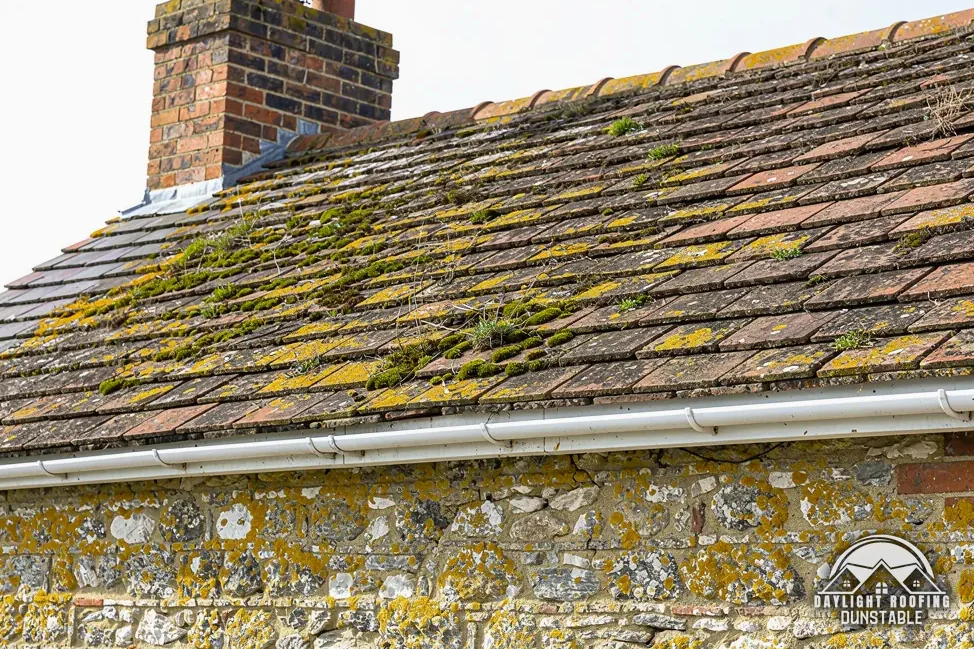
A roof with a light film of algae and a roof with a thick mat of moss are two different jobs. Heavy moss takes longer to lift, more debris comes off it and the gutters take more clearing afterwards. Lichen is slow and slow to shift, and a roof with a good deal of it can call for more careful work than the same area under moss. The three are described in the guide to moss, lichen and algae on roofs.
The condition of the tiles carries as much weight as the growth on them. A sound roof can be cleaned in the usual way. A roof with brittle, cracked or worn tiles needs a gentler and slower approach, and sometimes repairs first. If the tiles are past cleaning, the better advice may be to repair or replace rather than clean at all, and that is a conversation about the roof's future, not its looks.
Defects found under the growth are a further variable. A slipped tile, a loose ridge or a gap in bedding that shows up once the moss is off is repair work, and the cost of it is separate from the cost of the clean. Where a quote is silent on repairs, put that question before agreeing anything.
Roof cleaning is also not always a one-off. Moss returns where the damp conditions stay, and a roof under trees may need attention again sooner than one in open sun. A price for a single visit says nothing about how long the result will last, and no one can promise a duration without knowing the roof.
Method and treatment
The way a roof is cleaned affects both the price and the risk. Hand scraping is slow and labour-heavy. Soft wash is quicker over a large area. Steam and pressure are different again, with their own equipment and their own risks. Each method has its own cautions, which the guide to roof cleaning methods compared lists one by one.
A method that looks like a saving is not always one. A quote that uses a hard jet on tiles that cannot take it can leave a roof worn thin, and a thinned roof has a shorter life ahead. Marley, a tile maker, says: "The use of high powered jet washes is not recommended as it can damage the surface of the slate or tile, thus reducing its expected life considerably".
A biocide treatment is an extra on top of cleaning, and whether it is in the quote should be stated. The product, its label and what it is meant to achieve are all matters to ask about, and the biocide treatments guide sets them out. A treatment that is mentioned in the quote and not named is one to question.
A coating or sealant is a different product again, and it adds cost and its own questions about what it can and cannot do. If a quote includes one, ask for what it is, what the tile maker says about it and what it is expected to achieve. Where a price covers cleaning only, that should be clear too.
Gutters and the extras around a roof
Dead moss and grit come off a roof and land in the gutters, so gutter clearing is a natural companion to a roof clean. Whether it is in the quote, and how far it goes, are matters to settle. Clearing a gutter is its own job, and the timing around winter is covered in the guide to gutter cleaning and winter.
Fascias, soffits and downpipes run along the eaves and collect dirt from the same causes. A quote may or may not include cleaning them. Which? Trusted Traders list "Clear out all gutters at front and back of property" at £75 to £350, excluding VAT, from a survey of 11 traders in November 2025. That is a gutter job in its own right and no part of the Checkatrade range.
Wildlife can change the timing. Nesting birds and roosting bats are protected, and work near a nest or a roost may have to wait. That is a matter of the law, not of the price, and it has a guide of its own on roof cleaning, nesting birds and bats.
A roof clean touches the whole edge of the house. A price that covers the tiles and leaves the gutters, downpipes and fascias to someone else may be fair, but it should be clear that it is so.
Setting quotes against each other
Quotes for the same roof can look far apart and be for different things. The way to compare them is to put the same questions to each and set the answers side by side. Our own quote is a single total after a survey, and any quote should say what its total covers.
| Question | Why it matters |
|---|---|
| How is the roof reached? | Scaffold changes the work |
| Which method is used? | It sets risk to the tiles |
| Is a treatment included? | It is a separate product |
| Are the gutters included? | Debris lands there |
| What about repairs found? | A different job and price |
Beware a price given from a photograph alone, or by phone with no question about the roof. Ask what the figure was based on. A survey is how the roof's size, access, growth and condition get measured, and the total comes after it.
Whether the work is worth the money is a separate question, and it is answered in is roof cleaning worth it. To start with a photograph of the roof and the surrounding access, send it on WhatsApp, and the first look can begin there. The full set of cleaning guides sits under roof cleaning.