
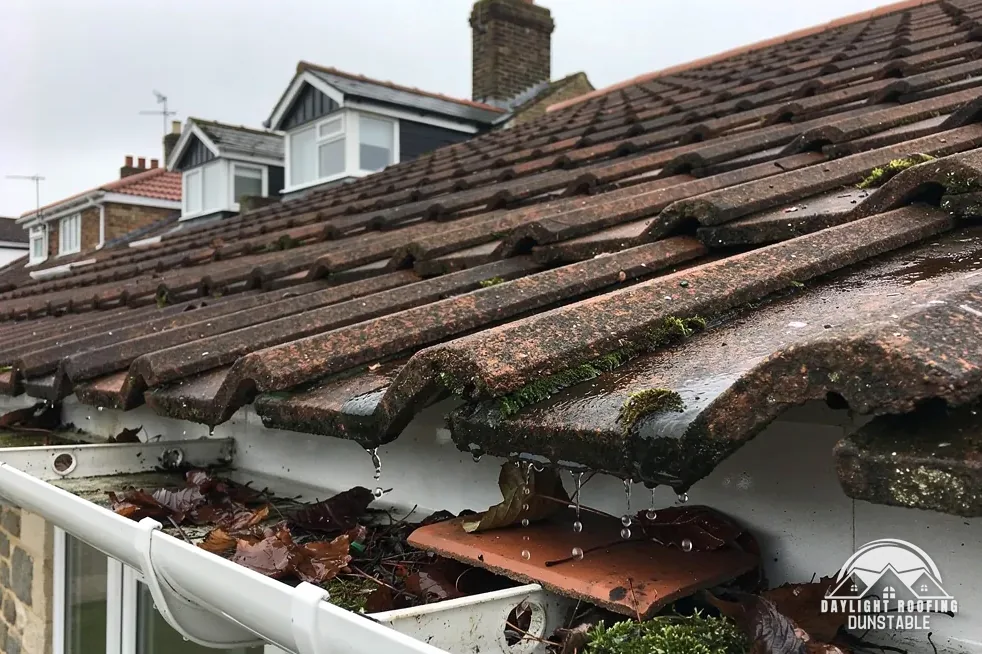
Three growths, three different things
People say moss for anything green or grey that has taken hold of a roof, and a clean-up quote can use the word the same way. The three growths are separate living things. Moss is a small plant with a soft, upright or cushion-like body. Lichen is a crust, a partnership between a fungus and an alga that grows flat on a surface. Algae is a thin film of tiny single-celled organisms that shows as a stain more than a growth.
The difference matters because each behaves differently on a roof. One soaks up water like a sponge, one grips the tile so hard it is difficult to lift off and one sits on the surface and does little more than darken it. A roofer reading a roof starts by working out which of the three is there, because the answer decides what the roof needs.
| Growth | Looks like | Holds water |
|---|---|---|
| Moss | Green or brown cushions and tufts | Yes, a good deal |
| Lichen | Flat grey, yellow or orange crusts | Little |
| Algae | Black, green or grey streaks | Very little |
Those traits hold in general. Real roofs carry mixtures, and a single slope can show all three at once, with moss in the shaded lower courses, lichen on the open face and algae streaking down from the ridge. Treating the roof as one thing is how a quote ends up covering the wrong work.
Moss: the one that holds water
Moss is the growth that gets the attention, and for good reason. Its body is built from tiny leaves that trap water, so a cushion of moss stays wet long after the surrounding tile has dried. On a tile roof it packs into the gaps where courses overlap and into the channels of interlocking tiles, which are the paths the water is meant to follow.
A wet cushion on a tile is a wet patch on the roof for as long as the cushion lasts. Water held against concrete or clay for days at a time is more likely to work into the surface, and a cold night can then freeze it in place. Porous materials behave that way in general, and the effect builds over seasons rather than overnight.
Moss also builds. Dead growth, dust and fallen leaves collect inside it and feed the next layer, and a mat can thicken until it lifts the edge of a tile slightly. It can also shed into gutters and downpipes, where a clump becomes the start of a blockage. The question of leaks is taken up in can moss cause a roof to leak.
Moss does not make a roof fail on its own. A sound roof with a patch of moss is a sound roof with a patch of moss, and the cost of leaving it is slow wear, not a collapse. A mat over a slipped tile or a cracked ridge is another matter, because the moss hides what is underneath it, and a clean may be the first step toward finding that out. A hand-lifting approach has its own write-up in the blog post on moss on roof tiles.
Lichen on a roof: slow, crusty and hard to shift
Lichen on a roof grows as a flat, crusty patch, grey-green, yellow or orange, pressed against the surface so closely that it can look like paint. It is slow. A patch that is a few centimetres across may have taken years to get there, and it spreads outward from the edges at a pace that is almost invisible from one season to the next.
It is also firmly attached. Lichen grips by fine threads that work into the surface of the tile, so it does not lift away like moss. A brush takes the top off it, and what is left behind is a pale ghost mark. A hard jet may remove more, but it takes the tile face with it, which is the reason methods for lichen are chosen with care.
Because it holds little water, lichen is mostly a cosmetic problem and a slow one. It does not trap moisture the way a moss cushion does, and it does not block gutters. A roof with scattered lichen and no moss is, on the evidence of the growth alone, in better order than one with a heavy moss mat. Some owners treat lichen on an old tile as part of its character.
It can still matter. Heavy lichen cover on a tile that is already worn can add to how rough the surface is, and a rough surface collects moss. It is also an indicator of the conditions on the roof, since lichen spreads on surfaces that stay still and unwashed. On a period roof, whether to remove it at all is a question of its own, because the tile's age and, on a listed building, the consent question can both come into it.
Algae and the black streaks
The dark bands that run down from the ridge are algae. They start as a faint grey or green tinge, deepen to black and spread in bands down the roof, following the line that water takes. On a pale concrete tile they stand out sharply, on a dark tile they can pass for dirt.
Algae sits on the surface as a thin film, and it holds very little water compared with moss. By itself it does little harm to the tile. What it does is darken the roof, soak up heat and make a house look neglected, and in that sense it is cosmetic. It is also a signal: the algae is growing because the surface stays damp, so a roof with streaks is a roof that is not drying out.
A streaked roof is an easy one to sell a quick treatment to, and the sales line is easy to believe because the improvement is visible. A clean can lift algae and leave a roof looking years younger. It will not alter what made the surface damp, which can be shade, tree drip, a shallow pitch or a worn tile face. Without a change there, the streaks can return.
Streaks come in two directions. Down the roof is algae following the water. Across the roof in bands at the same level can be a sign of something else, such as a rainwater line from a fault above. A roofer who sees a pattern that does not match the water's path surveys the whole roof, and the question stops being about growth alone.
When growth matters to tiles and gutters
Growth matters where it holds water, blocks the path water should take or hides a defect. Moss is the main offender on the first two. A thick mat on a shaded slope, over a roof of porous tiles, is the case where leaving it costs the roof something. Moss in a valley or against a chimney can redirect water to where it is not meant to go.
It matters for the gutters when it falls. A cleaned roof sheds dead moss, grit and tile granules into the gutters, so ask whether clearing them afterwards is in the quote. The seasonal side of this is in the guide to gutter cleaning and winter.
- Moss in the overlaps of plain or interlocking tiles
- Moss packed into a valley, hip or ridge line
- Growth along the lower courses above a gutter
- Any growth over a slipped, cracked or missing tile
- Moss that has started to lift a tile edge
Where several of these show together, the roof is worth a survey before anything is quoted. A written total is given after it. What the roof has under the growth, in tiles, bedding and fixings, decides what the work should be, and the biocide question is covered in the guide to biocide roof treatments.
When growth does not matter much
Some growth can be left. A few patches of lichen on one slope, a light algae film on a north face and a thin scattering of moss on a sound roof are not an emergency. They are an invitation to keep an eye on things, and the sensible response may be to do nothing this year.
The test is whether the roof is doing its job. If the tiles are whole, the ridge is firm, the gutters run clear and the loft is dry after rain, a roof with some growth is working. A clean on such a roof is a choice about appearance and about slowing the build-up, and it is fair to weigh it as one.
Cleaning has costs. Every method can take something off the roof, even a gentle one, and a tile cleaned five times can have less surface left than one cleaned once. A roof that is cleaned because it looks green, rather than because it is at risk, is a roof where restraint can be the better choice. The cost side is covered in the guide to roof cleaning prices.
A written quote should say what is being cleaned, which growth is on the roof and why. One that says only "moss removal" for a roof with lichen and algae has not looked at it closely. Ask which growths were found and where, and what each would be allowed to do if left.
Check from the ground
- Binoculars on each slope
- Gutters for moss and grit
- Ridge line for gaps or lifting
- Loft for damp after rain
- Streak direction on tiles
Telling them apart and when to ask
A roof can be read well from the ground. Binoculars on a dry day show the colour, the texture and where the growth sits on each slope. Cushions and tufts are moss. Flat crusts are lichen. Smooth dark bands that follow the fall of the water are algae. A photo from the same spot each year makes it easy to see change.
Do not climb to find out. A wet slope, a ladder at the eaves and moss underfoot make a fall easy, and one cracked tile becomes a leak. A roof on a building of that age carries a further risk. HSE says: "If the building was built or refurbished before 2000, assume that there is asbestos in it." HSE also says "AC roofs are always fragile".
The questions worth asking are simple. Which growth is on each slope, how thick is it, is it near a valley, a ridge or a gutter, and are there any tiles under it that look slipped or cracked? Photos sent on WhatsApp answer some of that before anyone is up a ladder, and the survey answers the rest.
Cleaning methods are compared in roof cleaning methods compared, and the whole set of guides sits under roof cleaning.