
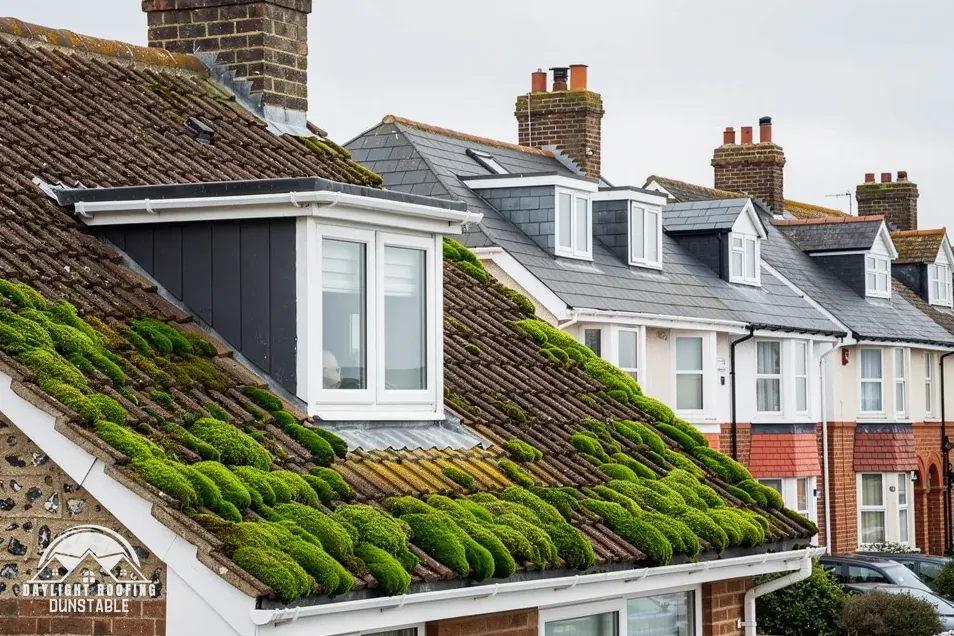
Why cleaning a roof can meet wildlife
A roof is a dry, sheltered, raised place, which is what many birds and some bats look for. Gaps at the eaves, a lifted tile, a space behind a fascia, a hollow at the end of a ridge or a hole in the soffit can each hold a nest or a roost. The wildlife does not see the roof as a house, and the roof's owner may never have seen it there.
Cleaning goes to exactly those places. A brush or scraper works along the eaves and verges. A rinse runs down the slope and into the gaps. A ladder rests against the fascia and a scaffold board against the soffit. Any of it can disturb an animal that is in residence, and some of it can damage the place where it lives.
The law treats the two groups differently, and the wording is exact. A bird's nest has cover while it is in use or being built. Bats and their roosts carry cover at all times, home or not. The rules are quoted below as written, with nothing added to them.
None of this means a roof must be left alone for good. A roof with nothing living in it can be cleaned without trouble, and the aim is to look first, to know the two rules and to stop when something turns up. The other cleaning guides are gathered under roof cleaning.
Nesting birds and the law
Section 1 of the Wildlife and Countryside Act 1981 lists acts that are offences when done "intentionally", among them one that bears on roof work: "takes, damages or destroys the nest of any wild bird while that nest is in use or being built". Two parts of that wording matter, and a summary can lose them.
The first is the word "intentionally". The offence is about doing the act on purpose, which is why it is not accurate to say that disturbing a nest is illegal in every case. The second is the phrase "while that nest is in use or being built". An old nest that is empty and abandoned is a different position from one with eggs or chicks, or one where a pair is building.
That does not mean an empty nest can be cleared without a thought. It means the question to answer first is whether the nest is in use. Birds flying to and from one gap at the eaves, droppings below it or the cheeping of chicks all point to a nest in use, and cleaning near it should wait.
Birds can nest at different times and in different places, so the test is the state of the nest and not the calendar, and nothing in the law quoted above hangs on a date. The separate page on whether you can remove a bird's nest from your roof deals with that question directly.
Bats and their roosts
Bats have stronger cover, and the key difference is that it does not depend on whether an animal is present. GOV.UK says: "All bat species, their breeding sites and resting places are fully protected by law". A roost in a roof keeps that cover when the bats are out feeding, away for the winter or not seen for months.
Under regulation 43(1)(d) of the 2017 habitats regulations, an offence is committed by anyone who "damages or destroys a breeding site or resting place of such an animal", and it has no intent word in it. Section 9(4) of the Wildlife and Countryside Act also reaches disturbing a bat where it shelters, or blocking its way in, when done "intentionally or recklessly". Damaging a roost is therefore an offence whatever was meant.
GOV.UK's bat guidance includes "repairing or replacing a roof" in its list of activities that may need a Natural England licence. Roof cleaning is not named in that line, but work that damages a roost or blocks a way in is the kind of thing the rules reach. So ask before any work goes under the tiles or into the eaves, rather than assume no rule applies.
A roost does not look like a nest. There is no material, and the animals are small, quiet and out of sight. A roof with a roost can show nothing from the ground. The page on roof work and bats in the roof covers what to do when signs turn up.
Where the signs show
Some signs can be spotted from the ground, and a few minutes with binoculars on a dry day can show several of them. The places to look are the same on every house: along the eaves, under the fascia, at the soffit, around the ridge ends and at the junctions with chimneys and walls.
- One gap that birds keep returning to
- Twigs, grass, feathers or straw trailing from the eaves
- Droppings or staining on the wall or windows below a gap
- Scratching or rustling sounds from the roof space
- Dark staining around a small gap, which can mark a regular way in
Bat signs are subtler. Small droppings under a gap or on a window ledge, staining around an entry point and sightings of bats leaving at dusk near the house are clues to look for. A single bat seen does not prove a roost, and no bat seen does not prove there is none, which is why the legal position is written the way it is.
The tiles themselves can hide a good deal. A lifted tile, a missing section of bedding at a verge and a broken fascia board each leave a gap. Moss can also close a gap that animals use, and removing it can open one. A roof that is cleaned without a look at those places can disturb a nest or roost without anyone noticing, and the roof's owner may be the person who finds out.
What to do if you find a nest or roost
Stop. The first step is the same for both: do not carry on with the work near the place. A nest in use or a possible roost is a reason to pause, whatever the schedule says, because a pause can be undone and a disturbance cannot.
Leave the nest, the droppings and the gap as they are. Do not block a hole, stuff it with foam or fill it with sealant, since blocking a way in can fall under section 9(4) when it is done "intentionally or recklessly". Take photographs from a safe place, note where and when, and keep the notes.
For birds, the question is whether the nest is in use. For bats, work affecting a roost can need a Natural England licence, and the process runs through that body and not through a roofer or a council. GOV.UK has guidance for both, on bats, their surveys and licences, and on wild birds and licences.
Where the wildlife has to be dealt with before roof work can go ahead, the work may have to wait, change or be done in a way that protects the animals. The law sets this, not preference, and it can affect the timing of a clean. A roofer who finds signs on a survey can say so, and the work can be revisited once the position is settled.
How wildlife can change the method
Where a nest or roost is known, the approach to cleaning changes. The area around it is left alone, work is planned to keep clear of it and anything that goes into the eaves, under the tiles or onto the soffit is held back. A biocide or a rinse near an active nest is a poor idea, since the label's warnings about harm to animals apply.
Cleaning can sometimes be done on the rest of the roof while a protected spot is left, and sometimes it cannot. That depends on where the nest or roost is and how the roof is laid out. A roof with a nest at one verge can still have its other slopes dealt with, while one with a roost under the ridge may need the whole job paused.
A written quote can say how a known nest or roost is handled. It can also say what happens if one turns up during the work. That is a sensible question to put, and the answer shows whether the roofer has thought about it. The methods themselves, and the risks of each, are compared in the guide to roof cleaning methods compared.
The same care applies to the product side. What a biocide can harm is on its label, and animals can be among the entries. The questions to put are in the guide to biocide roof treatments, and the point here is that a roof with wildlife is a roof where the label counts for more.
Questions to ask before work starts
A few questions put early save a great deal later. They are short, and none of them takes long to answer, but they show whether the roof is being thought about as a place where something may live.
- Has anyone looked at the eaves, verges and ridge for signs of nests or roosts?
- What happens if a nest or a possible roost is found during the work?
- Will any work go under the tiles or into the gaps at the eaves?
- Is anything planned that could block a gap?
- If the roof has bats, who is asked about a licence?
Get the answers in writing and keep them with the quote. One written total is given after a survey, and the survey of the roof from outside is where signs may first show. A photo of any gap, droppings or nest material that you send on WhatsApp will be looked at, though it cannot stand in for a proper assessment where bats may be present.
Roof cleaning around wildlife is about timing and restraint more than technique. Nothing in the rules asks for a roof to be left dirty for ever, and the answer is to look, to wait for the right moment or to change where the work starts. What grows on the roof is covered in the guide to moss, lichen and algae.