
The short answer
Sometimes. Whether a roof clean needs scaffolding depends on how high the eaves are, how steep the slope is and what means of reaching it are open, and a survey settles it rather than a guess from the pavement. Whatever scaffold the roof requires is built into a single written price, and for any on the street we arrange the licence with our scaffolder.
What decides whether a roof needs scaffold
A low extension with a gentle pitch poses a different problem from a tall house with a steep slope and a narrow side passage. Eaves height, the angle of the slope, the ground at the base of the wall and the shape of the roof all affect how safely a person can reach the surface and stay on it.
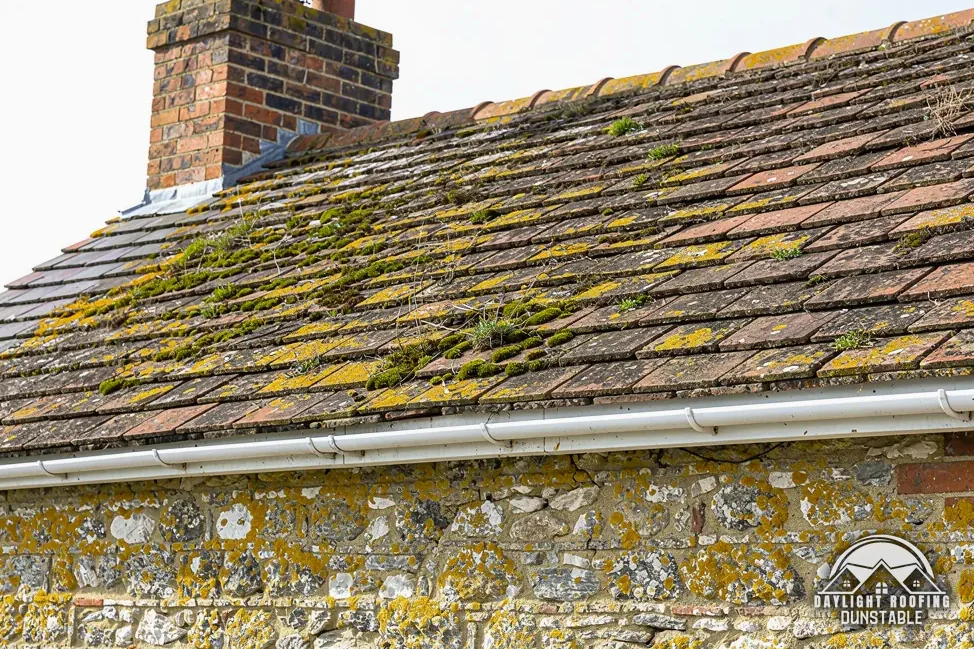
A scaffold provides a level platform and a guard rail along the eaves, so nobody is relying on a ladder or on the tiles for balance. A wet roof furred with moss is slippery, and the growth hides the true surface from view. That combination makes a steep, mossy slope the situation where scaffold is most worth considering.
Access runs from a ladder on a low, gentle roof to a full scaffold with edge protection on a tall or steep one.
| Situation | Access that may suit |
|---|---|
| Low roof, gentle pitch | Ladder or a tower |
| Two or more storeys | Scaffold along the eaves |
| Steep slope, slippery growth | Scaffold with edge protection |
| Narrow side access | Judged on the day of the survey |
None of these is a fixed rule. The survey looks at the real building, and the access it settles on is built into the quote.
Licences for the pavement or road
Needing a scaffold is one question, and where it would stand is another. Scaffolding on the pavement or road needs a scaffold licence from the highway authority; we arrange the licence with our scaffolder. For Dunstable addresses that authority is Central Bedfordshire Council, which licenses scaffolding on its roads.
A highway licence is about the public footway or carriageway. A scaffold erected entirely in a back garden touches neither, so for that setup the questions are about firm ground, a clear route for the materials and the boundary with the next house.
Whatever scaffold the roof needs is folded into the single price you receive after the survey, so access never turns into a second figure to chase. It helps to mention at the survey anything that could get in the way: parked cars, a narrow pavement, a shared drive, or a conservatory built close to the wall. Each of those is easier to plan around at the start than to discover halfway through the job.
Timing matters for licences as well, because a council runs its own process for issuing one, and the licence must be in place before the scaffold goes up. It is a legal requirement and cannot wait until the poles are already standing. The roof cleaning costs guide explains what moves the price of the whole job.
Fragile roofs and older buildings
Some roofs cannot take a person's weight, and scaffolding does nothing to change that. HSE advises: "If the building was built or refurbished before 2000, assume that there is asbestos in it." HSE also says "AC roofs are always fragile", and AC means asbestos cement, the sheeting seen on some garages, sheds and farm-style outbuildings.
A roof clean starts with knowing what the roof is made of. A tiled or slated house roof is one material, a corrugated sheet on a garage is another, and a sheet roof of unknown age should be identified before anyone steps on it. If you cannot tell what an outbuilding roof is, treat it as fragile and keep off it until a specialist has identified it.
- Stay off a sheet roof, even for a quick look.
- Leave scrubbing, scraping and washing of a sheet roof of unknown type alone.
- Photograph it from ground level and get it identified.
- Keep children and pets clear of any broken sheeting.
The main roof cleaning page covers tiled and slated roofs, where cleaning is a routine question, and the page on cleaning a flat roof deals with a different surface.