
The short answer
A slate and a half is a slate roughly one and a half times the width of the standard slate on the roof. It is used at a verge or against a wall at the end of every other course, so the staggered bond carries through to the edge without a narrow, weak sliver of slate.
How slates are laid and where the problem starts
A slate roof is laid in horizontal courses, each overlapping the one below. The slates are staggered, so that the joint between two slates in one course falls over the middle of the slate beneath, and the same arrangement continues up the roof. This is called a broken bond, and it avoids a straight run of joints for rain to follow down the roof.
The stagger creates a puzzle at the edges. If one course ends with a whole slate, the next course, offset by half a slate, would end with only half a slate. A half-width piece is narrow, hard to fix properly with two nails and more likely to crack or slip. If every course ended with a whole slate there would be no stagger at all. Slate is brittle, and a thin cut piece with a nail hole close to its edge can split as it is fixed.
The way round is to alternate at the edge. One course ends in a standard slate and the next in a slate and a half, a slate roughly half as wide again as the standard width. That gives a piece wide enough to fix and hold, and the bond runs on all the way to the edge of the slope.
Where a slate and a half goes
The wider slate is a finishing piece. It appears where a course meets something that stops the roof, such as a verge, a wall that stands above the slope or a gable end.
| Position | Why a wider slate is used |
|---|---|
| Verge | Keeps the bond at the end of alternate courses |
| Abutment against a wall | Avoids a narrow cut piece against the flashing |
| Beside a valley or dormer cheek | Gives a fixable width where courses stop |
The same slate may be cut from a wider one on site, or ordered in that width from the supplier, depending on the product. Natural and man-made slates are made in different ranges, and the guide to natural and man-made slate sets out how they differ. What is available for a given roof comes from the maker's range. The widths needed at the edges are worked out from the roof's measurements and included with the main order.
A dry-fixed verge uses a separate system of its own, covered by BS 8612:2018. The slate and a half still settles how the last slate in each course sits against that system, and the two are specified together so the edge is tidy and fixed.
What it means for repairs and the roof's condition
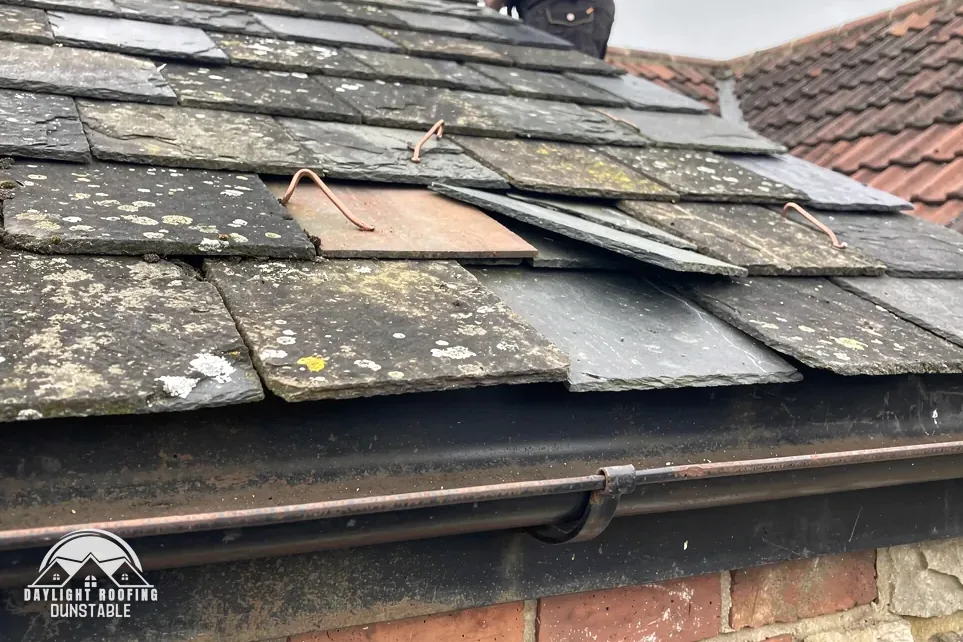
A narrow or badly fixed slate at the verge is a weak point, and slipped or missing slates there can be seen from the ground. A neat line of alternating widths along a verge suggests the bond was set out with care, while a ragged edge of thin cut pieces suggests it was not.
When slates at the edge are replaced, the same pattern is kept. A repair that swaps a slate and a half for a standard slate breaks the bond and leaves a joint running down the roof, so the width is matched as well as the thickness and colour. The fixing follows the slate's size and the roof's pitch, and hook fixings are ruled out below 25 degrees, according to Cupa.
Pitch matters at the edges as it does elsewhere. The minimum pitch for slate page covers the figures. If slates at a verge have slipped or cracked, the slate roof problems page lists the causes, and our slate roofing page describes what we do. Send a photograph to 07880 284133 on WhatsApp for a first look. A clear picture of the verge, taken from the ground, shows the bond well. A repair at an edge is a small job, but it is only a good one if the pattern comes out the same as before.