
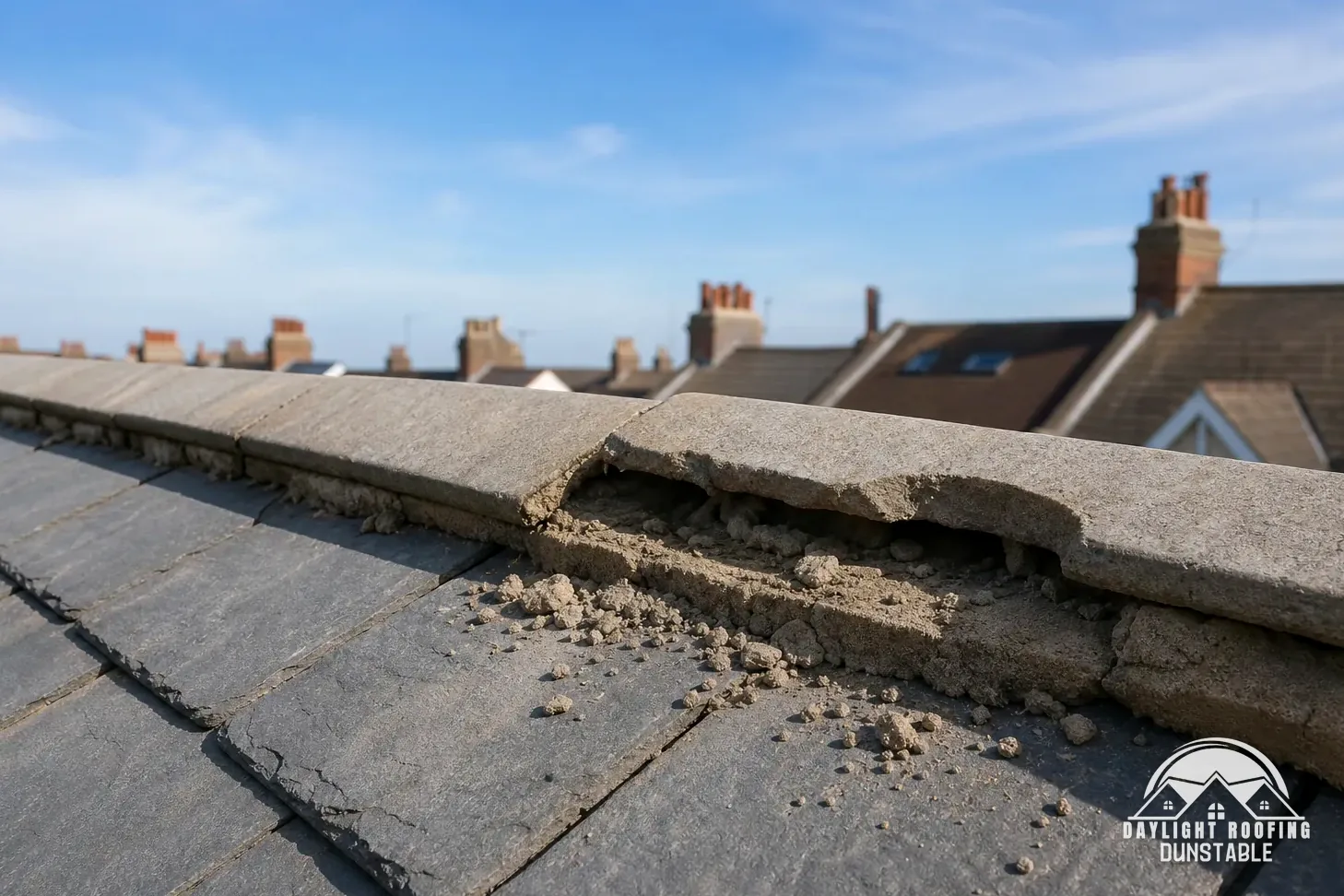
The short answer
The ridge of a slate roof is finished with a covering of its own: ridge tiles, a lead roll or a dry-fixed system. Whichever is used is mechanically fixed, as Marley advises for ridge and hip tiles, so it resists the calculated uplift of the wind, and the choice is made for the particular roof.
What the ridge is and what covers it
The ridge is the crest of a pitched roof, the line along which the two slopes meet. Slates stop short of it, because nothing sits above them to overlap, so a separate covering closes the gap and keeps rain out of the joint between the slopes. It is a cap along the whole length of that line.
The options for a slate roof depend on the roof and its look. Ridge tiles of clay or concrete sit over the top of the slopes. A roll of lead can be dressed over the ridge. Dry-fixed ridge systems are made for the purpose and are held by clips or screws instead of mortar. A roofer chooses among them for the roof's pitch and character, and the choice is named in the specification behind the quote.
Each option has to do the same jobs: shed water from the top of the roof, allow the roof space to breathe where it is designed to, and stay put in the wind. A ridge that looks neat but is poorly fixed becomes a hazard once a gale arrives, because a ridge tile or section that comes loose can fall to the ground below.
Fixing, standards and the role of mortar
Marley says that ridge or hip tiles, in all cases, should be "mechanically fixed to resist the calculated wind uplift force". It adds that since the 2015 amendments to BS 5534, mortar "could no longer be relied upon as the only means of securing the roof covering". Mortar may still bed a ridge tile, but a mechanical fixing is expected alongside it.
| Standard | What it covers |
|---|---|
| BS 5534:2014+A2:2018 | Slating and tiling for pitched roofs, current |
| BS 8612:2018 | Dry-fixed systems covering ridges, hips and verges, current |
BS 5534 is a code of practice, and Marley points out that installing to it "isn't required by law". It is still the reference a ridge is specified against. The fixings are worked out for the individual site and its exposure, so the ridge on one house may be fixed differently from the ridge on the next.
The slate roofs and Building Regulations guide covers the approval side of re-roofing, which includes the ridge when it is part of a full re-slate. Where only the ridge is being redone, the repair is smaller, but the same fixing principles still apply and the same standards are the reference.
What a ridge costs and when it needs attention
Two sources give figures for ridge tile work, and they differ. For a new ridge tile, Which? Trusted Traders give £80 to £300 (VAT excluded), from a survey of 11 traders in November 2025. MyJobQuote says that in 2026 the average ridge tile replacement costs between £225 and £550 (page dated 1 October 2026). Both are third-party ranges for tile replacement, not prices for a particular roof.
Ridge figures do not stand in for hips, which are priced after a survey. The total is written down once the survey is done, and it is never a sum of per-metre rates.
Signs that a ridge needs a look include cracked or missing tiles, mortar crumbling out of the joints, a ridge line that no longer runs straight and slates close to the ridge that have shifted. Some are visible from the ground with binoculars. The slate roof problems guide lists related faults, and the repair or replace a slate roof guide helps weigh a repair against more. A photograph sent to 07880 284133 on WhatsApp starts a conversation, and the slate roofing page describes our work. Fixing problems here can show up as rattling in wind or a ridge that looks slightly out of line.