
Call 01582 935272

Dinton · 21 road miles west

Roofers in Dinton

Roof repairs, re-covering and rainwater work for Dinton, Upton, Westlington and Gibraltar, the roof being surveyed before a single total is put in writing.

Get a written quote

Call 01582 935272WhatsApp us

Council
Buckinghamshire
Road miles
21
Conservation area
Dinton, Westlington, Upton and Gibraltar
Building control
Buckinghamshire Council

Roofs in Dinton, Westlington, Upton and Gibraltar

Dinton is a Buckinghamshire village 20.9 road miles west of Dunstable, roughly 39 minutes by car. Its parish, Dinton-with-Ford and Upton, had 814 usual residents at the 2021 Census, so this is a small place where one roof stands out and a neighbour's job is easy to compare with yours. Buckinghamshire Council, as local planning authority, designated the Dinton, Westlington, Upton and Gibraltar conservation area, and the village also holds Grade I and Grade II* listed buildings. On a narrow lane a scaffold can affect the neighbours, so where it would stand is worth settling early.

That mix means a Dinton roof job can begin with a question about the address and ends with a question about the covering. We survey before quoting, put what we find to you in plain words, and give one written total price. Whether the answer is a repair to a patch of tiles or a pitched roof stripped and re-covered, the survey is what decides it, not a guess from the road.

  1. 01Dinton Hall and CastleBoth are listed Grade II* (entries 1158977 and 1118308), first listed on 25 October 1951, so listed building rules govern any roof work to them.
  2. 02Cottages and Grade II housesDinton Cottage is Grade II (entry 1118294); work on a listed cottage roof turns on whether it would alter the building's character.
  3. 03Parish church roofSaints Peter and Paul is Grade I and Church of England, so repairs follow the faculty system, not listed building consent.
  4. 04Moated site near DintonA scheduled monument, list entry 1018731. Works to scheduled land are authorised separately and are not a roofing matter.
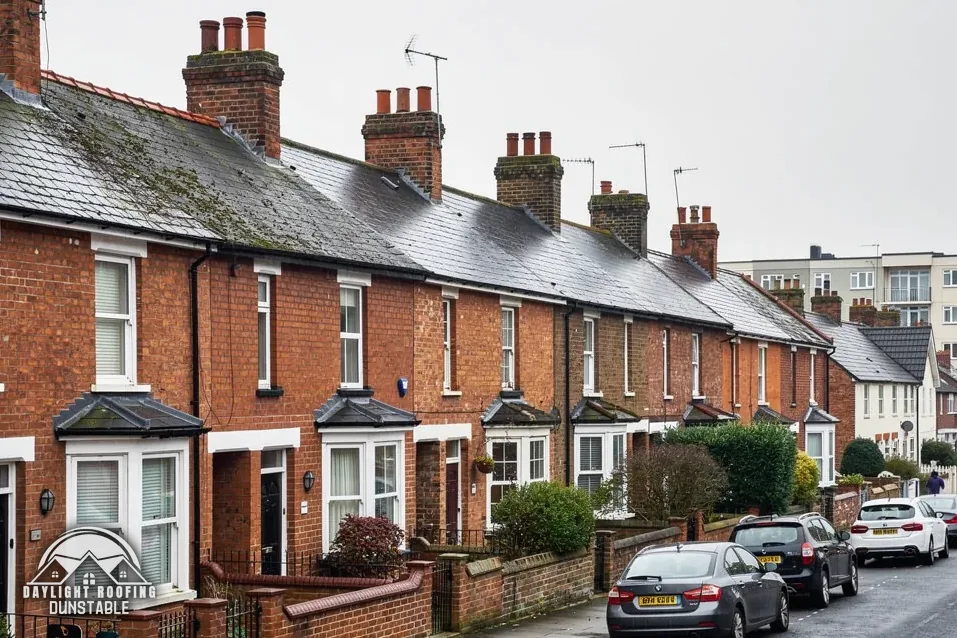
A Victorian brick terrace with slate roofs and tall chimney stacks

Plain words for Dinton

Grade II*
A listing grade above Grade II, for a building of more than special interest.
Faculty
The Church of England's permission for changes to a church in use.
Batten
The thin timber strip that each row of tiles hangs from.
Valley
The sunken line, lined with lead or a trough, where roof planes angle in.

The plain-as-day roof check

What to look for before a Dinton roof fails

4 checks about 3 minutes to read

  1. Slipped and cracked tiles
  2. Valleys between slopes
  3. Fascia and soffit boards
  4. Signs from inside the loft

01 Slipped and cracked tiles

Walk the boundary of the house and scan each slope for one tile hanging lower than the rest of its row, a shadowed hole in the pattern, or pieces of tile on the ground below. A tile slips when the nail or clip that holds it has corroded or snapped, so one that has moved tells you something about the fixings next to it, not only about itself. Binoculars on a bright day show the edges of each tile far better than the naked eye, and a phone photo zoomed in later shows more still.

Cracked tiles let rain through to the underlay and the battens beneath. The survey counts how many tiles are affected and where they are, and that count is what separates a small repair from a covering that has reached the end of what patching can do. A roof's age alone does not condemn a covering: it is judged on its condition, tile by tile and course by course. If the damaged area is small and the tiles are still available to match, a repair costs less than a re-cover; if the tiles are no longer made, the survey establishes that and the closest substitute is chosen.

02 Valleys between slopes

Two slopes that meet in an inward corner share a valley, the gutter-like gully that takes the run-off of both. The lining can be sheet lead, a plastic or glass-fibre trough, or special tiles bedded in mortar. Look for moss or leaves packed along the channel, a split in the lining, or a ceiling stain that follows the line of the valley indoors. Lead-lined valleys are sound for long periods, but the lead can crack where it has been walked on or where it was dressed too tightly into the corner.

Because a valley collects a large share of the roof's water into one narrow path, a small tear does more harm there than the same tear on an open slope. Debris should be cleared carefully by hand, and a damaged lining is replaced rather than painted over, since a coating on a split trough does not close the split. After clearing, run water from a hose down the valley and watch where it goes: it should leave the bottom of the channel cleanly, not pool or soak into the adjoining courses.

03 Fascia and soffit boards

Along the roof edge, the fascia takes the gutter's fixings and the soffit closes the gap under the overhang. Look for blistered or lifting paint, a board belly-ing out from the wall, or a dark crack along the joint. Soft timber shows when a screwdriver tip sinks into it. The ends of rafters sit behind the fascia, so rot in the board can run back into the timbers that carry the roof edge.

A uPVC roofline can be fitted in place of rotten boards. For uPVC fascia boards, a retailer puts the span of reliable performance at between 20 and 40 years when they are installed correctly, and says they can "typically" reach it. Where the house is listed, or stands within the conservation area, timber against plastic is a question for Buckinghamshire Council before any boards come off. Gutters that are fixed to the fascia also lose their fall when the board moves, so the boards and the gutter are looked at together.

04 Signs from inside the loft

You can learn a good deal without climbing on the roof. After heavy rain, look into the loft with a torch from the hatch, without stepping off the joists. Daylight showing through the covering, a damp patch showing on the under face of the boards or felt, or water marks on a rafter all point to where the roof is letting water in. Do not walk on the boards or the ceiling plaster between joists, and keep a hand on the hatch frame; a torch and a phone camera are all the equipment you need.

Wet insulation matters because it stops doing its job and holds moisture against timber. Note where each mark is, relative to the chimney or the eaves, and say so when you ring: it lets us tie what you saw inside to what the survey finds outside, and keeps the written price tied to the right part of the roof. Roof windows and skylights show up differently, as a ring on the lining around the opening, and that is worth noting too.

The dashed ring takes in the nearest towns and villages we cover around Dinton. Map tiles © Esri; map data © OpenStreetMap contributors.

Dinton roof questions, answered one by one

01How do you decide between patching a Dinton roof and re-covering it?

The survey looks at how widespread the damage is. A handful of slipped tiles, a failed flashing or one lifted ridge section points to repair. Cracking spread across a slope, fixings that have corroded along whole courses or battens that have gone soft points to re-covering. The finding is given in plain words, with any other fault we spotted along the way, so the two options can be compared on the page rather than argued over on the doorstep. If you can describe where the first stain showed up inside, that points us to the right slope quickly.

02Which parts of Dinton are in the conservation area?

Buckinghamshire Council designated the Dinton, Westlington, Upton and Gibraltar Conservation Area. Where its boundary runs is for Buckinghamshire Council to say, and two houses facing each other across a lane may fall on different sides of it. Anything that changes how the roof appears, be it a new covering or a new opening in a slope, is worth raising with the council before anything is ordered. Our planning permission guide explains how the rules shift in protected areas. Taking a photograph of each elevation of the house, from the road, before you speak to the council, saves a round of questions. That includes a pair of semi-detached houses where only one is covered, a point the council can confirm.

03What changes if my Dinton house is next to Dinton Hall or Dinton Castle?

Being near a listed building does not by itself list your house. Dinton Hall (Grade II*, list entry 1158977) and Dinton Castle (Grade II*, entry 1118308) are each listed in their own right, and Dinton Cottage is Grade II (entry 1118294). Your own roof is treated as listed only if your own house is. For a neighbouring address that is not listed, the question is whether it lies within the conservation area, and Buckinghamshire Council can say. Your own deeds or the council can confirm whether anything on the property has been listed, and listing is a question that changes the roof rules.

04Which consent route covers the parish church roof in Dinton?

The Parish Church of Saints Peter and Paul is Grade I (list entry 1319069, first listed 21 December 1967) and is a Church of England church. Churches of that denomination in use are covered by the faculty system and not by listed building consent. For certain matching repairs, the archdeacon's written notice may be enough. Work to the outside can still raise a planning question, which goes to Buckinghamshire Council. The archdeacon's notice route is for like-for-like work, so a change of covering material would be treated differently from replacing worn tiles with identical ones. Where there is doubt, the council and the church are asked together, not in turn.

05Is the moated site near Dinton relevant to my roof?

A moated site near Dinton is a scheduled monument (list entry 1018731). A house roof is not part of it, so ordinary roofing does not come under scheduled monument rules. Where works would touch scheduled land itself, they must be authorised; consent is a decision for the Secretary of State, with Historic England receiving the applications. Scheduled monument consent is a separate route from listed building consent, and a roofer should never start on land like that without it. Mentioning the scheduled land in your first call lets us plan around it from the start. A roofer working beside such land stays on the house and its own boundary.

06When does a Dinton scaffold need a highway licence?

A scaffold that will stand on the footway or carriageway is licensed by Buckinghamshire Council, the highway authority. Buckinghamshire Council charges £402.78 for 28 days, with a renewal at £69.09, and a retrospective licence costs £777.63. On who may apply, Buckinghamshire Council states: "You must be a registered scaffolding company to apply for a licence." We arrange the licence with our scaffolder. Scaffolding kept wholly within your own boundary is not a highway matter. Say at the survey where the scaffold would need to stand, because the position of the frame decides whether a licence is wanted at all. The renewal price applies only where a job runs past the 28 days the first licence covers.

07Do I need a party wall notice to take out a chimney breast in Dinton?

Where the chimney breast is on a party wall, yes. The notice is the building owner's to serve, and it must be served on the neighbour at least two months before work starts, since removing a chimney breast from a party wall counts as work to a party structure. If the neighbour consents in writing, work can start earlier. A surveyor is needed only if the neighbour dissents or does not reply within 14 days. Separately, removing a chimney breast always needs Building Regulations approval, because it is part of the structure. Party wall questions go to a party wall surveyor, not to building control, so do not wait for the council to raise it. A written consent from the neighbour, signed and dated, is the document that matters.

08Could the old garage roof at my Dinton house contain asbestos?

HSE's rule of thumb is: "If the building was built or refurbished before 2000, assume that there is asbestos in it." It also says "AC roofs are always fragile", so do not walk on a sheet roof. HSE treats cement sheeting that is lifted off whole as non-licensed work, while sheets that have been broken up fall into a different category. For the waste, HSE says to use a lockable skip, not an open one. Ask before disturbing anything. If you are not sure of the age of the roof, treat it as suspect and leave it undisturbed until it has been identified. Never sweep, drill or break up sheets, and keep children and animals well back from them.

09What should I do first when a storm lifts tiles in Dinton?

Photograph the damage before anything is moved, from the ground, and keep the photos. The Financial Ombudsman Service says it will usually look at expert reports and photos, so they help if you claim. Tell your insurer promptly. The ombudsman's own rule is that "For most complaints, a business has up to 8 weeks to consider a complaint" before you can escalate it. The repair itself is worked out after a survey of the roof. Keep a note of the date and time the damage was found, because an insurer will ask.

Get a written price for your roof

10-year workmanship guarantee, in writing

Tell us about your roof

Call WhatsApp Written quote