
Call 01582 935272

Longwick · 21 road miles south-west

Roofers in Longwick

Roof repairs, replacements and roofline work for homes in Longwick and Ilmer, with every roof looked over before any figure is given, and that figure written down as a single total.

Get a written quote

Call 01582 935272WhatsApp us

Council
Buckinghamshire
Road miles
21
Building control
Buckinghamshire Council

Roofs in Longwick-cum-Ilmer, parish by parish

Longwick is 20.6 road miles from Dunstable, in the south-west direction, with a drive of about 37 minutes, and its parish, Longwick-cum-Ilmer, had 1,763 usual residents at the 2021 Census. Buckinghamshire Council is the local planning authority, so any question about permission for outside work goes to its planning team. The village has several listed buildings, among them The Red Lion Public House and Chestnut Farmhouse, and that shapes the first question on any job: which rules touch this particular address? Parish figures count everyone in the civil parish, which takes in Ilmer as well as Longwick itself, so the number says more about the area than about any one street.

The survey comes before the quote, and what it turns up, anything else we spotted up there included, is put to you in plain words. A small roof repair and a full replacement start the same way, with the survey, and one written total price comes after it. Work to a chimney, a flat-roofed extension or the gutters is looked at in the same visit, so the quote reflects the whole roof and not only the part you pointed to.

  1. 01Listed village buildingsThe Red Lion Public House, Sara's Cottage and the Old Orchard, and Chestnut Farmhouse are all Grade II, so roof work on them is a listed building matter.
  2. 02Baptist Chapel roofGrade II, list entry 1159247. Because it is a Baptist church, its consent route is one to check with the church and the council.
  3. 03Ridge, hips and vergesThe lines along the top and side edges of a roof are where bedding and fixings are tested by wind and by age.
  4. 04Gutters and downpipesRainwater goods carry the roof's run-off clear of the walls; sagging runs, loose brackets and blocked outlets all let water down the brickwork.
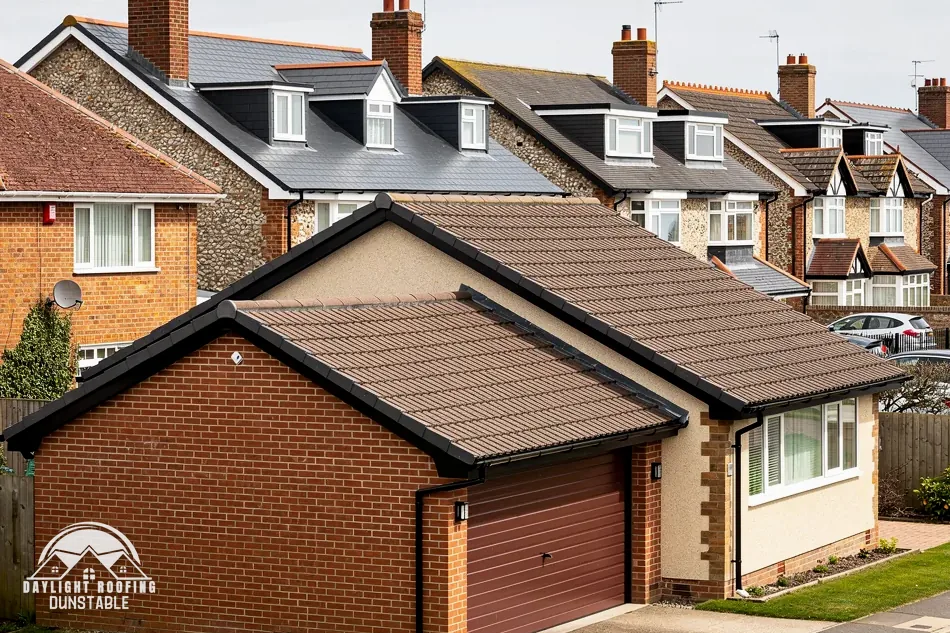
A detached brick garage with a newly re-tiled pitched roof

Longwick terms, in plain words

Grade II
A listing grade for a building of special interest; roof work can need listed building consent.
Article 4 direction
A council direction that withdraws some permitted development rights, so an extra application can be needed.
Scaffold licence
Council permission to put scaffolding on a pavement or road.
Verge
The tiled or boarded edge down the side of a gabled roof.

The plain-as-day roof check

Looking up at a Longwick roof: four checks

4 checks about 3 minutes to read

  1. The ridge line
  2. Verges and gable edges
  3. Flashings by the chimney
  4. Eaves and the rainwater run

01 The ridge line

Stand back from the house, in the lane or the garden, and sight along the ridge. One that dips, or ridge tiles sitting at different heights, points to bedding that has let go beneath them. Gaps between tiles and crumbling joints can let rain reach the ridge board and the tops of the rafters, and a pair of binoculars shows more than the naked eye does from the ground.

BS 5534 is a code of practice, not law, but since its 2015 amendments mortar alone is no longer relied on to secure the roof covering. Ridge and hip tiles need mechanical fixings that resist the uplift calculated for that particular roof, so a sound repair rebuilds the bedding and adds proper fixings rather than topping up old mortar. Hips, the sloping lines where two slopes meet at an outward corner, get the same treatment, and a cracked ridge tile is replaced rather than glued. Where a ridge line is straight and the joints are sound, leave it alone: a repair that is not needed is money wasted.

02 Verges and gable edges

The verge is where a roof ends at the gable, and the last course of tiles is held by a bed of mortar or by a dry-fixed verge system made to BS 8612. Look for tiles that have shifted outward, mortar that has fallen away in lumps, or green growth along the edge, which holds damp against the timber behind it. Where the verge has pulled away from the wall, rain can run down inside the gable. Where a verge meets a porch or an extension roof, the junction is worth a closer look because two sets of tiles and a flashing meet in a small space.

The verge takes wind from the side as well as from above, which is why a loose verge tile is worth dealing with before the next gale. If a verge needs rebuilding, the survey establishes how many courses are affected and the whole edge is dealt with as one piece of work. The barge board or the cloaking tile beneath the edge is looked at for rot while the verge is open, because a new edge fixed to soft timber will not hold.

03 Flashings by the chimney

At the point where a stack comes up through the slope, a strip of lead is dressed over the tiles and turned into the brickwork. Look for lead lifting at its upper edge, a gap between the lead and the mortar line, or brown damp patches on the breast indoors. Cracked flaunching, the mortar cap round the pots, lets water into the stack from above and shows as dark patches on the brick below.

MyJobQuote says correctly installed lead flashing can last for over 80 years, which makes a lifted flashing a fault in how it was fixed or what it was made from, not only a question of age. Chimney leadwork is a repair in its own right, covered on our chimney repairs page, and it is looked at in the same visit as the remainder of the roof. A stack that has been disused for years still needs its flashing and flaunching kept watertight, since the roof round it carries on shedding water either way.

04 Eaves and the rainwater run

Follow a downpipe from the roof edge to the ground after a wet spell. Brickwork that stays dark below a joint, water left standing in a gutter or a downpipe that has pulled away from its bracket each tell you where run-off is leaving the intended route. A tide mark on the wall below the eaves is worth photographing, and a photo sent through WhatsApp is enough to start a conversation. Gutters on a long rear extension, where one run carries water from a wide slope, have more work to do than a short run on a porch.

A gutter is laid to fall towards its outlet, and Brett Martin gives 1 mm for every 600 mm. One that sags between brackets holds water however clean it is. The fascia and soffit boards behind the gutter take the damage when a run keeps spilling, and those boards are checked at the same visit, since replacing a gutter in front of rotten timber fixes nothing at all.

The dashed ring takes in the nearest towns and villages we cover around Longwick. Map tiles © Esri; map data © OpenStreetMap contributors.

Longwick roofs: your questions answered

01What does a survey of a Longwick roof look at?

The survey covers every slope you can reach or see: the tiles or slates, the top line of the roof, the gable edges, the metalwork round chimneys and walls, and the gutters and fascias at the eaves. You hear in plain words what the survey found, along with any other fault spotted that you did not ask about, and the quote that comes afterwards is a single sum in writing. If your roof has a stack, a roof window or a flat-roofed extension, each of those is looked at too, so nothing on the roof is left out of the price. The same visit shows whether a repair will do or whether the whole covering has had its day.

02How does a Grade II listing change roof work in Longwick?

Listed buildings in the village include The Red Lion Public House (Grade II, list entry 1332037, first listed 21 June 1955), Sara's Cottage and the Old Orchard (Grade II, entry 1125843) and Chestnut Farmhouse (Grade II, entry 1125872). Work on a listed building needs listed building consent where it would be done "in any manner which would affect its character as a building of special architectural or historic interest". Which side of that line your repair falls on is checked with Buckinghamshire Council before work starts. Like-for-like work on a plain concrete garage roof or a modern extension is a different question from work to the listed buildings themselves.

03Which consent route applies to the Baptist Chapel roof?

The Baptist Chapel is Grade II (list entry 1159247, first listed 26 April 1985) and is a Baptist church. Where an ecclesiastical exemption applies it replaces listed building consent only. It does not replace planning permission, which can still be needed for work to the outside. Which route covers this chapel is a point for the church and Buckinghamshire Council to settle, so that question comes first, before any roofing contractor plans the work or orders materials for it. A parish or village group planning repairs should ask both bodies in writing and keep the replies. It is also worth finding out whether the building is held in a way that brings it inside the exemption at all.

04Is any part of Longwick inside a conservation area?

Meadle, Monks Risborough, Owlswick, Princes Risborough, Alscot, Horsenden and Ilmer all have conservation areas near Longwick. None of that puts a particular street inside one, and the line that counts runs round your own plot. Buckinghamshire Council designates the areas, so it is the body to ask about your address. Our planning permission guide sets out how the roof rules change in protected areas, so it is worth reading before you decide what to ask the council. Ask the council which designation, if any, applies to the house.

05Does scaffolding for a Longwick re-roof need a council licence?

Pavement or road space taken by scaffold has to be licensed through the highway authority, which for Longwick is the council itself. Buckinghamshire Council says: "You must be a registered scaffolding company to apply for a licence." It lists £402.78 for 28 days, a renewal at £69.09 and a retrospective licence at £777.63. We arrange the licence with our scaffolder. A frame that stays entirely on your own drive or lawn never reaches the highway and is a different matter. Say so early if the scaffold needs to stand on the road side of the house, because it is the road side that needs the permit.

06Does a full re-roof in Longwick need Building Regulations approval?

Under the Planning Portal's guide, work that goes past either limit, such as a full re-roof, needs Building Regulations approval. The limits are "Less than 25 per cent of the total 'building envelope'" and "Less than 50 per cent of the roof is affected", and a replacement covering that is "15 per cent or more" heavier than the old covering needs approval as well; a structural engineer or surveyor is asked beforehand. Buckinghamshire Council has its own building control service, and the council's website carries its contact details. If the covering is a new material, ask for it to be named in the written price so its weight can be checked against the old one.

07Could an Article 4 direction affect a roof in Longwick?

An Article 4 direction can remove further permitted development rights, so we check with the council first. Directions exist near the village, and a general guide cannot tell you what each removes at your house, because each is drawn for its own land. The question that settles it goes to Buckinghamshire Council: does an Article 4 direction cover your address? Ask before you seek a price for anything beyond a repair in matching materials, because the answer can change which application comes first. File the council's reply; it answers a question that later paperwork can raise.

08Does flood risk matter for roof drainage in Longwick?

GOV.UK's long-term flood risk service describes an area's risk and says nothing certain about one house, so treat it as a starting point rather than a ruling. For a planning application, the Environment Agency's flood map for planning shows a site's flood zone. Drainage from the roof is about getting run-off away from the walls and into a sound gutter and downpipe, and the state of that run is something we look at during the survey of your roof, along with where the downpipes discharge at the foot of the wall. If a loft hatch is stained or a ceiling shows a ring after rain, mention it, because it narrows down where the water is coming in.

09Can I send a photo of a damaged Longwick roof on WhatsApp first?

Yes. Send a photo to 07880 284133 and it gets looked at. A photo helps with a slipped tile, a hanging gutter or a stained ceiling, but it cannot show the whole roof, so a survey still comes before any quote. You can also call 01582 935272 or use the quote form on this page. Add the road name and a line on where the damage is, for example above the porch or on the rear slope, and a clear daylight shot from the garden is better than one taken from a window.

Get a written price for your roof

10-year workmanship guarantee, in writing

Tell us about your roof

Call WhatsApp Written quote