
Call 01582 935272

Stone · 19 road miles west

Roofers in Stone

Whatever is wrong with a Stone roof, from worn slate or tile to leaks, stacks and gutters, we go and look before putting one written total to you.

Get a written quote

Call 01582 935272WhatsApp us

Council
Buckinghamshire
Road miles
19
Conservation area
Stone
Building control
Buckinghamshire Council

Stone roofs, Grade II* church to listed cottage

Stone lies west of Dunstable, 19 road miles away, which is 35 minutes of driving. At the 2021 Census, Stone with Bishopstone and Hartwell parish had 2,698 usual residents. Questions on planning for roof work in the village belong with Buckinghamshire Council, and its building control team is the other port of call; the building control page on its website gives the route to reach it. The Planning Portal's rules are the yardstick for a re-roof in Stone. Buckinghamshire Council has designated a conservation area at Stone, so a roof change that alters what the street sees is worth raising with the council first. Permitted development limits are set out in the planning permission guide, which also deals with listed homes. The roof here is judged on its own survey.

Stone's heritage list entries are 1, Eythrope Road and Elm Cottage (Grade II, entries 1203964 and 1118459), the Base of Cross in Churchyard South of South Porch (Grade II, entry 1281439) and St John the Baptist's church, listed Grade II* (entry 1118457). We look at the roof before any price is set, and we mention whatever else shows up so that each item can be weighed. A WhatsApp photograph helps.

  1. 01St John the Baptist churchGrade II*; Church of England; a faculty matter in place of listed building consent.
  2. 021, Eythrope RoadGrade II (entry 1203964, first listed 11 October 1985); changes to its roof need a listed-building check first.
  3. 03Elm CottageGrade II (entry 1118459), also first listed on 11 October 1985, with the same consent rule on its roof.
  4. 04Cross base in the churchyardThe Base of Cross in Churchyard South of South Porch is Grade II (entry 1281439), set beside the church.
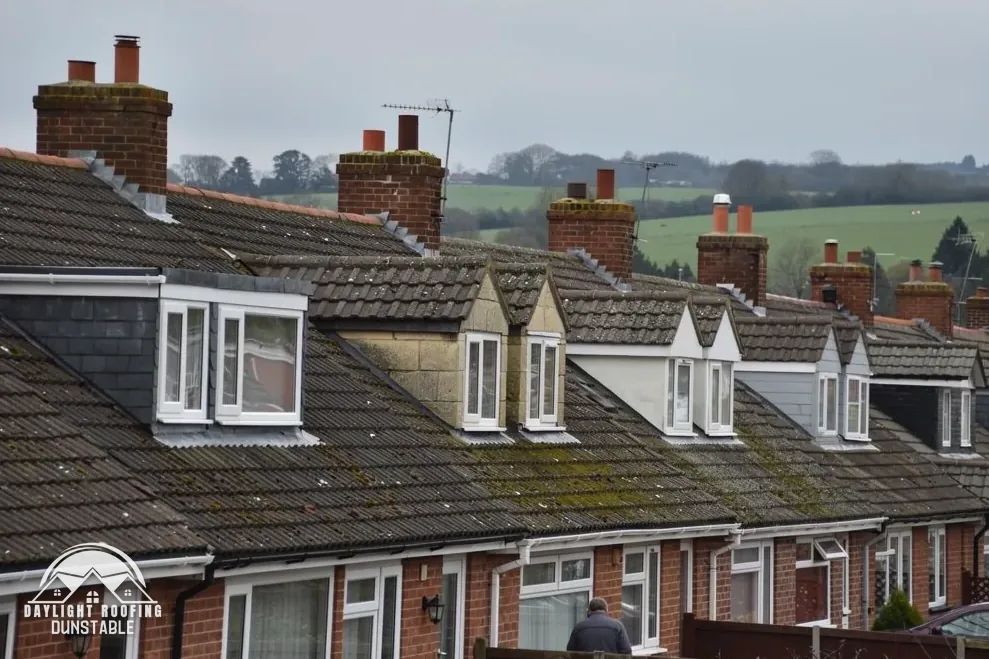
Concrete tiled estate rooftops towards green hills

The roof, in plain words

Headlap
How far one row of slates overlaps the row two below it.
Hopper
A funnel-shaped box that catches water from a gutter or pipe.
Standing seam
A raised joint between metal roof sheets.
Roost
A bat's resting place, protected by law.

The plain-as-day roof check

What the roofs of Stone ask you to look at

4 checks about 3 minutes to read

  1. Slate fixings and headlap
  2. Zinc and metal extension roofs
  3. Hoppers and downpipes
  4. Bats and nests in the eaves

01 Slate fixings and headlap

Slates are held by nails or hooks and stay put because each row overlaps the next. From the ground, look for a slate sitting lower than the rest of its course, a gap that shows the batten, or a slate lying in the garden. Cupa's guidance sets out a 20-degree floor for natural slate under BS 5534, in moderate exposure, using a 500 mm slate with a 115 mm headlap, and it rules out hooks on pitches under 25 degrees. If you find a slate in the garden, keep it, because its size and thickness help identify the type and the supplier.

HomeBuilding's approximate lifespans run from 50-80 years for reclaimed Welsh slate through 75-100 for Spanish slate to 100+ for Welsh slate. A slate can outlast the nails that hold it, so a roof whose slates look sound may still need re-fixing. The slate roofing page describes the work, and the survey tells you which of its parts applies to your roof.

02 Zinc and metal extension roofs

A rear extension or dormer may carry a metal roof in sheets joined by raised seams. Look at the seams for lifting, at the fixings for corrosion and at the edges for open gaps. A stain on a ceiling can sit some way from the actual opening, because a smooth metal sheet carries water along it to the lowest joint before it drops through. Ponding on a flat section behind a parapet is worth a photograph too.

VMZinc states that, correctly designed and installed, a zinc roof can last in excess of 100 years. That is the maker's own statement, and the conditions matter: the substrate, the ventilation behind the sheets and the detailing at each junction all affect how long a metal roof lasts. Those are what a survey examines, along with the surface visible from the ground. If the sheets were laid over timber boards, the boards under a leak are worth checking for softness.

03 Hoppers and downpipes

A hopper collects water from a gutter or a flat roof and hands it to the downpipe. Look for leaves packed into the box, a pipe that is out of plumb and a joint that weeps down the wall. A blocked hopper overflows onto the wall below, so a green stain beneath it tells you the water has been leaving by the wrong route for some time. A hopper that has been painted over many times can hide a crack in the casting, so tap it and look for a hairline split.

Brett Martin gives a fall of 1 mm for every 600 mm towards the outlet, and the same logic applies to a long gutter feeding a single downpipe. Where a gutter serves a big roof, one outlet may be too few. The guttering, soffits and fascias work covers outlets and pipework. Gutters on a long single-storey run can need support at closer intervals than a short one.

04 Bats and nests in the eaves

An old roof can hold wildlife. Under section 1 of the Wildlife and Countryside Act 1981, a person commits an offence if they intentionally take, damage or destroy a wild bird's nest "while that nest is in use or being built". A bat roost that is damaged counts as an offence whatever the intent. Look at the eaves and the ridge at dusk for droppings below a gap, or for bats leaving. Lofts that have been left alone for a long time deserve the most careful look before any work begins.

Where bats are involved, GOV.UK puts roof repair and replacement among the jobs for which a Natural England licence may be required. Mention anything you have noticed when you book the survey, because it changes how and when work can be done. The roof survey is where such signs are looked at, and a licence question is raised with the right body, not guessed at.

The dashed ring takes in the nearest towns and villages we cover around Stone. Map tiles © Esri; map data © OpenStreetMap contributors.

Stone roofs, asked and answered

01What happens if my Stone house is listed?

Elm Cottage (entry 1118459) and 1, Eythrope Road (entry 1203964) are Grade II and were first listed on 11 October 1985. Listed buildings come under the Planning (Listed Buildings and Conservation Areas) Act 1990, which requires consent for work touching their character. Roofs, ridges, chimneys and rainwater goods can all be part of that character, so put any new covering or new roof window to Buckinghamshire Council, with the reply in hand before a contractor is booked. Photographs of the roof as it is today, with dates, record its condition.

02Which consent route covers the church roof?

St John the Baptist's carries a Grade II* listing (entry 1118457, first listed 21 December 1967), and it is a Church of England church. As a place of worship in use, St John's follows the faculty system, not listed building consent; swapping like for like on the roof can need nothing beyond a written notice from the archdeacon. Listed building consent is all that the exemption replaces, so ask the council whether outside work needs planning permission. The faculty system and the council are separate routes, and the church can tell you which one a particular piece of work takes.

03Is the cross base in the churchyard listed?

Yes. The Base of Cross in Churchyard South of South Porch is listed Grade II (entry 1281439). It sits within the churchyard and is a separate listing from the church itself. For any roof work on the church or nearby buildings, consent runs through the church's own system and the council, and the surroundings, including a listed structure in the yard, are part of what planners take into account when they consider a proposal. A churchyard structure is not a roof, but it shows how much of the setting is protected.

04What does Stone's conservation area mean for a re-roof?

The conservation area at Stone was designated by Buckinghamshire Council, which holds the map showing which addresses fall inside it. Work that keeps the same covering is treated differently from work that changes the roofline, so describe the plan to the council before you commit to anything. Inside a conservation area permitted development rights are tighter, and the planning guide lays out which roof jobs they touch. It helps to have a sketch of the proposed work to hand when you ring. A neighbour who has had a roof altered in the same area is a useful clue, though only the council can say whether the same route applies to you.

05Who arranges the scaffold licence in Stone?

The licence for a scaffold over a pavement or lane comes from the highway authority, and for Stone addresses that authority is the unitary council. Buckinghamshire Council sets the fee at £402.78 for 28 days, with a renewal at £69.09 and £777.63 where the licence is sought afterwards, and the application page reads "You must be a registered scaffolding company to apply for a licence." We arrange the licence with our scaffolder. Scaffold cost sits inside the written quote, which keeps the paperwork to one document.

06Does a re-roof in Stone need building control?

Under the Planning Portal's guide, no application is "normally" needed for re-roofing where the work affects "Less than 25 per cent of the total 'building envelope'" and "Less than 50 per cent of the roof is affected". A complete re-roof passes the 50 per cent roof limit on its own, and the Portal's main page says "In most situations, this work will need Building Regulations approval." The building control service of Buckinghamshire Council covers Stone, and its website has the contact route. The roof covering is only one of the elements that building control considers, and it can also look at insulation and structure. A patch repair on one slope sits well inside the Portal limits.

07What does spray foam removal cost?

In July 2026 Checkatrade gave around £3,200 for removal from a detached three-bedroom house and £50 to £75 per m2 for open-cell foam, with no VAT basis stated. DESNZ says that for mortgage providers, removal "will not always guarantee that they will still lend", and it advises specialist surveyor advice first. Whether removal is needed is a surveyor's question, and a roof survey from us describes only what can be seen on the slopes. If a loft hatch shows the underside of the roof coated in foam, photograph it and tell the surveyor. DESNZ also warns that improper removal could lead to further issues.

08Does NHBC cover a roof defect on a newer house?

Buildmark, NHBC's cover, comprises a builder warranty and NHBC guarantee for two years after completion and then eight years of insurance cover against defects to certain parts of the home. This protection is tied to the new-build contract, and the policy documents set out which parts it takes in. If your house is newer, read those documents before arranging repair work, so that you know what the cover takes in. The policy wording settles what is covered, and the completion date sets when each period began. That is the order of events for a house still inside the scheme. Reading the policy documents early avoids delays.

09What does the law say about the quality of roof work?

Section 49 of the Consumer Rights Act 2015 carries the heading "Service to be performed with reasonable care and skill", and that duty applies to roof work as it does to any other service. If something goes wrong, the Citizens Advice consumer helpline on 0808 223 1133 gives guidance. Trading Standards does not advise individuals. Hold on to the written quote, messages and dated photographs, since they record what was agreed and the roof's state at each point. Any firm should be willing to explain in writing what it is proposing to do on each part of the roof.

Get a written price for your roof

10-year workmanship guarantee, in writing

Tell us about your roof

Call WhatsApp Written quote