
Call 01582 935272

Hughenden Valley · 23 road miles south-west

Roofers in Hughenden Valley

Leaks, loose tiles, chimney stacks and flat porch roofs in Hughenden Valley, surveyed before any quote and priced as a single written total.

Get a written quote

Call 01582 935272WhatsApp us

Council
Buckinghamshire
Road miles
23
Building control
Buckinghamshire Council

Coombe Farm barns and Hughenden Valley houses

Hughenden Valley is 23.4 road miles south-west of Dunstable, in Buckinghamshire; reckon on 41 minutes by road. The 2021 Census counted 8,265 usual residents in Hughenden parish. Buckinghamshire Council is the authority for planning and for building control, and the Chilterns National Landscape takes in the village. Applications are not sent to the Chilterns Conservation Board: it advises, and answers consultations, while the council makes the call. Conservation areas close by include West Wycombe, Terriers and Upper North Dean, so an individual address is one to check with Buckinghamshire Council.

Some roofs here belong to buildings with a listing attached, and the Coombe Farm barn is a case in point. Others are family houses with everyday faults: slipped tiles, tired flashings, a porch roof letting water in. The roof is surveyed before we quote, and we report back plainly on what is wrong and what else turned up. A repair can be enough for one failed junction, and a worn covering is replaced as part of a new roof.

  1. 01Boss Lane HouseListed Grade II (entry 1125781, first listed 4 July 1985); any roof alteration that touches its character needs listed building consent.
  2. 02Coombe FarmhouseGrade II listed under entry 1125782, which makes a roof repair there a conversation with Buckinghamshire Council before a tile is lifted.
  3. 03Barn at Coombe FarmThe barn to the south of Coombe Farmhouse is Grade II (entry 1365639, first listed 1 December 1978), with the same consent rules.
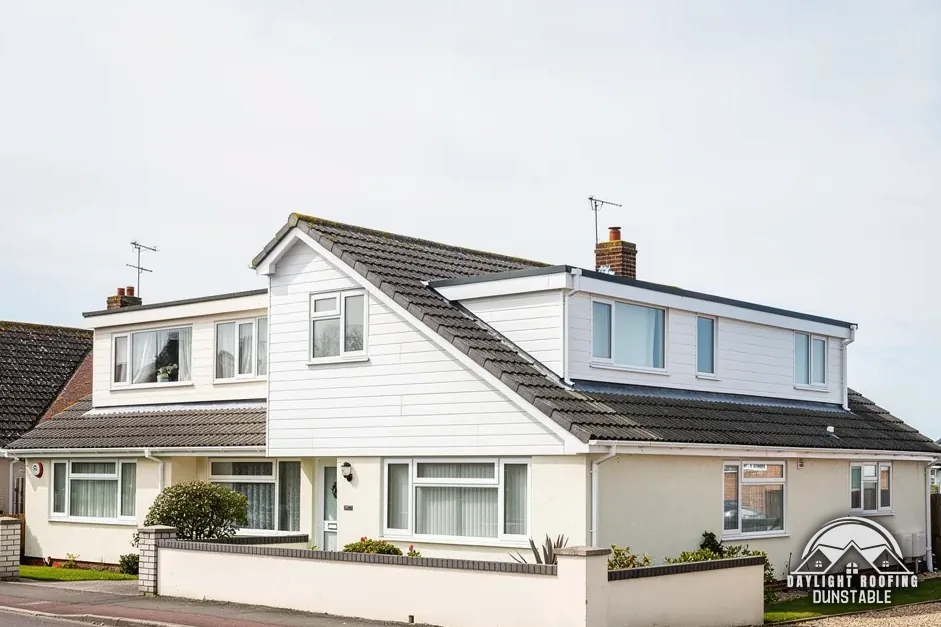
A pair of chalet bungalows with flat-roofed box dormers

Terms you may meet

Listed building consent
Approval required ahead of work altering the character of a listed building.
Flashing
Sheet metal, such as lead, that seals a roof against a wall or chimney.
Batten
A slim length of timber nailed over the rafters, carrying one row of tiles.
Fall
The slope that drains water off a flat roof or along a gutter.

The plain-as-day roof check

Four clues on a Hughenden Valley roof

4 checks about 3 minutes to read

  1. Tiles out of line
  2. Roof window surrounds
  3. Loft-side clues
  4. Porch and extension flats

01 Tiles out of line

A tile that has slid sits lower than its neighbours and breaks the straight line of its course. A cracked one shows a dark seam, and a missing one leaves a gap through which the underlay is visible. From the garden, scan every slope on a bright day and look at the ground beneath the eaves as well, since fragments land there. Tiles are held by nails or clips, and a slipped tile says that its own fixing has given way.

That is why the survey does not stop at the visible fault. The tiles either side of a slipped one share the same age and the same fixings, so they are tested by hand wherever that can be done safely. If only a few have moved and the covering is otherwise sound, a repair restores the roof. If fixings have failed across whole courses, patching is delaying a re-cover, and you are told plainly which of the two it is. Moss on a slope is worth noting as well: it holds damp against tiles and clips, so its position on the roof tells us where water lingers.

02 Roof window surrounds

A roof window or rooflight is a hole in the roof with a frame fitted into it, and the frame's surround is where a leak can start. Look at the flashing kit around the glass: lead or aluminium that has lifted at a corner, sealant that has split, or a stain on the reveal inside. The glazed unit itself can be perfectly sound while the weatherproofing round it has failed.

Approved Document L treats a rooflight as a glazed unit "out of plane with the surface of the roof on a kerb or upstand", while a roof window sits "in the same orientation as, and in plane with, the surrounding roof". Which one you have matters if the unit is ever replaced, because the two are measured against different thermal figures. Photograph the surround from inside and out, and send the pictures with the make if you know it. A job on the unit starts from that picture.

03 Loft-side clues

Rain that gets in does not drip where the damage is. It runs along a rafter or the underlay and drops somewhere else, so a ceiling stain can sit a metre from the hole. A torch from the hatch, held without stepping off the joists, shows daylight through the covering, dark rings on timber, wet insulation or a tide mark on the felt. Do these checks after rain, and photograph what you see.

Hold the picture up against the outside as you describe it: this stain sits below the chimney, that mark is under the valley. Such a note gives the survey somewhere to start, and a stain under a chimney points to flashing before it points to tiles. Any timber that feels soft under a fingertip, or insulation that is damp to the touch, goes into the description too, because both show how long water has been getting in. A photograph of each, with something in the frame for scale, makes the written description easier to match to a slope.

04 Porch and extension flats

Small flat roofs over porches, bay windows and extensions have fewer places to hide a fault. Look for water that stands after rain, a blister or split in the membrane, an upstand at the wall that has come away, or a bubble of moss in a corner. A flat roof drains only if it has fall, and a hollow that stays wet for a day shows that the fall has been lost.

Sources disagree on how long flat coverings last: HomeBuilding gives EPDM 25-30 years, GRP 25-30 years and felt 10-15 years, where Less gives EPDM 30 to 50, GRP 25 to 40 and torch-on felt 10 to 20 years depending on quality and installation. Neither figure is a promise for your roof. A survey reads the condition of the membrane, the upstands and the outlet, and a flat roof that is sound apart from one junction needs only that junction put right.

The dashed ring takes in the nearest towns and villages we cover around Hughenden Valley. Map tiles © Esri; map data © OpenStreetMap contributors.

Coombe Farm, foam and dormers in Hughenden Valley

01Why would a Hughenden Valley ceiling stain sit away from the damaged tile?

Water that passes the covering lands on the underlay or a rafter and then follows the timber or the felt downhill, so it can reach the ceiling some distance from where it got in. A stain below a chimney may be a flashing fault two metres away. That is the reason a survey works from the outside inwards, and why it helps to write down where the stain sits. Tell us whether it grows after rain or stays the same size, since a stain that spreads while the weather is dry points to something other than a roof leak, such as condensation or a pipe. If the mark is new, a picture sent by WhatsApp gives us something to read before anyone visits.

02Does the Coombe Farm barn roof count as a listed building matter?

Yes. The barn to the south of Coombe Farmhouse is Grade II (list entry 1365639, first listed 1 December 1978), as is the farmhouse itself (entry 1125782), and so is Boss Lane House (entry 1125781). Alterations carried out "in any manner which would affect its character as a building of special architectural or historic interest" call for listed building consent. Repairs in matching materials are still talked through with Buckinghamshire Council beforehand, and we raise the question at the survey, before any tile is moved.

03Will a conservation area near Terriers or West Wycombe affect my house?

Only if your house lies within one, and the answer sits with Buckinghamshire Council. West Wycombe, Terriers and Upper North Dean are conservation areas close to Hughenden Valley, but closeness does not place a house in them. Article 4 entries lie near the village too; Buckinghamshire Council alone can say what each of them removes. Before any change that alters how a roof looks, we ask Buckinghamshire Council whether an Article 4 direction applies. A like-for-like repair in matching tiles is the simple case, and a new material or a new opening is the one to raise early.

04What changes when a chimney breast comes out?

Two things. Building regulations approval will always apply when removing chimney breasts, in the Planning Portal's words, because the breast is part of the building's structure. And where it stands on a party wall, notice from the owner has to go out at least two months before the work: the Act says it must "be served at least two months before the date on which the proposed work will begin". Neighbour disputes go to a party wall surveyor, not to building control, and a neighbour's written consent to an earlier start is the document that counts. The roof above the breast is looked at on the same survey, since the stack and its flashings are affected by the removal.

05What does scaffolding cost the customer in licence terms here?

Buckinghamshire Council licenses scaffold that blocks a footway or the road. Its published charge is £402.78 for 28 days, £69.09 to renew and £777.63 if the licence is retrospective, and Buckinghamshire Council states that "You must be a registered scaffolding company to apply for a licence." We arrange the licence with our scaffolder, and the written quote is the single total. A drive-side frame that never leaves your own land does not need a licence at all, which is worth saying at the survey.

06Could dormer plans be affected by the Chilterns designation?

They could. Hughenden Valley is inside the Chilterns National Landscape, and any application for the roof still goes to Buckinghamshire Council; the Chilterns Conservation Board only comments. Our planning permission guide sets out the rules for each case. For the Chilterns' traditional buildings, the Board's published notes find plain clay tiles "universally predominant", which describes the landscape's older buildings and is not a requirement placed on your roof. Where a roof is being re-covered, ask Buckinghamshire Council whether a listing or an Article 4 direction touches that particular house, and file its reply alongside the quote. A written note from the council settles any later doubt about what was agreed.

07Is sprayed foam under the rafters a problem when selling?

It can raise questions, and the wording matters. DESNZ says: "Many mortgage providers are open to lending on properties with spray foam, subject to their own requirements." The Energy Saving Trust adds that foam "doesn't automatically prevent you from getting a mortgage, but some lenders may ask for extra checks". Removing it "will not always guarantee that they will still lend", and DESNZ points to advice from a specialist surveyor. Look at the foam and the paperwork before any sale, and ask a surveyor to read both.

08Do bats or nesting birds stop roof work?

They can. The Wildlife and Countryside Act 1981 is aimed at anyone who "takes, damages or destroys the nest of any wild bird while that nest is in use or being built", and damaging or destroying a bat roost is an offence regardless of intent. Where bats are present, work of the kind covered by "repairing or replacing a roof" can need a Natural England licence, so a bat sighting changes the plan for the job. If you have seen bats at dusk, or a nest tucked under the eaves, say so at the survey so that the work is planned around it.

09Is there a way out if I change my mind after signing?

When a roofing contract follows a survey at your own home, you can cancel it, and "the cancellation period ends at the end of 14 days after the day on which the contract is entered into". Starting inside that window needs your request in writing; asking does not cost you the cancellation right, but a bill for what is already done can follow. A repair visit you asked us to make because of an urgent leak sits outside the right, so the point is worth settling before you book one.

Get a written price for your roof

10-year workmanship guarantee, in writing

Tell us about your roof

Call WhatsApp Written quote