
Call 01582 935272

Walter's Ash · 23 road miles south-west

Roofers in Walter's Ash

Tile repairs, new coverings and chimney work for Walter's Ash houses, farm buildings and sheds, each roof looked over first and the job priced as one written total.

Get a written quote

Call 01582 935272WhatsApp us

Council
Buckinghamshire
Road miles
23
Building control
Buckinghamshire Council

Farmhouse, barn and house roofs in Walter's Ash

Walter's Ash is a village in Buckinghamshire. By road it is 23.2 miles south-west of Dunstable and takes about 43 minutes to reach. It lies in Hughenden parish, which had 8,265 usual residents at the 2021 Census. Buckinghamshire Council receives planning applications from Walter's Ash, and Walter's Ash itself lies inside the Chilterns National Landscape. That status leaves the route untouched: an application still lands with the council, and the board that conserves the Chilterns offers opinions when consulted but takes no decisions. Conservation areas lie close by, among them Bradenham and Downley Common, so a question about one particular address belongs with Buckinghamshire Council.

Walters Ash Farmhouse and the barns beside it are listed, so a roof on an old farm building here can raise a heritage question before it raises a roofing one. On an ordinary house the order is plainer: we survey the roof before quoting, study the covering, the fixings and each junction, and give you one written total price. A pitched roof that has run its course is stripped and re-covered, while a patch of failed tiles may call only for a repair.

  1. 01Walters Ash FarmhouseListed Grade II (entry 1125751, first listed 4 July 1985); any roof change is weighed against what gives the farmhouse its character.
  2. 02Barn and stable beside itThe barn and stable north of the farmhouse are Grade II (entry 1160449, first listed 4 July 1985), governed by the same listed building rules.
  3. 03Barn by Moseley LodgeA barn 25 metres north-west of Moseley Lodge is Grade II (entry 1310588); a change to its roof starts with listed building consent.
  4. 04Grim's Ditch earthworkA 660m section west of the village is a scheduled monument (entry 1021193); anything done there is authorised separately from roofing.
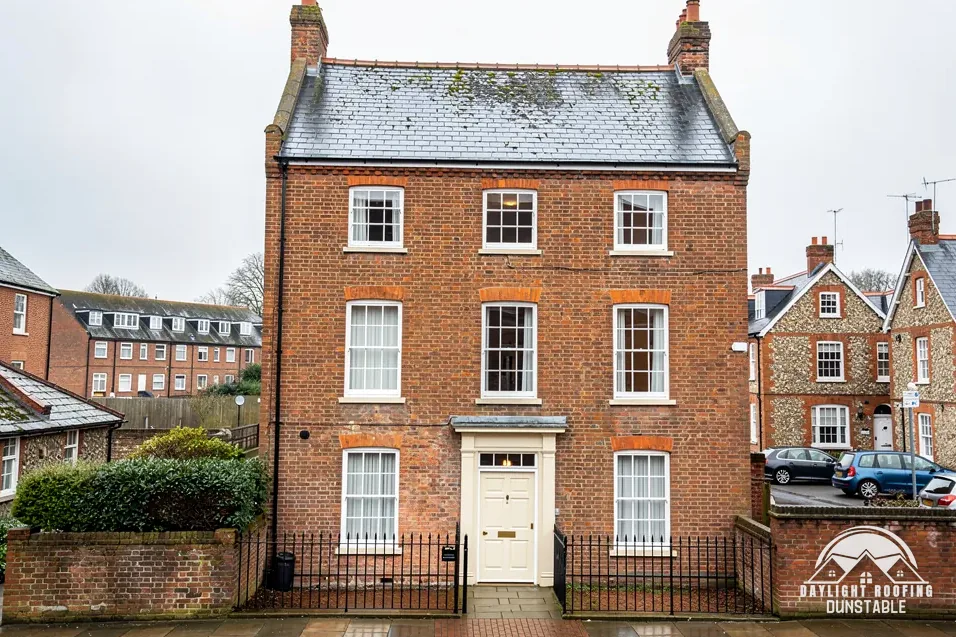
A Georgian-style brick house with a slate roof and two chimneys

Plain words for the village

Grade II
Protected status for a building of special interest; consent covers roof changes affecting its character.
Scheduled monument
An ancient site under national protection, where works need authorising before they begin.
Underlay
The sheet laid beneath tiles to carry off whatever slips past the covering.
Verge
The sloping roof edge beside a gable wall, sealed to the wall with mortar or clips.

The plain-as-day roof check

A ground-level look at your Walter's Ash roof

4 checks about 3 minutes to read

  1. Caps along the ridge
  2. Barn and shed sheets
  3. Stack, pot and flashing
  4. Gutter runs and eaves boards

01 Caps along the ridge

From the lane, or the far side of the garden, run your eye along the top of each slope. A ridge is a straight line, and the caps on it sit tight together with no gaps between them and no crumbs of mortar lying on the slope below. Cracked caps and missing bedding both show clearly from the ground, and so does a line of moss, which holds damp against the bedding beneath it. Hip tiles, the capping down the sloping corner where two planes meet, wear in just the same way, and the survey takes them in the same pass.

Marley says that since the 2015 amendments mortar "could no longer be relied upon as the only means of securing the roof covering", and ridge and hip tiles are held on with fixings chosen for the wind uplift that each roof is calculated to face. A ridge with loose caps may therefore need re-bedding and fixing, not simply a trowel of fresh mortar. Binoculars help, so does the zoom on a phone, and a picture of whatever looks wrong is welcome on our WhatsApp before you book anything.

02 Barn and shed sheets

An outbuilding can wear a different covering from the house beside it. Corrugated sheets, bitumen-coated or cement-based, are screwed or bolted to purlins that span the frame, and their faults show in a handful of places: a sheet that sags between supports, a fixing that has lifted, rust running from a bolt, or a thin line of daylight along an overlap. A sheet split along a corrugation lets rain in the moment a shower starts.

Never walk on a sheet roof. HSE advises: "If the building was built or refurbished before 2000, assume that there is asbestos in it." On cement sheeting its wording is "AC roofs are always fragile", which means a sheet that looks sound can still give way underfoot. If you cannot date a roof, treat it as suspect, leave it alone, and let a survey from ground level establish what it is made of.

03 Stack, pot and flashing

A chimney stack takes the weather on all four faces at once. From the garden, look at the pot or cowl, the mortar between the bricks, the sloping mortar bed called flaunching beneath the pots, and the lead dressed round the base of the stack. Lead that has lifted at an edge, cracked along a fold or pulled clear of the brickwork lets rain in behind it. A tea-coloured mark on the chimney breast indoors, or damp in the wall next to it, points the same way.

Chimney repairs begin with whichever part is failing: a stack can be repointed, re-flashed or rebuilt, and the survey decides which. A flashing can sometimes be reformed in place, whereas a stack with bulging courses is a bigger undertaking. If you note where an indoor stain sits in relation to the chimney, that lets us match your view from inside with what we find outside.

04 Gutter runs and eaves boards

Rainwater leaves the roof through its gutters, so watch what a gutter does in a downpour. Overflow at a joint, a sagging length, drips falling behind the trough onto the board that carries it, or a plant sprouting from the channel are all visible without a ladder. Brett Martin gives a fall of 1 mm for every 600 mm towards the outlet; a length holding a standing pool has lost that slope and will keep spilling at the same spot.

The board the gutter hangs from takes the knocks when a gutter fails. Press a thumb along its underside: flaking paint, or timber that gives under the tip of a screwdriver, means rot, and rot can run back into the rafter ends behind it. The gutter, the board and the roof edge are checked together, because one that fails drags its neighbours with it, and a new gutter bolted to a soft board will not stay level for long.

The dashed ring takes in the nearest towns and villages we cover around Walter's Ash. Map tiles © Esri; map data © OpenStreetMap contributors.

Walter's Ash roof questions, one by one

01What does a roof survey in Walter's Ash look at on an older house?

The survey works across the covering slope by slope, then moves to the places where one plane meets another: ridge, hips, valleys, verges, the flashings round a chimney and the gutters along the eaves. Where tiles can be lifted, it takes in the battens and underlay beneath. Other faults seen on the roof are reported to you plainly, whether you asked about them or not, and the written price follows as one total. A survey of a farm building or outbuilding follows the same steps, with extra attention to the frame that carries the sheets. A picture of a ceiling stain or a fallen tile can come to us on WhatsApp ahead of the visit.

02Which body takes planning applications for a roof here?

Buckinghamshire Council, because a Walter's Ash address falls under its planning service. Whether a given job needs an application depends on the house, the work and any listing or designation on the property, and our planning permission guide sets out the tests. For a firm answer on one address, the council has the last word, and the route is confirmed with Buckinghamshire Council before any work begins. Photos of every elevation and a note of what is changing keep that conversation short.

03Is a full re-roof in the village a Building Regulations matter?

Yes. The Planning Portal's test for work needing no application is "Less than 25 per cent of the total 'building envelope'" together with "Less than 50 per cent of the roof is affected", and a full re-cover of every slope pushes the job past the 50 per cent roof limit. Its main page adds: "In most situations, this work will need Building Regulations approval." Buckinghamshire Council runs its own building control service, and its building control page says how to contact the service. A new covering 15 per cent or more heavier also needs a structural check.

04What licence does scaffolding outside a Walter's Ash house need?

Poles and boards that overhang a footway or carriageway need a section 169 licence under the Highways Act 1980, issued by the highway authority, which here means Buckinghamshire Council. Buckinghamshire Council charges £402.78 for 28 days, with a renewal at £69.09 and a retrospective licence at £777.63. On who applies, Buckinghamshire Council says: "You must be a registered scaffolding company to apply for a licence." We arrange the licence with our scaffolder. A frame kept wholly inside your own boundary never touches the highway at all.

05What does National Landscape status change for a Walter's Ash roof?

Buckinghamshire Council still receives every application, while the Chilterns Conservation Board's role is advice: it answers consultations and makes no decisions. Among the Board's published notes, one finds plain clay tiles "universally predominant" across the Chilterns' traditional buildings, and another observes that flint "is often combined with brick" in older buildings and along boundary walls; the notes describe older buildings in the landscape and give no instruction for your roof, and nothing in them stops a sound modern covering from being used. A dormer or other enlargement has its own rules, covered in the planning permission guide.

06What does Grade II listing mean for the farmhouse and barn roofs?

It means roof work has to respect the building's character. Walters Ash Farmhouse is Grade II (list entry 1125751), as is the barn and stable to its north (entry 1160449); a barn near Moseley Lodge is Grade II as well (entry 1310588). Listed building consent applies to any work done "in any manner which would affect its character as a building of special architectural or historic interest", and a matching repair is still worth raising with Buckinghamshire Council before it begins.

07Does the scheduled stretch of Grim's Ditch affect a house roof?

No. A 660m section of Buckinghamshire Grim's Ditch to the west of Walter's Ash is a scheduled monument (National Heritage List entry 1021193), and a house roof is no part of it. Scheduled land is protected differently: the Secretary of State is the one who authorises works on it, with Historic England receiving the applications. Listed building consent is a separate route and has no bearing on a scheduled earthwork. Ordinary repairs to a house near the earthwork stay ordinary jobs. Tell us at the survey if your plot borders it, so that the site plan keeps well clear of protected ground.

08What should I do first after a storm lifts tiles?

Take pictures of whatever has come loose, from the ground, before anything is cleared, and note the date on them. Keep the originals, not just copies sent on to others. The Financial Ombudsman Service says it will "usually look at expert reports and photos", so they help if a claim is disputed. Tell your insurer. The ombudsman's own guidance is that "For most complaints, a business has up to 8 weeks to consider a complaint", and only then can the ombudsman step in. Then arrange a survey, so that a temporary fix is not mistaken for the lasting repair. A tarpaulin or a bucket in the loft buys time and nothing more.

09Is there a way out of a roofing contract agreed in my own home?

An agreement reached at your front door or kitchen table carries a right to cancel for a fixed period, and the regulations count it so: "the cancellation period ends at the end of 14 days after the day on which the contract is entered into". Should you want the job started inside those 14 days, a written request from you is needed; making it leaves the right to cancel intact, though a charge may arise for anything already done. If you called us out for an urgent repair, that visit falls outside the cancellation right. The Citizens Advice consumer helpline, 0808 223 1133, gives free guidance on consumer rights.

Get a written price for your roof

10-year workmanship guarantee, in writing

Tell us about your roof

Call WhatsApp Written quote