
Call 01582 935272

High Wycombe · 26 road miles south-west

Roofers in High Wycombe

Repairs, re-roofs, chimneys and flat roofs for High Wycombe properties, with listed buildings and conservation areas in the background, and one total, written down, once the survey is done.

Get a written quote

Call 01582 935272WhatsApp us

Council
Buckinghamshire
Road miles
26
Conservation area
High Wycombe
Building control
Buckinghamshire Council

Roofs round All Saints and the Guildhall

High Wycombe is a Buckinghamshire town 25.8 road miles from Dunstable, heading south-west, with about 47 minutes on the road. Its listed buildings include the Church of All Saints (entry 1125180) and the Guildhall (entry 1332349), both Grade I and both first listed on 9 January 1954, and two Grade II* buildings: 7, Castle Street (entry 1159695, first listed 28 June 1973) and The Little Market House (entry 1310836). Castle Hill, a motte and bailey castle and Saxon burial 50m west of Castle Hill House, is a scheduled monument (entry 1009537) near the town.

High Wycombe has a conservation area, and others carry names from round it: Priory Avenue, Wycombe Abbey, Amersham Hill and Leigh Street Furniture Heritage, all designated by Buckinghamshire Council, which also takes the planning applications. Buckinghamshire Council's Article 4 list includes a direction for Four Ashes, High Wycombe, and what it covers is a question for that council. Asking about the address before a roof is quoted means a restriction is known before the scaffold is standing. The survey comes first, then one written total.

  1. 01The GuildhallListed Grade I (entry 1332349), so roof work is judged against the list entry, with consent sought where character is touched.
  2. 027, Castle StreetGrade II* (entry 1159695, first listed 28 June 1973), so a change of covering is read against the listing before it is ordered.
  3. 03The Little Market HouseListed Grade II* (entry 1310836), so the council hears about any roof plan before scaffolding is arranged.
  4. 04Conservation-area streetsHouses in the named areas have the address confirmed with the council before a roof is quoted or scaffolded.
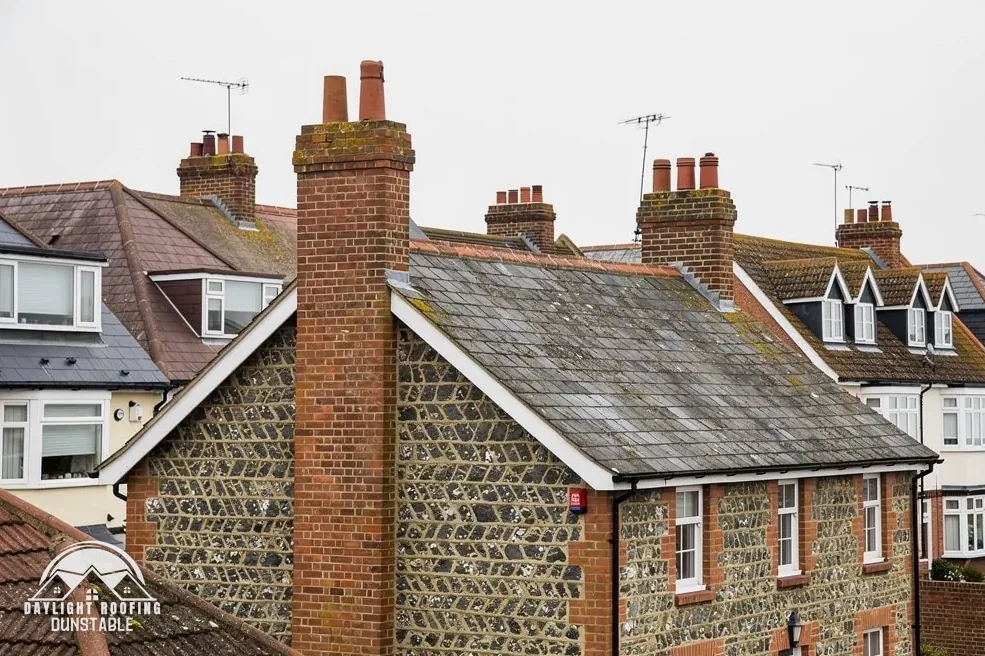
A flint and brick cottage with a grey slate roof

The roof, in plain words

Rafter
A sloping timber carrying the covering's weight down to the walls.
Valley
The trough where two slopes meet and share their runoff.
Tile lap
How far each tile overlaps the one below it.
Motte and bailey
An early castle plan pairing a raised mound with an enclosed courtyard.

The plain-as-day roof check

Four details that tell a High Wycombe roof's story

4 checks about 3 minutes to read

  1. The lowest pitch a covering allows
  2. How long a tile roof lasts
  3. A chimney breast coming out
  4. Storm damage to read from the ground

01 The lowest pitch a covering allows

Every covering has a lowest slope it can safely sit on, and the figure belongs to the product, not to the roof. Marley lists 35 degrees for its clay Ashdowne tile and 15 degrees for its Lincoln clay pantile; among its concrete tiles, the Plain tile is listed at 35 degrees and the Double Roman at 22.5. Natural slate has its own figure, which Cupa gives as 20 degrees in moderate exposure with a 500mm slate and 115mm overlap.

Pitch therefore limits which coverings suit a roof, and a shallow extension slope cannot take just any tile. When a new covering is under discussion, the existing slope is measured and the product is chosen to fit it, never the other way round. From the ground a pitch can only be guessed at, so the survey puts a number on it. A tile that is fine at 35 degrees is not necessarily fine on the shallower slope of a porch or a dormer cheek, so small roofs on a house are checked separately from the main slope. Pitched work is covered under pitched roofing.

02 How long a tile roof lasts

For clay tiles, Marley cites the BRE, which "determined a minimum life expectancy of 60 years". HomeBuilding (last updated 30 September 2025) gives approximate lifespans of 60-80 years for clay tiles and 40-50 years for plain concrete tiles. Marley also says of any such figure: "This is not a guarantee or warranty of its longevity." Those are published ranges, and they describe tiles in general. Neither is a forecast for a roof that has stood through its own weather, its own repairs and its own earlier fixing methods.

A lifespan figure cannot say anything about one particular roof, because coverings age along with their fixings, their underlay and the way they were laid. A survey reads what is in front of it: cracked or flaking tiles, a sagging line along a slope, a worn ridge, a lifted flashing. Those signs decide between patching and replacing, whatever age the roof is, and a roof with a short list of faults is a repair, not a replacement.

03 A chimney breast coming out

Taking out a chimney breast alters the structure, and Building Regulations approval "will always apply when removing chimney breasts as they are part of the building's structure". When the breast stands on a party wall, the neighbour has to be told: a notice for work such as cutting away a chimney breast must "be served at least two months before the date on which the proposed work will begin", and the building owner serves it.

MyJobQuote says removing a chimney breast costs an average of around £2,500, and removing the breast together with the whole stack around £3,000 to £3,500 (page dated 3 November 2026). Above the roofline, a stack that has been taken down leaves a hole that has to be made good in the covering and the rafters around it. More on stacks is under chimney repairs.

04 Storm damage to read from the ground

After a blow, walk the boundary and look up: slipped or missing tiles, a ridge piece that has lifted, a gutter hanging off its brackets, or a flap of felt showing. Photograph each sign from where you stand, in daylight, before anything is moved. Fallen pieces are worth keeping for the insurer's inspection, and the roof itself is no place to climb while it is wet and damaged.

MyJobQuote says emergency roofer call-out costs "typically range from £150 to £300, while extensive storm damage repairs can cost £1,200 or more" (page dated 22 October 2026). Those are another source's figures and nothing here promises a price. A temporary cover over a damaged slope buys time for a proper survey, which then decides what the repair needs and how much of the slope it touches. If an insurer is involved, the dated photographs you took are your own record of what the storm did.

The dashed ring takes in the nearest towns and villages we cover around High Wycombe. Map tiles © Esri; map data © OpenStreetMap contributors.

Questions for High Wycombe roofs, taken in turn

01What does a High Wycombe roof survey look at besides the obvious fault?

Besides the tile or gutter that prompted the call, the survey covers the ridge, the hips, the valleys, the flashings round any stack, the verges and the fascias. If something else shows, such as a failing flashing a few metres from the leak, you are told about it in plain words alongside the main fault. A photo on WhatsApp is a good starting point, but it is only that, because close inspection finds what a view from the ground cannot. The one written total comes after the survey is done, and it covers the whole job rather than the visible fault alone.

02What route do All Saints' roof repairs take?

The church is listed Grade I (entry 1125180, first listed 9 January 1954) and is a Church of England church, so work to it goes through the faculty system and not listed building consent. List B of the Faculty Jurisdiction Rules 2015 treats the like for like replacement of roof lead more lightly, with the archdeacon simply giving notice in writing. Whether outside work on a church also needs planning permission turns on the job. A house, by contrast, is judged on the ordinary tests and by the council.

03What does a Grade II* listing, as at 7, Castle Street, mean for a roof?

The legislation asks one thing of a listed building: will the work be done "in any manner which would affect its character as a building of special architectural or historic interest"? if it would, consent is required, although a listed home is not stripped of the ordinary permitted development rights. 7, Castle Street (entry 1159695) and The Little Market House (entry 1310836) are both listed Grade II*. On which side of that line a particular repair or change of covering falls, Buckinghamshire Council decides, and asking first avoids having to redo work. Where a listed roof is being repaired with matching material, the council's view is still worth having in advance.

04Which conservation areas are named near High Wycombe, and how is an address checked?

Buckinghamshire Council designated High Wycombe, Priory Avenue, Wycombe Abbey, Amersham Hill and Leigh Street Furniture Heritage as conservation areas. Whether a given street falls inside one is a question for the council, and it is asked of the council by address, not by street name alone. A Four Ashes direction also appears on the council's Article 4 list, and the council is the authority on what it removes. The planning guide explains how planning applies to roof work generally, and the council's reply for an address overrides it. A roof inside any of these areas gets the same survey as one outside, and the council check is made alongside it.

05Does the Castle Hill scheduled monument touch the roof of a house nearby?

Only when the protected site takes in the house or its land. Castle Hill (entry 1009537), near High Wycombe, is a scheduled monument. Works to a protected monument need authorisation first: Historic England receives the requests, and it is the Secretary of State who grants or refuses consent. That track runs apart from planning and from listed building consent, so one cannot stand in for another. The protected area is mapped on the monument's entry in the National Heritage List, which is the place to check an address before a scaffold is booked.

06What is the fee for a scaffold on a High Wycombe road?

Putting scaffold over a footway or carriageway brings in section 169 of the Highways Act 1980, with the licence coming from Buckinghamshire Council as the highway authority. Its fee is £402.78 for 28 days, £69.09 to renew and £777.63 if the licence is applied for after the scaffold is up, and Buckinghamshire Council states "You must be a registered scaffolding company to apply for a licence." We arrange the licence with our scaffolder, so the householder is spared the application, and the written quote takes in the scaffold.

07What do published figures say about flat roof replacement for an extension?

MyJobQuote says that in 2026 the average flat roof replacement costs between £1,500 and £6,000 (page dated 20 October 2026), and that at around £60 per square metre, an average rubber roof comes to £1,050 fully installed (page dated 9 October 2026). Those are third-party averages for roofs of unknown size. A real figure depends on the area, the deck beneath and the access, and our price is a figure given in writing only after the roof has been surveyed. A flat roof on a listed or conservation-area building can also raise the consent question, so that is asked before the price is given.

08Is a full re-roof in High Wycombe caught by the Building Regulations tests?

Yes. The Planning Portal sets two limits for no application being normally needed: "Less than 25 per cent of the total 'building envelope'" affected and "Less than 50 per cent of the roof is affected". A complete re-roof goes beyond the second, so approval applies whatever the covering, and the building control route is confirmed before work begins. In High Wycombe, Buckinghamshire Council's own service handles building control, and contact details are given on its building control page. A covering that adds "15 per cent or more" to the roof's weight needs approval on its own account.

09Can High Wycombe owners get public money for roof work?

None of the schemes pays for roof replacement or repair. Open government schemes in England cover insulation, such as loft insulation, and heating upgrades rather than roof replacement; check GOV.UK for what you can get. The Energy Company Obligation is closing on 31 December 2026, so if you think you qualify, check GOV.UK or your council soon. The Warm Homes: Local Grant depends on the home having "an Energy Performance Certificate (EPC) of D, E, F or G" and on this test: "Your household income must usually be £36,000 a year or less."

Get a written price for your roof

10-year workmanship guarantee, in writing

Tell us about your roof

Call WhatsApp Written quote