
Call 01582 935272

Downley · 27 road miles south-west

Roofers in Downley

Tile repairs, verges, flat roofs and wildlife-sensitive roof work for Downley houses, with the Downley Common conservation area kept in view and one written total after a survey.

Get a written quote

Call 01582 935272WhatsApp us

Council
Buckinghamshire
Road miles
27
Conservation area
Downley Common
Building control
Buckinghamshire Council

Roofs round Downley Common and Plomer Green

Downley lies south-west of Dunstable, 26.5 road miles away and roughly 49 minutes by road, in Buckinghamshire. Downley parish had 5,165 usual residents at the 2021 Census. Hughenden Manor Farmhouse is listed Grade II* (entry 1125184, first listed 9 January 1954), and Plomer Green Cottages (entry 1125652) were first listed on 22 January 1986 at Grade II; Pant Y Maes (entry 1223302) is Grade II too. Roofs that stand near those entries are read with the listing in front of the surveyor. The survey reads the listing details first, because a roof near a protected frontage can be limited in how it is repaired.

Buckinghamshire Council designated the Downley Common conservation area, and its Article 4 list has entries near the village, among them one for Manor Farm on Coates Lane. Ask Buckinghamshire Council whether a direction reaches your house; what a particular direction removes is for the council to say, and your address is worth raising with it before picking a covering. The roof is surveyed, one written total follows, and any other fault the survey turns up is put to you plainly.

  1. 01Hughenden Manor FarmhouseListed Grade II* (entry 1125184), so work that could change the roof's character needs consent sorted out first.
  2. 02Plomer Green CottagesListed Grade II in 1986 (entry 1125652), so repairs are matched to the existing covering and agreed beforehand.
  3. 03Pant Y MaesListed Grade II (entry 1223302), so a change of tile or an opening in the slope is raised with the council.
  4. 04Houses by the CommonA house inside the conservation area has its address confirmed with the council before a quote is accepted.
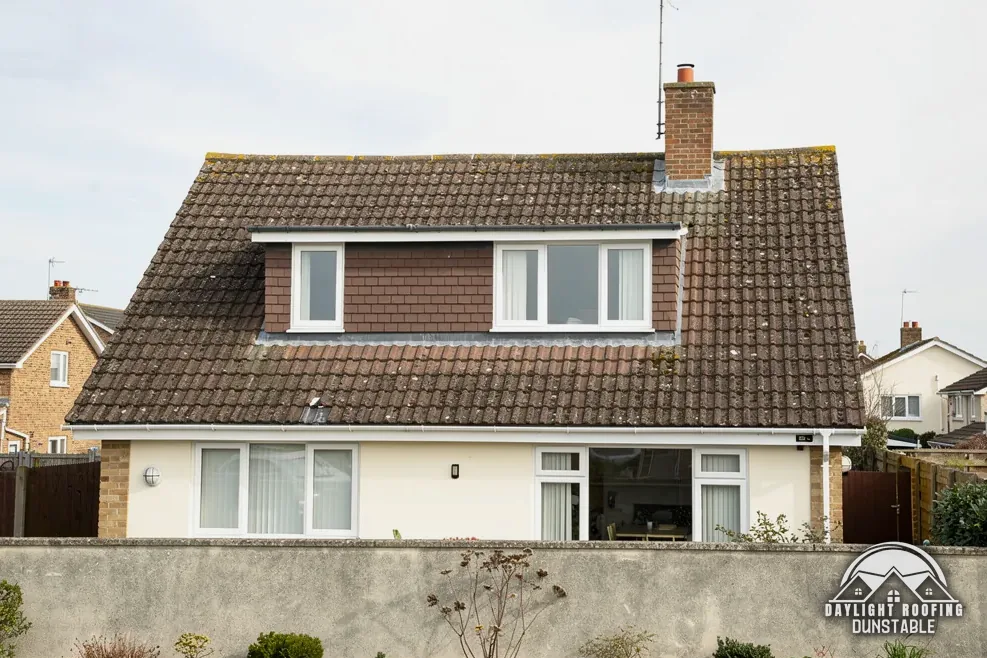
A chalet bungalow with a wide front dormer and a concrete tile roof

The roof, in plain words

Bat roost
A place a bat uses to rest or breed, protected by law.
Dry verge
A gable edge fixed with clips and fittings, not mortar.
Underlay
Sheet laid under the tiles to catch water that gets past them.
Soffit
The panel that closes the gap beneath the roof overhang.

The plain-as-day roof check

Four Downley roof matters with a legal edge

4 checks about 3 minutes to read

  1. Birds and bats under the tiles
  2. Air in a breathable roof
  3. Dry verges at the gable
  4. Flat roofs and their lifespans

01 Birds and bats under the tiles

Roof work can meet wildlife. Under section 1 of the Wildlife and Countryside Act 1981, the offence is committed by anyone who intentionally "takes, damages or destroys the nest of any wild bird while that nest is in use or being built". Bats get stronger protection: the Habitats Regulations protect "a breeding site or resting place of such an animal" from damage or destruction, and no intent is needed. GOV.UK states that "All bat species, their breeding sites and resting places are fully protected by law". The same rules apply to a roof on a shed or outbuilding as to the house roof.

GOV.UK also lists "repairing or replacing a roof" among the jobs for which a Natural England licence may be needed. Disturbing a bat in a place of shelter or blocking its way in is an offence where done "intentionally or recklessly". Droppings under the eaves, a bird flying in and out of a gap, or a rustle in the roof space are signs to mention before any work starts. The legal test for a nest is whether it is in use or being built, so an empty nest and an active one are treated differently, and work near an active one waits.

02 Air in a breathable roof

Not every roof needs the same ventilation. For a roof that combines a low-resistance underlay (with a sealed ceiling below and an air-permeable covering above), Marley says "fortuitous ventilation at the eaves via normal eaves construction (3mm) is all that is required, provided the requirements of UKAS Third Party certification are fully met". High-resistance underlay is a different case, because it is not vapour-permeable, and BS 5250:2021 is the standard covering moisture in buildings.

Which kind of underlay is up there is something only a look in the loft settles. A damp patch on a ceiling can come from the covering or from moisture inside the house, and the cure differs. A survey therefore reads the underlay, the eaves and the insulation as a set, not as separate items, before saying whether the answer is a repair or a ventilation change. Pitched roofs are covered under pitched roofing. Insulation pushed hard against the roof at the eaves is one way a ventilated roof stops breathing.

03 Dry verges at the gable

A gable edge has to shed water while resisting the wind. BS 8612:2018 is current and covers ridge, hip and verge fixing without mortar, and Marley records that since the 2015 amendments mortar "could no longer be relied upon as the only means of securing the roof covering". An older verge held by mortar alone is therefore a candidate for a survey, even where it looks tidy from the road.

MyJobQuote says a dry verge system "usually falls between £500 and £2,000" (page dated 8 October 2026). Look for a verge tile that has dropped, a crack running along the mortar, or green staining below the gable edge. The survey looks under the edge too, at the batten ends and the tile beneath, because that is where a failing verge does its damage. More is under roof repairs. Fresh mortar on an old verge can look tidy for a season and still leave the edge without a mechanical fixing.

04 Flat roofs and their lifespans

The current flat-roof code, BS 6229:2025, concerns continuously supported flexible waterproof coverings, which excludes lead. HomeBuilding gives 25-30 years for EPDM and GRP and 10-15 years for felt, while Less gives "30 to 50 years" for EPDM, "25 to 40 years" for GRP and "10 to 20 years" for felt "depending on quality and installation". The two sources disagree, and neither is a promise about a particular roof.

On a typical single garage of 6m x 3m, Which? Trusted Traders give £1,400 to £3,500 for felt and £1,950 to £4,000 for new boards under a rubber EPDM covering (all excluding VAT, November 2025). A flat roof that holds water in a puddle, or shows a stain on the ceiling below, needs looking at, because the fall is what lets it drain. More is under flat roofing. Where a garage roof is sheet, not membrane, the sheet type is checked before anything is cut or lifted.

The dashed ring takes in the nearest towns and villages we cover around Downley. Map tiles © Esri; map data © OpenStreetMap contributors.

Downley roof questions, answered one at a time

01What from ground level suggests trouble on a Downley roof?

Look along the ridge and the hips for a tile that has moved, at the gable edges for crumbled mortar or a dropped edge tile, and at the gutters for a sag or a green streak below. Check the chimney for lifted lead. Indoors, a damp patch that grows after rain or a patch of daylight in the loft is worth noting. Send a photo on WhatsApp and it gets a look before any visit is booked. These are signs and not diagnoses; what each one means is settled at the survey, from up on the roof. Look from both the front and the back of the house, since a rear slope can hide a problem the street never shows.

02What does the Downley Common conservation area add to a re-roof?

Another question to ask first. Buckinghamshire Council designated the Downley Common conservation area, and the council is the body that confirms if an address lies inside it. The village has further Article 4 list entries from Buckinghamshire Council close by, and what any one removes is the council's to say. Because an Article 4 direction can remove further permitted development rights, we check with the council first. The planning guide gives the general position on roof work, and the council's answer for the address comes before it.

03What consent do Plomer Green Cottages or Pant Y Maes need for roof work?

Both are listed Grade II (entries 1125652 and 1223302), and Hughenden Manor Farmhouse (entry 1125184) is Grade II*. A listed home keeps its permitted development rights, yet "in any manner which would affect its character as a building of special architectural or historic interest" is the test for listed building consent. Replacing a covering with matching material and switching to a different one can fall on different sides of that test, so Buckinghamshire Council is asked before materials are ordered.

04How does a scaffold licence work for a Downley house?

We arrange it with our scaffolder. For scaffolding on a Downley road or pavement, Buckinghamshire Council issues the licence at £402.78 for 28 days, with £69.09 for a renewal and £777.63 for a licence sought after the event. Buckinghamshire Council's own wording is: "You must be a registered scaffolding company to apply for a licence." Where the job needs scaffolding, that cost is part of the quote in writing. The frame can stay up for the whole job, since a renewal stretches the licence beyond the 28 days when needed.

05Does a full re-roof in Downley need Building Regulations approval?

Yes. The Planning Portal sets two limits below which no application is normally needed: "Less than 25 per cent of the total 'building envelope'" affected, and "Less than 50 per cent of the roof is affected". Replacing the whole roof exceeds the second limit. Buckinghamshire Council operates its own building control service, and how to contact it is set out on its building control page. Building control is carried out by the council's team or by a registered building control approver, and each ends with its own certificate of the work. Approval is confirmed before the work starts, not after.

06Does clay outlast concrete on a Downley roof?

Published figures vary. For clay tiles, Marley cites the BRE as having "determined a minimum life expectancy of 60 years", and HomeBuilding (last updated 30 September 2025) gives 60-80 years for clay and 40-50 years for plain concrete tiles. Marley says of tile life generally: "This is not a guarantee or warranty of its longevity." The age and condition of a particular roof depend on its fixings, underlay and history, so the survey reads the roof, not a chart. A lifespan figure describes a type of tile in general and cannot see a hairline crack or a failed batten.

07How long does an insurer have to answer a storm claim for a Downley roof?

The Financial Ombudsman Service says: "For most complaints, a business has up to 8 weeks to consider a complaint." It adds that "You have 6 months from the date on the final response" to take it further. The two periods are separate, and the 6 months run from the final response. The Ombudsman will "usually look at expert reports and photos", so photograph storm damage before anything is moved, keep any fallen pieces, and note the date. Dated photographs and your own notes of what you saw give a claim something firm to rest on.

08Who must be told when a Downley chimney breast is cut away?

The adjoining owner, where the breast is built against the wall shared with next door. The Party Wall etc. Act 1996 makes the building owner the one who serves notice, and where a party structure is being altered, for example by cutting a breast away, the Act's wording for the notice is: "be served at least two months before the date on which the proposed work will begin". If the adjoining owner has not consented within 14 days, they are "deemed to have dissented", which starts the surveyor procedure; it is not a veto. Separately, Building Regulations approval "will always apply when removing chimney breasts as they are part of the building's structure". Party wall questions go to a party wall surveyor, not to building control.

09What can a Downley owner see from the road that points to a lead problem?

Lead round a chimney or bay shows its trouble in a few ways: a strip lifting at an edge, a split along a fold, or a stain streaking the brick below. MyJobQuote says correctly installed lead flashing "can last for over 80 years", and for chimney flashings alone its page gives around £200 for a patch repair and around £570 for a full replacement. Lead sheet to BS EN 12588 comes in codes 3 to 8, and the specification sets the code. A lead repair is judged on what the survey finds at the joint.

Get a written price for your roof

10-year workmanship guarantee, in writing

Tell us about your roof

Call WhatsApp Written quote