
Call 01582 935272

Bradenham · 24 road miles south-west

Roofers in Bradenham

Old tiled roofs, chimney stacks, leadwork and barn roofs in Bradenham, each surveyed before you are given one written total price for the job.

Get a written quote

Call 01582 935272WhatsApp us

Council
Buckinghamshire
Road miles
24
Conservation area
Bradenham
Building control
Buckinghamshire Council

St Botolph, the Manor and the Bradenham village roofs

Bradenham is a village in Buckinghamshire, 24 road miles south-west of Dunstable; the journey takes about 44 minutes. Bradenham parish had 620 usual residents at the 2021 Census. Buckinghamshire Council designated the Bradenham Conservation Area, and the village lies inside the Chilterns National Landscape, so two layers of local sensitivity sit over roof work here. Planning applications reach Buckinghamshire Council, and the Chilterns Conservation Board comments through the consultation process without deciding anything.

Some of the village's listed buildings are Grade II*, and roof work on those starts as a heritage matter before it is a building job. For ordinary houses, the sequence is simple: a survey of the covering and its junctions, a plain account of what it found, and one written total price. A pitched roof that is failing across its width is re-covered, and a stack in poor order is dealt with under chimney repairs.

  1. 01Church of St BotolphGrade II* (entry 1125779, first listed 21 June 1955) and a Church of England church, so its roof work goes through the faculty system.
  2. 02Bradenham ManorListed Grade II* under entry 1332048, first listed 21 June 1955; roof alterations that affect its character need listed building consent.
  3. 03The White HouseAlso Grade II* (entry 1310723, first listed 21 June 1955), so a re-cover there is a conversation with the council first.
  4. 04Barns at Manor FarmThe pair of barns west and north-west of Manor Farmhouse is Grade II (entry 1160088), with the same listed building rules.
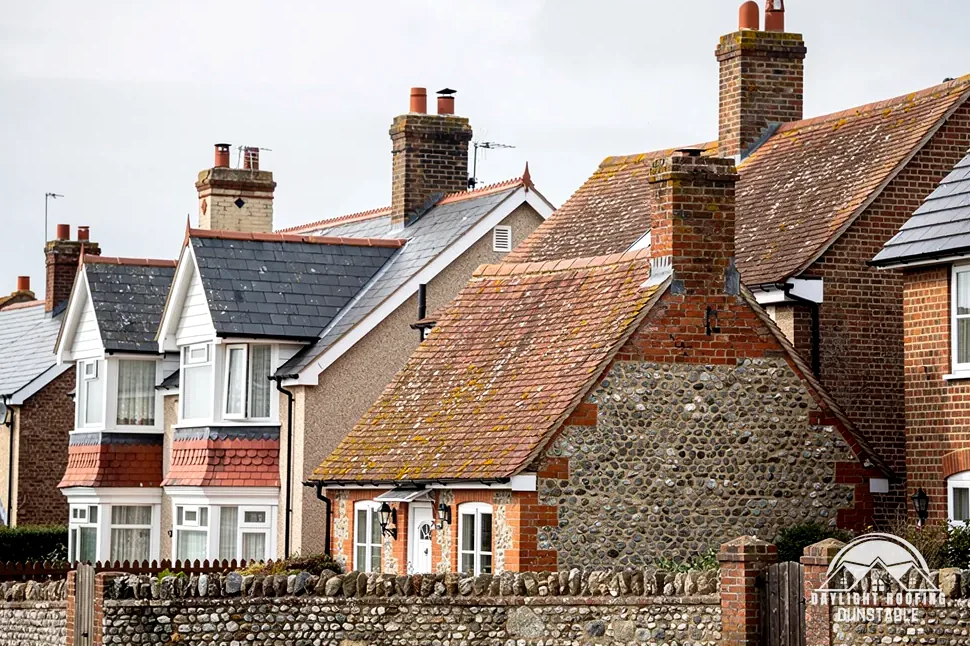
A flint and brick cottage with a weathered clay tile roof

Plain words, Bradenham

Faculty
The Church of England's consent route for work to a church that is in use.
Lead code
A figure between 3 and 8 naming how thick a sheet of rolled lead is.
Flaunching
The sloping mortar bed around a pot's base that fixes it and drains the stack top.
Purlin
A horizontal timber beam that carries the rafters part-way up a roof.

The plain-as-day roof check

Reading an old Bradenham roof from outside

4 checks about 3 minutes to read

  1. Tiles that have shifted
  2. Barn roof timbers
  3. Lead sheet and its code
  4. Roof-slope windows

01 Tiles that have shifted

An old tiled roof can settle. Over decades the fixings can loosen, some tiles creep downhill and the rows lose their neat alignment, which gives an old roof its soft, uneven look and also marks the places where water can reach the battens. From the ground, look for a tile that hangs lower than its row, a dark gap where one is missing, a patch that looks more ragged than the rest, and fragments on paths or flower beds below. The Chilterns Conservation Board's notes call plain clay tiles "universally predominant" on the Chilterns' traditional buildings, a regional description, not a survey of Bradenham's own roofs.

Replacement tiles have to suit the roof, and on an old one that can mean salvaged or closely matched tiles, which the survey looks at before the price is set. A roof with a few shifted tiles is repaired in place. A roof that has moved across whole slopes is a re-cover, and that decision is made on the condition of the fixings and battens, not on the roof's age alone. If the house is listed, the council is asked about materials first, and a sample tile held against the old ones in daylight shows quickly whether a match is close enough to be offered.

02 Barn roof timbers

A barn roof is a big span, and the timbers that carry it show their condition from inside. Look at the purlins, the horizontal beams that carry the rafters, and the rafters themselves: a bowed purlin, a rafter that has split at a joint, daylight between tiles or sheets, and dark staining on the wood that points to a long-running leak. Birds and other wildlife may share the roof space, and their presence is worth noting, because nests in use and bat roosts both change when and how a roof may be opened.

A pair of barns near Manor Farmhouse is Grade II, and a listed barn is dealt with as a listed building even when it is used for storage. So Buckinghamshire Council hears about repairs ahead of the work, and swapping the covering for another material is the council's call. A barn roof with a timber problem is a structural job as well as a covering one, so the survey looks at both, and the written price covers the whole of what the roof needs and not only the visible covering.

03 Lead sheet and its code

Lead sheet is sold by code, and the code is a number from 3 to 8 that stands for thickness. Calder and Ecobat both make rolled lead to BS EN 12588, and code 4 is 1.80 mm; code 6 is 2.65 mm. Lead weights differ slightly between makers, so a weight in kilograms per square metre means little unless the maker is named. A specification picks the code for each detail; habit does not.

On a roof, lead shows up in flashings, valley linings, chimney aprons and small flat areas. Look for lead that has creased, split or been pulled from the wall, and for patches of sealant where a repair has been attempted. A leadwork repair depends on the fixing and the detail beneath it, so the survey looks at the whole junction, not just the cracked strip. Lead that has been stuck down with sealant rather than dressed into a chase can fail again at the same line, which is why old patches are looked at closely.

04 Roof-slope windows

A window set into a slope has a frame, a flashing kit and a lining, and it interrupts the covering in a way that every other part of the roof does not. Check from outside, on a bright day if possible, for flashing that has lifted at a corner, a gap at the frame, moss gathered above the window or a crack in the sealant, and from inside for a damp stain on the reveal or the lining.

Approved Document L separates two kinds of glazed unit: a rooflight "out of plane with the surface of the roof on a kerb or upstand", and a roof window "in the same orientation as, and in plane with, the surrounding roof". Which is fitted decides which thermal figure applies when it is replaced. On a listed building, or where an Article 4 direction applies, a new opening in a roof slope can also need consent, so the council hears about it before anything is cut, and the choice between rooflight and roof window is settled on paper first.

The dashed ring takes in the nearest towns and villages we cover around Bradenham. Map tiles © Esri; map data © OpenStreetMap contributors.

Questions about Bradenham roofs

01What does a survey check on a chimney stack in an older Bradenham house?

It looks at the pots and cowls, the mortar between the courses, the flaunching, which holds the pots in place, and the lead flashing where the stack meets the roof. Each can fail on its own, so the survey identifies which part is at fault, whether it needs repointing, re-flashing or rebuilding, and says so plainly, along with any other fault spotted up there. A photo of a stain on the chimney breast indoors, sent on WhatsApp, helps us point the survey at the right stack.

02Who agrees repairs to the roof of St Botolph's church?

St Botolph's, Bradenham's parish church, is Grade II* (list entry 1125779, first listed 21 June 1955) and belongs to the Church of England. Where such a church is in use, the route is "the faculty jurisdiction of the Church of England" and not listed building consent. Planning permission for exterior work can still apply, so Buckinghamshire Council is consulted about that separately. A roofer's survey gives the facts a faculty application would draw on, but it is no substitute for one, and a like-for-like repair can fall under a lighter notice route than a change of material.

03Are Bradenham Manor and The White House treated differently from ordinary houses?

Yes. Bradenham Manor (entry 1332048) and The White House (entry 1310723) are both Grade II*, first listed on 21 June 1955, and the pair of barns west and north-west of Manor Farmhouse is Grade II (entry 1160088). A listed building needs listed building consent for work done "in any manner which would affect its character as a building of special architectural or historic interest". Your own house is not listed just because a neighbour's is, though the neighbour's listing shows the care expected, and the council can tell you at once whether your address is on the list.

04My house is in the Bradenham Conservation Area. What changes?

Buckinghamshire Council designated the conservation area, and it is the body that can place an address on one side of the boundary or the other. If it is, a change to how the roof looks, such as a new covering or an opening, is raised with the council first. An Article 4 entry lies near the village, and Buckinghamshire Council is the body to say whether a direction applies to your property. Our planning permission guide sets out the tests.

05Does the Chilterns designation require clay tiles on my roof?

Nothing in the Board's notes says so. They describe plain clay tiles as "universally predominant" on the Chilterns' traditional buildings, and say flint "is often combined with brick" in older buildings and boundary walls, but they are descriptions, not rules for your house. Buckinghamshire Council still receives the application and decides it; the Chilterns Conservation Board advises and answers consultations. A re-cover in a different material is a question to put to the council before the order is placed, and the reply is worth keeping with your quote so the choice is on record.

06How is scaffolding licensed for a Bradenham roof?

A frame standing on a footway or carriageway must be licensed by the highway authority, which here is Buckinghamshire Council. Buckinghamshire Council charges £402.78 for a 28-day licence, with £69.09 for a renewal and £777.63 for a retrospective one, and it says: "You must be a registered scaffolding company to apply for a licence." We arrange the licence with our scaffolder. A lane with no footway can leave the frame in the carriageway, so access is settled at the survey, along with how long the frame needs to stand.

07What does a lead code mean on a quote?

Rolled lead sheet is made to BS EN 12588 in codes 3 to 8, and code 4, for instance, is 1.80 mm thick. Calder and Ecobat both publish charts, and their weights per square metre differ for codes 3 and 6, so a weight needs the maker's name beside it. The specification sets the code for each detail, which is why the survey looks at what each flashing has to do before a code is chosen. The code chosen for an apron, a valley or a step flashing comes from that specification, not from a rule of thumb.

08Can the white boards under the eaves contain asbestos?

They can. HSE lists "AIB white soffit panels to underside of roof eaves" among places asbestos insulating board has been used, and most work on asbestos insulating board is licensed. HSE also says: "If the building was built or refurbished before 2000, assume that there is asbestos in it." So do not drill, cut or break a soffit board of that age. Leave it as it is and ask for it to be identified before any fascia or soffit work starts. Damaged panel is a separate matter, and HSE lists a damaged AIB soffit among the materials to treat with extra care.

09What standard of workmanship does the law give me?

Under section 49 of the Consumer Rights Act 2015, a trader must perform a service with "reasonable care and skill". That is the heading the Act gives the rule: "Service to be performed with reasonable care and skill". If you feel the work falls short, the Citizens Advice consumer helpline is 0808 223 1133. Keep your quote, your messages and dated photographs of the roof before and after, because a complaint is easier to settle with a clear record in hand.

Get a written price for your roof

10-year workmanship guarantee, in writing

Tell us about your roof

Call WhatsApp Written quote