
Call 01582 935272

Loudwater, High Wycombe · 29 road miles south

Roofers in Loudwater, High Wycombe

Re-roofs, repairs, chimney work and emergency roof calls in Loudwater, High Wycombe, which sits 29.2 road miles south of Dunstable. A look at the roof comes first, and the price follows in writing as one total.

Get a written quote

Call 01582 935272WhatsApp us

Council
Buckinghamshire
Road miles
29
Building control
Buckinghamshire Council

Roofs round Clapton Revel and Snakeley Mill

Loudwater, High Wycombe is a village in Buckinghamshire, 29.2 road miles south of Dunstable, about 50 minutes by road. It lies in Chepping Wycombe parish, which had 14,537 usual residents at the 2021 Census. The Common Flackwell Heath and Clapton Mill conservation areas, both designated by Buckinghamshire Council, lie near Loudwater, and nearness does not put a house within either, a point the council settles address by address. Check with Buckinghamshire Council whether an Article 4 direction applies to a particular house.

Buckinghamshire Council is the local planning authority a Loudwater roof application goes to, and the planning guide gives the permitted development position for a house roof. A quote has to wait for a look at the roof itself. The survey speaks in plain terms, and one total, put in writing, is the price. Storm damage and urgent make-safe work sit under roof repairs, and stack work under chimney repairs.

  1. 01Church of St PeterListed Grade II, National Heritage List entry 1332132, first listed on 8 January 1987, a Church of England church.
  2. 02Clapton RevelListed Grade II*, entry 1125541, first listed on 17 October 1969, so roof changes follow the listed building route.
  3. 03Snakeley Mill houseMill House, Snakeley Mill, listed Grade II, entry 1125622, first listed on 26 September 1973.
  4. 04Loudwater HouseListed Grade II, National Heritage List entry 1125630, so the council hears about any roof change at the start.
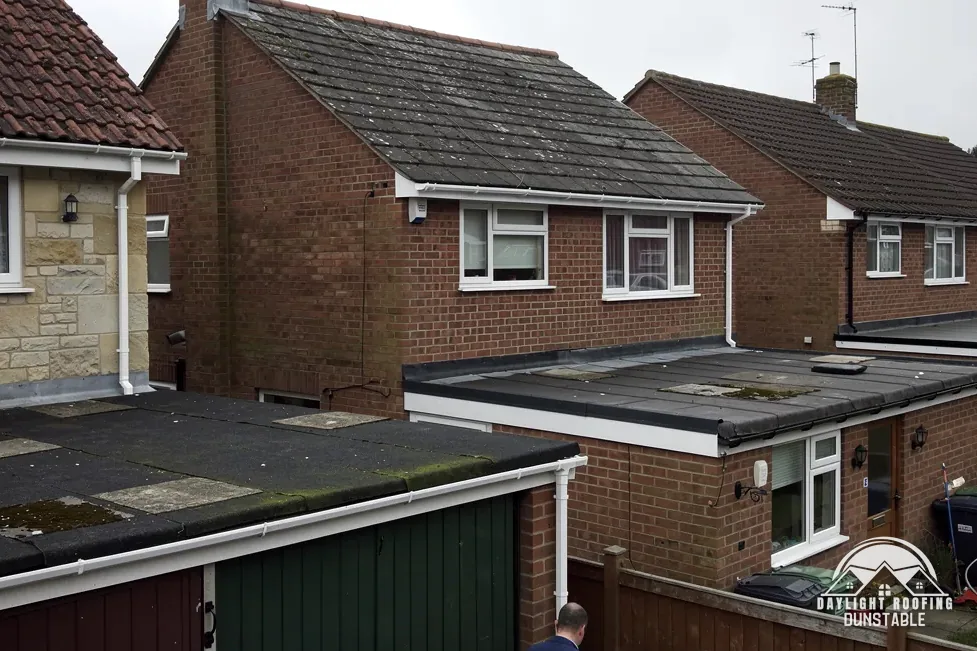
Flat-roofed garages behind brick semi-detached houses

Make-safe, stack and slate explained

Make-safe
Stopping further damage from a failure, ahead of a full repair.
Stack
The brick column of a chimney rising above the roof.
Rafter
A sloping beam that runs from ridge to eaves beneath the battens.
Slate
Thin split stone laid in overlapping courses as a roof covering.

The plain-as-day roof check

Weight, call-outs, stacks and slate: four Loudwater checks

4 checks about 3 minutes to read

  1. A heavier covering
  2. An emergency roof call
  3. A chimney stack coming down
  4. Slate on a Loudwater roof

01 A heavier covering

A new covering changes the load on the rafters, and the rules watch for that. The Planning Portal lists as a trigger a new covering material that "increases the weight of the roof covering by 15 per cent or more", and for weight it advises seeking a structural engineer's or surveyor's view before work begins. Approved Document A puts it this way: "A significant change in roof loading is when the loading upon the roof is increased by more than 15%." Neither source ranks one material above another for weight, and nor do we.

From inside the loft you can see whether the rafters already sag between their supports, whether the ridge dips, or whether old repairs have been nailed beside cracked timbers. Photograph anything that looks bent before a new covering is discussed, and a torch held along the rafter shows a bow better than the naked eye does. The survey looks at the covering on the roof now, so a replacement is judged against the real roof, never against a guess based on the neighbours' houses.

02 An emergency roof call

When tiles have come down or a ceiling is dripping, keep off the roof and go indoors to look. Move belongings from under the wet patch, put a bucket beneath, and photograph the ceiling and the fallen material before anything is shifted. MyJobQuote says "Emergency roofer call-out costs typically range from £150 to £300, while extensive storm damage repairs can cost £1,200 or more", in a page dated 22 October 2026.

A call-out fee buys the visit and a make-safe, such as securing loose material or covering an opening, and a lasting repair is a separate job. For a Loudwater roof the make-safe and the repair are described in plain words, with what was found on the visit, and the repair carries one written total afterwards. Phone 01582 935272 or send photographs on WhatsApp to 07880 284133; a picture shows whether the problem is a slipped tile or something bigger.

03 A chimney stack coming down

Taking a chimney breast out of a room is structural, and Planning Portal guidance says "Building regulations approval will always apply when removing chimney breasts as they are part of the building's structure". In MyJobQuote's page dated 3 November 2026, removing a chimney breast averages around £2,500, and taking down the entire stack together with the breast comes to around £3,000 to £3,500. Taking a stack down opens a gap in the roof surface to be made good, so the covering around it is part of the job.

Leadwork at a stack is priced on its own. MyJobQuote gives around £200 for a patch repair of the lead flashing at a chimney, an average of around £570 for a full replacement, and a range of £350 to £920 that depends largely on whether scaffolding is required. Each of those figures is for chimney leadwork alone, and flat roofs, bays and valleys are not covered by them. Study the stack from the lawn or the pavement for leaning, loose brick and flaking pointing, and say if the chimney is no longer in use.

04 Slate on a Loudwater roof

Slate laid in overlapping courses sheds water well and shows its age in particular ways: slates that have slipped from their nails, a ragged or flaking surface, and rust streaks from corroded fixings. Cupa's advice is that hook fixings are unsuitable on any pitch below 25º. A slipped slate leaves the batten and underlay exposed, and the gap shows from the ground as a short dark break in the course.

HomeBuilding's approximate lifespans, last updated 30 September 2025, are 100+ years for Welsh slate, 75-100 for Spanish natural slate and 50-80 for reclaimed Welsh slate. MyJobQuote's figure is "The average cost of fitting a slate roof is around £7,800", in a page dated 6 October 2026. Those are published guides for materials in good order; the survey judges a particular roof on its own condition, including its fixings and any lead at the edges. A slate roof that has lost a few slates can be repaired in place; one with failed fixings across a whole slope is a different conversation, and the survey says plainly which of the two you have, so a Loudwater owner knows whether a repair or a re-cover is the sensible step.

The dashed ring takes in the nearest towns and villages we cover around Loudwater, High Wycombe. Map tiles © Esri; map data © OpenStreetMap contributors.

Loudwater roofs near Clapton Revel and St Peter's

01How does a survey show whether a Loudwater roof can take a heavier covering?

It looks at the covering already on the roof and along the ridge and slopes for sagging, bowing or old repairs. Where a new covering adds "15 per cent or more" to the weight, Building Regulations approval is required, and the Planning Portal advises a structural engineer's or surveyor's check. The survey describes what it sees in plain words, with anything else noticed, and the written price follows as a single total. Photographs from the loft hatch help us before the visit.

02Does closeness to Clapton Mill or The Common Flackwell Heath change a roof job in Loudwater?

Buckinghamshire Council designated both as conservation areas, and each lies near Loudwater, which does not put your house inside either one. The council can tell you whether your own address is in a conservation area at all. Article 4 directions can remove further permitted development rights, so we check with the council first, ahead of pricing. For roof windows and dormers the planning guide sets out the rules, and this answer leaves them there. A note of the road name helps when we raise the question.

03Does a Grade II* house like Clapton Revel need a roof plan agreed with the council?

Clapton Revel is listed Grade II* (entry 1125541), and Mill House, Snakeley Mill (entry 1125622) and Loudwater House (entry 1125630) are listed Grade II. Consent is needed for works "in any manner which would affect its character as a building of special architectural or historic interest", and Buckinghamshire Council judges whether a roof job does that. Getting the council's answer in writing before any scaffold goes up means the quote rests on a settled position, and the choice of covering is made knowing what the council will accept.

04How are roof repairs handled at St Peter's church in Loudwater?

The Church of St Peter is a Church of England church, listed Grade II (entry 1332132). St Peter's is within the faculty jurisdiction of the Church of England while in use, so the faculty system takes the place of listed building consent. Under List B, putting roof lead or covering back precisely as it was needs the archdeacon's written notice, while any exterior work raises the ordinary planning tests as a separate question. Nothing in that process touches a householder's own roof in Loudwater, and a house near the church is judged on its own merits and any listing it has of its own.

05Which body issues a scaffold licence on a Loudwater road, and at what price?

For scaffolding on or over a road, section 169 of the Highways Act 1980 requires a licence, and Buckinghamshire Council grants those for Loudwater. The Buckinghamshire Council scale is £402.78 for 28 days and £69.09 to renew, with £777.63 for a retrospective licence, one sought after the scaffolding is already up. Buckinghamshire Council's page adds "You must be a registered scaffolding company to apply for a licence". We arrange the licence with our scaffolder, and the scaffold for a Loudwater job is part of your single written quote. A scaffold wholly on your own drive needs no highway licence.

06How much is an urgent roofer's visit in the published cost guides?

MyJobQuote's page of 22 October 2026 says "Emergency roofer call-out costs typically range from £150 to £300, while extensive storm damage repairs can cost £1,200 or more". That is a third-party guide, not our figure, and the call-out is a make-safe rather than a repair. Our own price for a Loudwater repair is a single written total, reached after the roof has been examined, and the survey mentions whatever else was noticed on the slope or along the gutter. A picture of the damage taken from the lawn helps to judge how urgent the visit is.

07What do published guides give for the life and cost of a slate roof?

HomeBuilding gives approximate lifespans of 100+ years for Welsh slate, 75-100 for Spanish natural slate and 50-80 for reclaimed Welsh slate, in a page last updated 30 September 2025. MyJobQuote's page of 6 October 2026 puts a slate roof fitted at an average of around £7,800. Those are published guides for materials in good order, not our price. A Loudwater slate roof is judged on its fixings, its lead and the state of each course, and the figure that follows the survey is a single written total, which is the only price we give.

08Why does a Loudwater loft need its underlay and eaves looked at together?

Marley's ventilation figures depend on the underlay. For a high-resistance underlay in a cold roof it gives 25 mm along the eaves at 15° or less and 10 mm above 15°. For a low-resistance underlay, Marley's three conditions are a well-sealed ceiling, an air-permeable covering and compliance with UKAS third-party certification; then the normal 3mm eaves construction is all that is required. Each condition must hold for that particular roof, so the survey looks at the underlay, the ceiling and the eaves, then tells you plainly which arrangement your roof has.

09Where can a Loudwater homeowner check flood risk when planning roof work?

GOV.UK has two separate tools. The long-term flood risk service grades the danger to an area from several sources, and it stops short of forecasting what will happen at a single house. The Environment Agency's flood map for planning is built for planning applications and names a site's flood zone. A roof job changes neither, but where roof water leaves the house is something the survey can check, such as a downpipe that discharges beside a wall, or a gully that fills with leaves and backs up against the brickwork. Photographs of the foot of each downpipe, taken during rain, show what happens.

Get a written price for your roof

10-year workmanship guarantee, in writing

Tell us about your roof

Call WhatsApp Written quote