
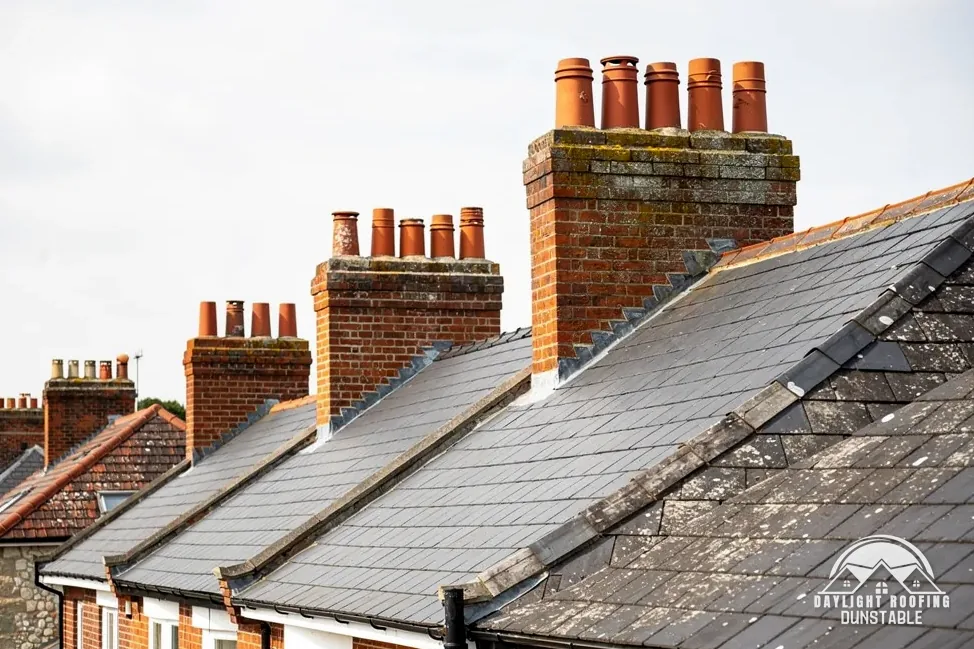
How a chimney heats the thatch beside it
A thatched roof and a working chimney sit closer together than the outside of a house suggests. The stack rises through the roof, and the flue inside it carries hot gas from a fire, a stove or a boiler up past the thatch before the gas reaches the open air. The flue is the channel. Around it is the flue brickwork, and at the point where the stack leaves the roof, the outer face of that brickwork sits against the thatch.
The 2017 Thatched Property Safety Guide, which lists the Bedfordshire, Cambridgeshire, Essex, Hertfordshire, Norfolk and Suffolk fire and rescue services among its contacts, is direct about one cause: "Recent research has identified that a major cause of chimney related thatch fires is attributable to heat transfer through the brickwork of the flue into the adjacent thatch." The sentence is about heat travelling through solid walls, not only about sparks leaving the top of the pot.
That is why the guide's advice starts with the chimney itself. The brickwork can be looked at from the roof, but what the heat inside is doing to the wall behind it is a question for a qualified chimney sweep and for the guide, not for guesswork from the ridge. A roofer reports what can be seen from outside on the stack and how it meets the roof. A sweep deals with the flue. The two jobs sit next to each other and neither replaces the other.
- FlueThe channel inside the stack that carries hot gas out.
- Flue brickworkThe brick walls built around that channel.
- FlaunchingThe mortar slope that holds the pot and sheds rain.
- StackThe part of the chimney that rises above the roof.
The parts of a chimney stack and what each does
Reading a stack from the top down makes a survey easier to follow. Every part has one job, and a fault in it has its own consequence. The table lines them up one beside another, so an owner looking up from the garden can name what is being described.
| Part | Its job | A fault lets |
|---|---|---|
| Pot | Carries smoke clear of the stack | Rain into the flue |
| Flaunching | Bonds the pot and sheds rain | Water into the brickwork |
| Brickwork joints | Hold the stack together | Damp through the wall |
| Lead flashing | Seals the stack to the roof | Rain into the roof space |
Lead flashing is the part that joins the stack to the slope. It is sheet lead tucked into a slot cut along the mortar joint and dressed down over the roof covering, so that water running down the stack is carried onto the slope instead of behind it. MyJobQuote says correctly installed lead flashing can last for over 80 years, and that the figure holds for flashing that has been fitted properly in the first place.
Thatch changes the weight of a repair, not its nature. A roofer cannot see heat transfer, and a roof survey does not measure it. What a survey can report is what is visible: the joints, any cracks, the pot, the flaunching and the lead. Anything about how the flue performs goes to a qualified chimney sweep.
Sweeping, and what the guide says about spark arrestors
On the chimney itself the guide says: "Have the chimney swept regularly by a qualified chimney sweep." How often a particular chimney needs sweeping depends on what it burns and how it is used, and the sweep is the person to ask.
Sweeping is a separate trade from roofing. A sweep clears the flue from below or above and can see the inside of the pot. A roofer works on the outside, where the stack meets the slope. When both are needed on a thatched house, it helps to keep the questions apart: the sweep for the flue, the roofer for the flaunching, the joints and the lead.
On spark arrestors the guide takes a cautious line. It does not recommend them on chimneys, and it adds that where one is installed it "must be kept clean". Whether a cap or mesh suits a given stack depends on the stack and the fire. An owner who finds one already fitted on the pot should say so to the sweep.
- Is anything fitted over the pot, such as a cap or a mesh?
- When was the chimney last swept, and by whom?
- Are any joints open, or the pot or the flaunching cracked?
- Is there staining on the brickwork or the ceiling below the stack?
Those four questions are worth putting before any roof work is priced, because each of them changes what the survey looks for.
Repairs on the stack: flaunching, pointing and lead
Flaunching is the sloped mortar bed at the foot of the pot, which grips the pot and sheds rain outward. When it cracks, water reaches the top of the brickwork. Repointing means raking out loose mortar from the joints and filling them again, so that rain cannot work into the wall. Lead flashing is renewed or patched where the stack meets the slope.
Sheet lead for flashings is rolled to BS EN 12588 and graded in codes 3 to 8, where code 4 is 1.80 mm thick. The specification names the code that each detail on the stack gets. For chimney leadwork, MyJobQuote's page (last updated 22 September 2026) puts a flashing patch at around £200 and a full replacement at around £570. For a chimney, the same page puts a full replacement of the leadwork at £350 to £920, depending largely on whether scaffolding is required. All of that applies to chimney leadwork alone.
What repointing costs is settled after the survey, because the amount of mortar that has failed can only be judged from the roof. Whatever the work, the figure you receive is one written total.
A stack rising above a pavement or road can put scaffolding on the highway, which needs a Highways Act scaffold licence from the highway authority. For Central Bedfordshire addresses that authority is the council itself. In Hertfordshire it is Hertfordshire County Council, which charges £134 for a 14-day scaffold licence and £59 for every week after, with an application that usually takes 3 weeks. We arrange the licence with our scaffolder.
One written total
What sets the price
Stack height, access to the roof and the amount of mortar and lead needing attention all move the figure, as does anything the survey turns up. You then receive a single price in writing.
Taking a chimney down: Building Regulations and the party wall
Some owners of a thatched cottage decide to stop using a chimney and ask about taking the breast out. The Planning Portal's wording is plain: "Building regulations approval will always apply when removing chimney breasts as they are part of the building's structure." The approval comes from the council's building control team or from a registered building control approver. For a Central Bedfordshire address the council's own team is on 0300 300 8635, a line for building control, not planning, enquiries.
A breast on a party wall brings in the Party Wall etc. Act 1996. Section 2 lists the right to cut away "any projecting chimney breast, jamb or flue" from a party wall, and the notice for work to a party structure must "be served at least two months before the date on which the proposed work will begin". The building owner serves the notice. A surveyor is appointed when the neighbour dissents or has not replied within 14 days, and the section 10 procedure follows; the neighbour holds no veto. Questions about a party wall go to a party wall surveyor, not to building control.
MyJobQuote's page, last updated 3 November 2026, gives around £2,500 as its average for a breast alone, and around £3,000 to £3,500 for removing the whole stack together with its breast. Both are third-party averages, so neither is a price for your house.
On planning, the householder permitted development class for roofs, Class C, excludes "the installation, alteration or replacement of a chimney, flue or soil and vent pipe". Whether a chimney change needs permission is therefore a question for the council, and the planning guide sets out the roof rules.
You might hear
A disused chimney can simply be taken down.
Plain as day
Removing a breast always needs Building Regulations approval, whatever its use.
Listed cottages, conservation areas and Article 4 lists
For a listed house the householder roof classes still apply, yet the law asks for consent where work is done "in any manner which would affect its character as a building of special architectural or historic interest". A chimney stack is part of how a cottage reads from the road, so a change to one on a listed house is a question for the council before anything is priced. A thatched roof does not by itself make a house listed: that depends on the house's own list entry.
Article 4 directions can take away further permitted development rights, and each council's list names its own works. The table gives the entries on the councils' lists that touch roofs or chimneys, and the Bedfordshire areas that name none.
| Place | Council | Roof or chimney item |
|---|---|---|
| Hitchin, Stockens Green | North Herts | Roof, chimney, flue |
| Fairfield parish | Central Beds | Roof enlargements |
| Toddington, Husborne Crawley | Central Beds | None named |
Hitchin and Stockens Green each carry a direction dated 9 October 2012, and North Herts Council's list shows both reaching "alterations to a roof of dwellinghouse" and "installation, alteration or replacement of a chimney, flue or soil and vent pipe" among other matters. In Central Bedfordshire, the Fairfield direction from 5 January 2021 puts dormer windows and similar roof enlargements under planning control. Its Toddington and Husborne Crawley directions name householder extensions, porches and outbuildings, and comparable works, with no roof item. For an address elsewhere, check with the council whether an Article 4 direction applies.
Birds, bats and getting the stack looked at
A chimney can hold a bird's nest, and a roof can hold a bat roost. It is an offence to intentionally take, damage or destroy a wild bird's nest while it is in use or being built, and damaging or destroying a bat roost is an offence whatever the intent. Roof work that affects bats can need a Natural England licence, and GOV.UK's bat guidance gives repairing or replacing a roof as one case where a licence can be needed. Finding a nest or a roost in a stack means work stops while the owner takes advice.
Whether the job is a stack or a whole slope, a survey on the roof comes ahead of any figure. We then tell you plainly what the survey showed, other faults seen along the way included, and you receive a single written total. When there is no easy view of the stack from the ground, a photograph is a start: send one to WhatsApp 07880 284133 and we will look at it.
Storm damage to a stack is a matter for the insurer. The Financial Ombudsman Service says it will usually look at expert reports and photos, so it is worth taking pictures of the stack and the room below before a ladder goes up, then telling the insurer. For more on the parts and the work, the hub page on chimney repairs sets out the services, the page on chimney flashing and leadwork covers the lead, and the page on chimney breast removal regulations covers the rules for taking a breast out.