
The short answer
The fire services' safety guide for thatched homes says: "Have the chimney swept regularly by a qualified chimney sweep." It names no interval, so how regularly depends on what is burned, how the appliance is used and the state of the flue. Sweeping clears the flue; a roofer looks after the stack outside.
What the fire services say about sweeping
The clearest published advice comes from a 2017 safety guide for thatched properties, to which the fire services in Bedfordshire and Hertfordshire were contributors. Its instruction to owners is short: "Have the chimney swept regularly by a qualified chimney sweep." It sets no number of months or fires, and it is written for thatched houses, so it is a general statement of good practice and not a timetable for a tiled roof. Whatever the roof covering, a flue left unswept can narrow with deposits.
The same guide explains why a flue needs care. It says that "a major cause of chimney related thatch fires is attributable to heat transfer through the brickwork of the flue into the adjacent thatch". Deposits inside a flue, and cracked or missing brickwork around it, are part of what a sweep and a stack survey look at. A tiled roof does not carry that particular fire route, but a blocked or damaged flue is a problem on any house.
Where a spark arrestor is fitted, the guide adds that it "must be kept clean", and it is a reminder that anything sitting on top of a flue can clog. A sweep can see inside the flue; a roofer can see the top of the stack from a safe working position. The two views are complementary, and neither replaces the other.
What sets the sweeping schedule for a flue
With no interval in the guide, put the question to a qualified sweep, who knows your appliance and has seen the inside of the flue. They can tell you what they found and when to book again, and that advice is better than any rule of thumb. Write the date of each sweep somewhere you will find it. The fuel burned, how much the appliance is used, the appliance and flue, and a thatched roof can all change the answer, though none is a rule by itself, and a sweep may weigh several of them together.
| Factor | Why it matters |
|---|---|
| Fuel burned | Different fuels leave different deposits |
| How much it is used | More burning can mean more build-up |
| Appliance and flue | Stoves, open fires and liners behave differently |
| Thatched roof | The fire services' guide stresses regular sweeping |
A flue that has stood unused for a long time is its own case, since birds' nests, fallen mortar or a damaged pot can block it, and a blocked flue can send smoke and fumes back into the room. Have it checked before lighting anything. Our page on capping an unused chimney covers the other side of that question.
Sweeping it yourself, and the outside of the stack
Householders do sweep their own flues, with rods and brushes pushed up from the fireplace. Whether that suits you comes down to confidence and equipment, and the thatch guide asks for a qualified sweep, so on a thatched roof there is no grey area. For any other roof, a sweep who has the right tools can also report on what they see inside the flue. Never go onto a roof to sweep from the top: that is where falls happen.
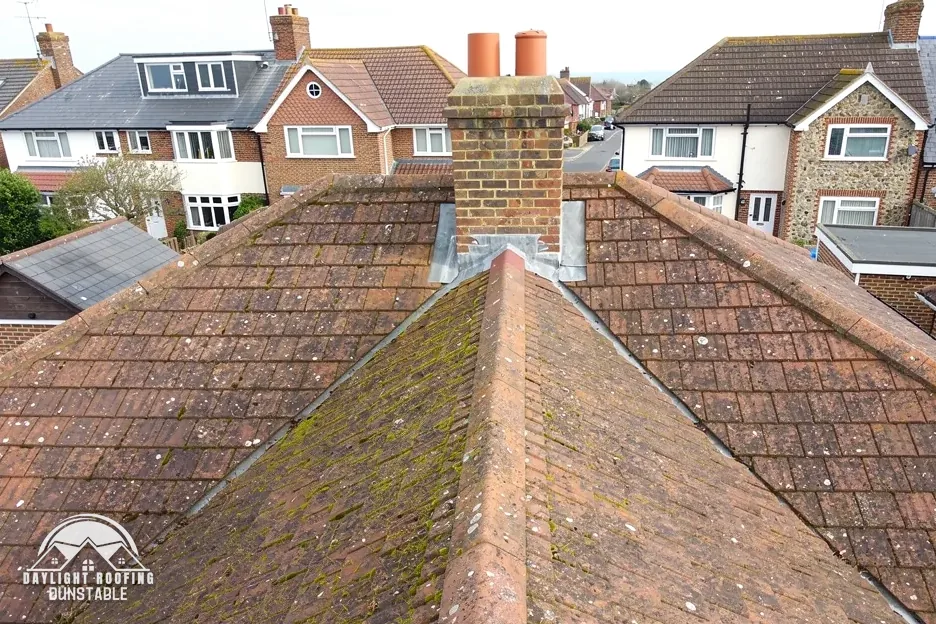
Sweeping deals with the inside of the flue. The outside is a roofing matter: the pot, the mortar bed around it, the brickwork, the lead flashing at the base and the cowl or cap on top. A sweep who spots a cracked pot or a loose cowl may suggest a roofer, and a roofer who finds a flue that looks sooty may suggest a sweep.
Our chimney repairs page covers the outside jobs, and the guide to signs of chimney damage lists what to look for from the garden. A photo sent to WhatsApp on 07880 284133 is a good way to start a conversation about the stack.