
The short answer
MyJobQuote says correctly installed lead flashing can last for over 80 years, and over 100 years for higher codes, given minimal upkeep. That is a statement of what is possible, not a promise or a minimum. Poor fixing, splits and damaged mortar joints can bring a flashing to the end of its life sooner.
What the 80 years figure says
The figure comes from MyJobQuote's page on replacing leadwork on a chimney. It says: "When correctly installed, lead flashing can last for over 80 years (over 100 years for higher codes) with minimal maintenance." Three conditions sit inside that sentence. The flashing has to be correctly installed, it has to be a higher code to reach the longer figure, and it has to receive minimal maintenance, which is not the same as none.
Two words in it carry weight. The first is can: the sentence describes what lead is able to do, not what every flashing does. The second is over, which marks an open-ended upper range and is not a floor to count on. Nobody can promise that the flashing on your own chimney will reach eighty, and the figure should not be read as a minimum service life or a length of cover.
Lead sheet comes in codes. It is made to BS EN 12588 in codes 3 to 8, and each detail in the specification names its own code. The lead sheet makers Calder and Ecobat both publish the thicknesses below, and the higher codes are the thicker sheets. The table gives thickness only, because makers' weights per square metre differ for some codes.
| Code | Thickness |
|---|---|
| 3 | 1.32 mm |
| 4 | 1.80 mm |
| 5 | 2.24 mm |
| 6 | 2.65 mm |
| 7 | 3.15 mm |
| 8 | 3.55 mm |
What can cut a flashing's life short
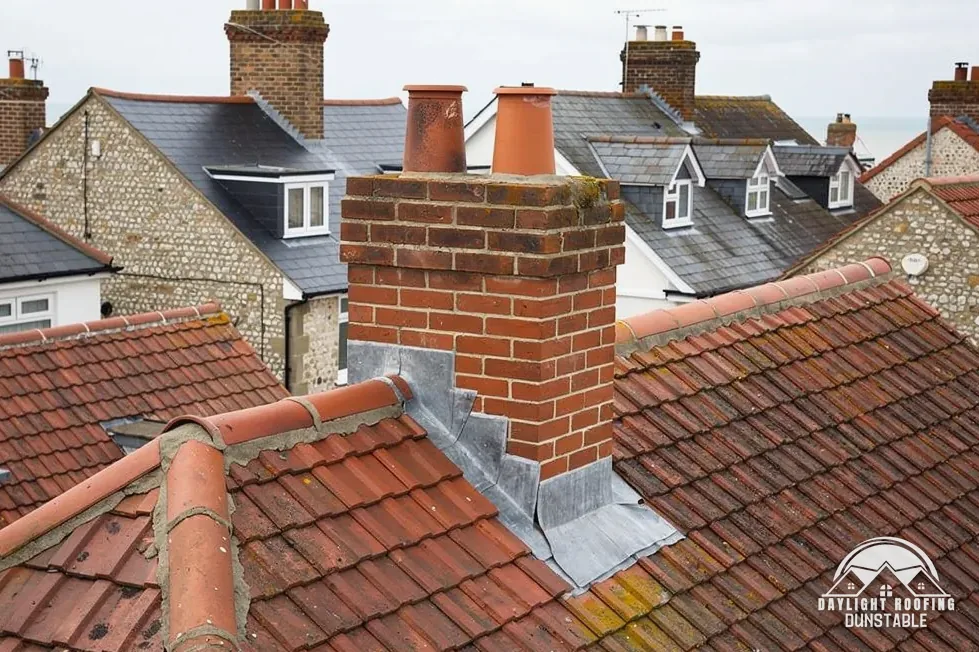
A chimney flashing is a set of lead pieces dressed around the foot of the stack to keep rain out of the gap where brickwork meets slope. Since the stack rises through the roof, that gap is where rain and movement meet, and the lead has to be dressed and fixed so it can expand and contract without splitting or lifting. A flashing fitted badly can fail early however good the sheet is.
Mortar plays its part. Flashing edges can be tucked into the joints of the brickwork, and when that mortar crumbles the lead edge can work loose. The cause can sit in the stack itself, such as weathered pointing, so a lead repair is worth looking at together with the brickwork. Our page on repointing a chimney explains that side.
Splits, lifted edges and gaps are the signs to look for. A stain or damp patch on the breast inside can follow a failed flashing, and our guide to chimney leaks in wet weather covers how to trace one. Where a flashing is split but the stack is sound, a repair to the lead may be enough, and a survey is how that call is made.
Patch, replace and what it costs
MyJobQuote's chimney leadwork figures give a sense of the choice, and apply to chimney leadwork only. It says that "a chimney lead flashing patch repair typically costs around £200, while a full replacement averages around £570", and that "a full leadwork replacement costs between £350 and £920, depending largely on whether scaffolding is required" (page last updated 22/09/26). They are third-party averages, not our prices.
A patch suits a localised fault, and a full replacement suits lead that has aged out or been poorly fitted. The step from one to the other is a judgement made on site, with the stack and slope in view, and it should be explained before you agree to either. Our quote follows the survey and arrives in writing as a single sum, so whichever option fits is priced as a whole.
For more on how lead is detailed around a stack, see our guide to chimney flashing and leadwork, and the chimney repairs page for the full list of jobs. A photo sent to WhatsApp on 07880 284133 shows us the flashing from a distance.