
The short answer
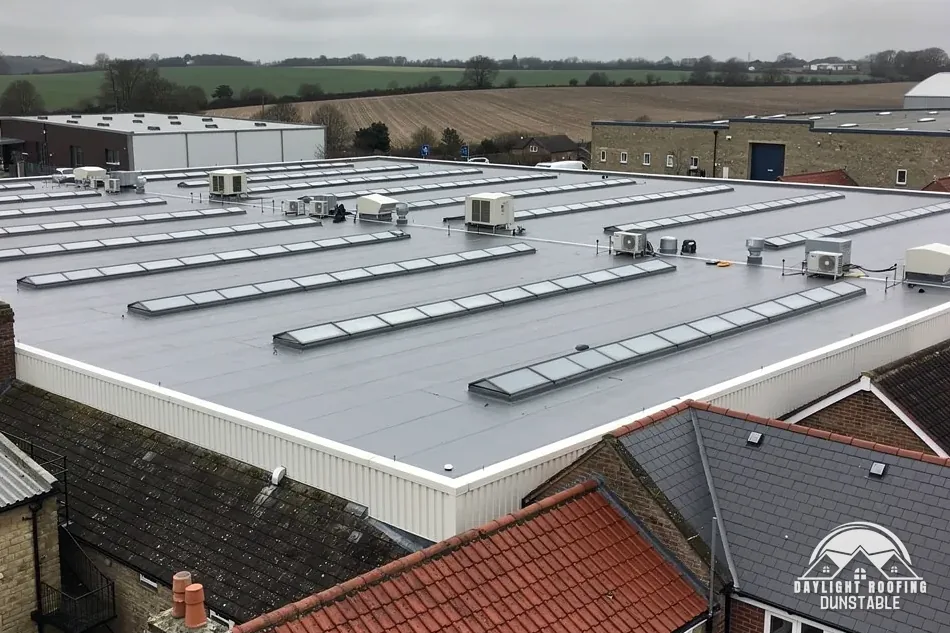
Rooflights on industrial roofs are translucent or glazed units built into the roof to let daylight into the building below. They can be sheets that match a profiled roof, or units sitting on a kerb. They may not carry a person's weight, and their fixings and seals are worth checking when a roof leaks.
What a rooflight is on a large roof
Approved Document L, in its definitions, calls a rooflight "A glazed unit installed out of plane with the surface of the roof on a kerb or upstand." That wording fits a lantern or a dome on a flat roof. On an industrial building the word also covers translucent sheets fitted into a profiled roof, which sit in line with the surrounding sheets instead of on a kerb, so usage in the trade is wider than the regulation's wording.
The job of either type is the same: letting daylight into a building whose floor is too far from any wall for windows to reach. A warehouse, a workshop or a factory may rely on rooflights to light a large floor, and a roof refurbishment that changes or covers them alters the light inside as well as the weather protection above. Some are fixed shut, and others are opening vents, which adds a mechanism to inspect.
Forms include translucent sheets that match the profile of the metal roof, individual domes or pyramids on kerbs, and long continuous strips along the ridge or across slopes. Each has its own fixings, seals and way of ageing, which is why the type is identified before a repair is specified.
Why rooflights call for care on the roof
Rooflights are weaker than the roof around them. HSE's guidance states that "AC roofs are always fragile", and a translucent sheet or a glazed dome in any covering can break under a person's weight as well, particularly once it has aged or been in strong sunlight for years. They are also hard to see, since moss, dirt and reflections hide them from someone walking on the roof. Edge protection, covers or guards are therefore part of the plan near any rooflight. Even where a rooflight looks new, a person's weight can concentrate on a small area of it.
They are also a place where leaks start. The sheet or dome, its fixings and caps, the laps and edges and the kerb each have faults a roofer looks for.
| Feature | Fault to look for |
|---|---|
| Sheet or dome | Cracks, crazing, discolouring |
| Fixings and caps | Loose or missing, failed seals |
| Laps and edges | Open joints, lifted sealant |
| Kerb or upstand | Gaps, cracked flashing |
Condensation inside a rooflight can look like a leak, and a real leak at a rooflight can run along the structure before dripping, so the visible wet patch may be some way off.
Replacing, covering or adding rooflights
Replacing a failed rooflight like for like is a repair. Adding new ones, enlarging openings or covering existing ones in an overcladding or re-roofing job changes the roof's structure, its light levels and its energy performance. Building control, the council's team or a registered building control approver, says whether approval is needed for your premises, and the energy requirements for a non-domestic building are theirs to confirm.
Each opening needs structural thought, because cutting a hole in a roof removes support from the sheets around it and can alter how the load reaches the frame. Where the roof is asbestos cement, any cutting or drilling needs the asbestos question answered first, because HSE's guidance on finding asbestos states: "If the building was built or refurbished before 2000, assume that there is asbestos in it."
To raise a rooflight problem, send photos by WhatsApp to 07880 284133, and the roof can then be surveyed ahead of a written price. Our commercial roofing page covers the wider work, the guide to fragile roofs and asbestos cement sheets explains the hazards, and roof overcladding covers what happens to rooflights when a roof is covered over.