
The short answer
Yes, tell your insurer promptly, and do not wait for the repair to be finished. Photograph the damage before anything is moved, keep every receipt, and read your policy wording for its own conditions. A make-safe that limits further damage is a separate step from the lasting repair, which comes later.
Why the order of events matters
Roof damage puts two pressures on a household at once. Water is coming in now, and a claim, if there is one, will be judged later on what can be shown. A sensible order is to stop the harm getting worse, record what happened and tell the insurer early, rather than repair everything and describe it afterwards. A repaired roof can no longer be inspected, and a description is weaker than a photograph.
Policies differ in their wording, so the exact duties on you are set by your own documents: how soon to report, what counts as a storm, what is excluded and whether the insurer wants to see damage before it is cleared away. Reading the policy before you call helps you ask the right questions. It also stops you assuming that a repair will be paid for simply because the damage looks like weather.
No page can promise that a claim will succeed, because the decision belongs to the insurer. What you can control is the record you leave. The page on storm-damaged roofs and insurance goes further into how storm damage and claims fit together.
What to record before anything is moved
The Financial Ombudsman Service says it will "usually look at expert reports and photos" when it considers a storm complaint, and that your insurer will normally ask a surveyor to write a report. Photographs of your own, taken at the outset and before slates are swept up or a ceiling is cleared, give you something to set beside that report. They also help later if the cause of a leak is disputed, since a stain on a ceiling can look very different a week after it first appeared.
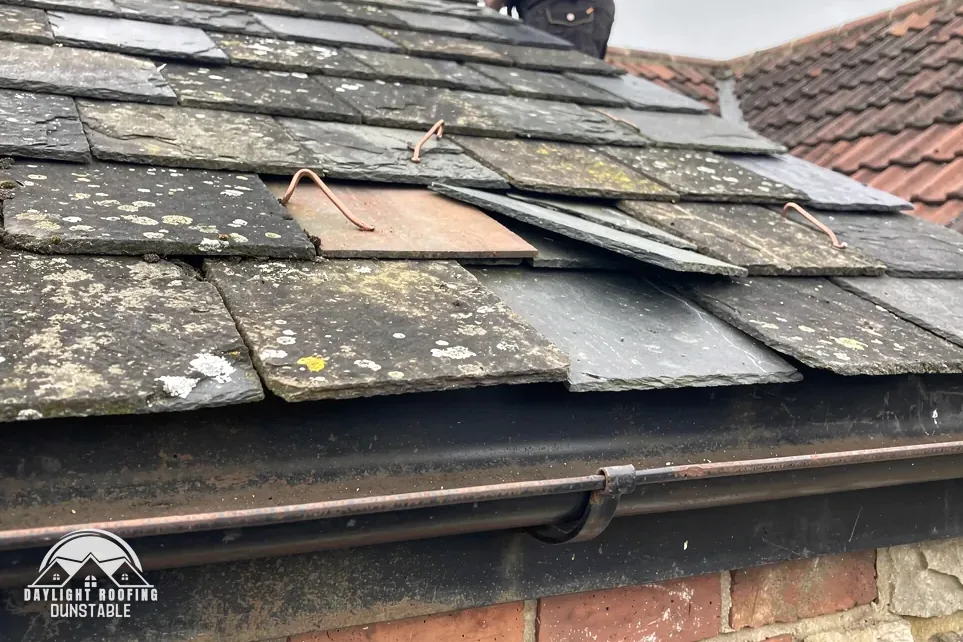
- Photograph the outside from the ground, showing missing, slipped or broken covering and anything blown onto the roof or into the garden, with a wide shot first and close-ups after.
- Photograph the inside: stains, drips, a bulging ceiling, and the date each one first appeared.
- Keep fallen pieces if it is safe, and note where each came from.
- Write down the date and time of the weather event.
- Keep every invoice and receipt for work done to limit the damage.
Stay off the roof to take any of these. The page on what photos to take of roof damage shows what a useful set looks like, and a picture sent to 07880 284133 on WhatsApp can be looked at by the roofer too.
A make-safe and the lasting repair
An emergency make-safe has a narrow aim: to limit further damage, for instance by covering an opening, so that the inside of the house stays as dry as it can. It makes sense to keep it to what that purpose needs and to leave the permanent repair until the insurer has had the chance to respond. Whether your policy expects this, and what it pays towards a temporary measure, is for the insurer to say.
That is why the lasting repair should not be rushed into just because the roof is open. Once the roof has been surveyed, the work is priced as a single total in writing, which gives you something definite to put in front of the insurer. The page on whether an insurer will pay for an emergency make-safe deals with that question directly.
If the insurer is slow or refuses, you have a route open. The Financial Ombudsman Service states: "For most complaints, a business has up to 8 weeks to consider a complaint." It can be reached on 0800 023 4567. The emergency roof repairs page gives the wider picture of what to do first.