
The short answer
If a gutter falls down, keep people and pets away from it, photograph it where it lies and do not climb to refit it. Move the loose length somewhere safe on the ground, then watch where rainwater now falls, because water running down a wall can cause damp. A roofer can check the fascia and brackets before anything is fixed back.
The first few steps
Start with people. A gutter that has dropped may still be partly attached, and a section dangling from a single bracket can swing in the wind or come down without warning. Keep children, pets and anyone passing the front door away from the area, and do not stand beneath it to look. Broken sections can have sharp edges, so wear gloves if a piece has to be moved.
Photograph the gutter where it landed, then the gap it has left along the edge of the roof, using the zoom from the ground. Include the brackets, the fascia board behind and any damage to the wall, the path or a car. Then move the fallen length to a safe spot, flat on the ground and out of the way. Cast iron is heavy, so take care lifting it, or leave it where it is and mark the area.
Resist the urge to climb a ladder and put it back, especially while it is still blowing. A gutter fixed in a hurry to a loose board will not hold, and a ladder footed in wet ground can slip. The page on wind damage to roofs covers what else a gale can do along the eaves, and a read through it helps you judge what else to check from the ground.
Where the water goes now
A gutter carries rainwater from the roof edge to a downpipe and away from the walls. With a length missing, water runs off the tiles at that point and lands against the wall or on the ground beside it. Left like that through several downpours, a wall can stay wet, which can lead to damp patches, and a path or flowerbed can wash out.
- Look at the wall below the gap after rain for a dark band or a trickle.
- Put a bucket or a tray under the worst of the spill if it can be done safely.
- Check inside, on the nearest ceiling and wall, for new marks.
- Note any overflow from the remaining gutter, which may now be draining the wrong way.
The fall matters as well. Brett Martin gives a fall of 1 mm for every 600 mm towards the outlet, so a run that has sagged on its remaining brackets may hold water instead of passing it along. That is why the rest of the run needs a look, and the page on repairing or replacing guttering goes into when a section can be refixed and when the whole run should be changed.
A wall that has been splashed for a few days is not an emergency in itself. Water that is entering the roof edge, or a ceiling showing a stain beneath the gap, is more serious, and a photo of it tells the roofer what to expect.
What to check before it is refixed
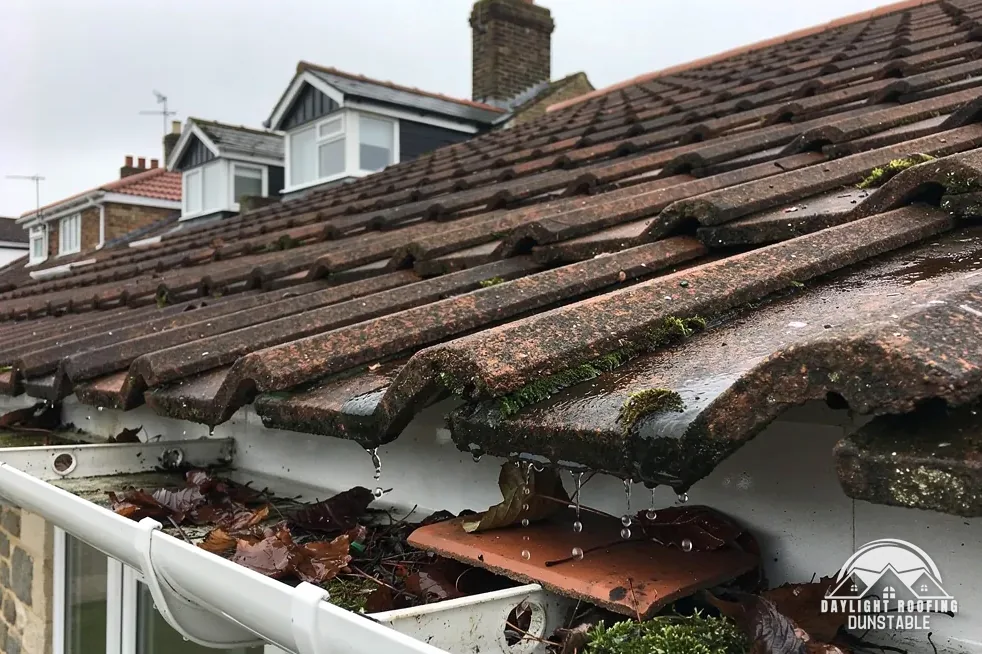
A gutter can come down because something behind it has given way. Brackets pull out of a fascia that has gone soft, or a board has been loosened by years of damp, and a gutter full of debris adds weight. Refixing the same gutter to the same board can fail again, so the fascia needs to be looked at first.
If the board or the soffit beneath it is an older panel, take care. HSE says: "If the building was built or refurbished before 2000, assume that there is asbestos in it." HSE also lists "AIB white soffit panels to underside of roof eaves" among materials that can contain it. Leave an old soffit panel alone and read the page on asbestos soffits before any work is arranged.
For the gutter itself, a roofer can look at the fascia, the brackets and the roof edge, and put the repair into a single written total price. A picture of the gap and the wall sent to 07880 284133 on WhatsApp is a way to begin. Tell your insurer too, since a storm-damaged gutter can form part of a wider claim, and see the emergency roof repairs hub for how a storm repair is ordered.