
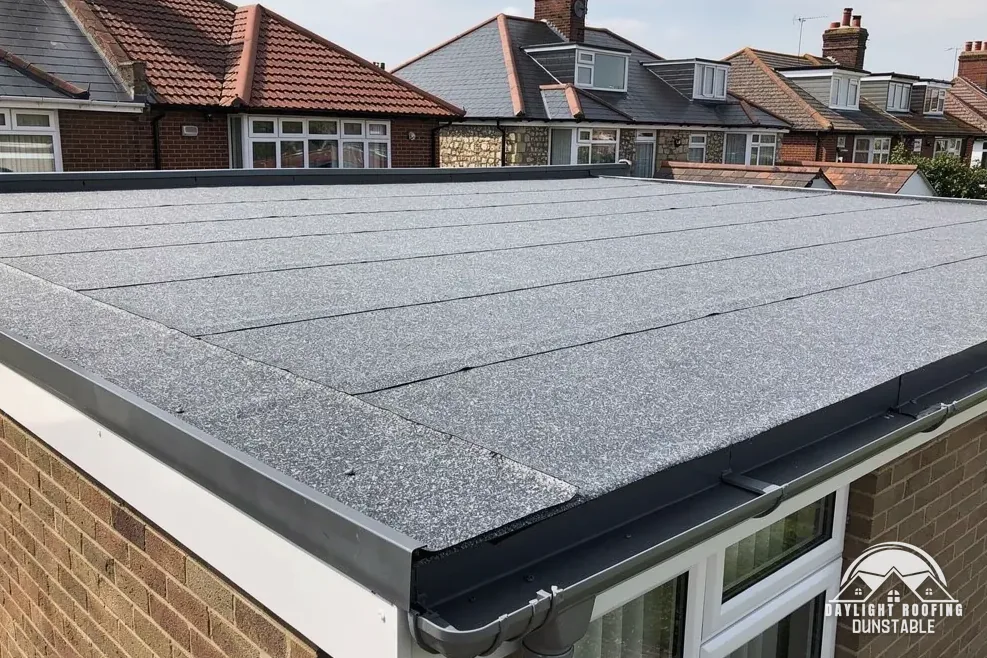
The short answer
The deck is the structural surface of a flat roof: the boards or sheets fixed across the joists that the waterproof covering is laid on. It carries the covering, snow and anyone who walks on the roof, and a deck that has rotted or sagged can need replacing before a new covering goes down.
What the deck is and where it sits
A flat roof is built in layers, and the deck is the one in the middle of the structure. The joists run across the room below. The deck is fixed over them as a continuous surface. The waterproof covering is laid or bonded onto that surface, and nothing else holds it up. Within the wider flat roofing work, the deck is the part that is covered over and so is forgotten until something goes wrong.
That continuous support matters to the standards. BS 6229:2025, which BSI lists as current, covers flat roofs that use continuously supported flexible waterproof coverings. Membranes such as EPDM, GRP and felt all rely on the surface beneath them being firm and unbroken, because a membrane spanning a gap would be left to carry loads it was never made to take.
Where the insulation sits changes the picture. In a cold roof the deck lies above a ventilated void with the insulation below it. Insulation in a warm roof lies over the deck and under the membrane. The warm and cold roofs guide sets out both, and either way the deck is the base that the layers above are built on.
How a deck fails under a flat roof
Timber and sheet decks fail from the same two causes. Water gets in, or moisture builds up from below, and the material softens and rots. A leak that has run unnoticed for a long time can leave a patch of deck that gives underfoot, and condensation in a cold roof can do the same slowly from underneath. Boards that stay damp lose strength, and screws or nails holding them to the joists can lose their grip in softened timber.
The second cause is deflection, which means sagging between the joists. A sagging deck leaves a shallow dip in the covering, and a dip can hold water. Falls matter here, and the minimum fall answer explains the figure the code sets. A new covering laid over a hollow deck keeps the hollow, and the pooled water keeps working on the membrane. Joist spacing, board thickness and fixings all affect how much a deck can flex, and a roof is judged on its own measurements.
| What you notice | What it can mean |
|---|---|
| Soft patch | Rot from a long-running leak |
| Dip holding water | Sagging between joists |
| Ceiling stain | Damp reaching the boards from above or below |
| Cracked covering | Movement in the deck beneath |
When the deck is replaced before recovering
A survey comes first. It looks at the covering, the ceiling underneath and any void, and it checks whether the deck feels firm. A deck is seen in full only once the old covering is off, so a survey describes what it can reach and the roof itself settles the rest. Edges, upstands and outlets get a look as well, because they are fixed to or through the deck.
Where boards have rotted or sagged, they come out and new ones go in before the membrane. Patching the covering over a failed deck leaves the cause in place. Which? Trusted Traders put a PVC or rubber EPDM flat roof with new boards at £1,950 to £4,000 for a single garage of 6m x 3m, excluding VAT, from a survey of 11 traders in November 2025.
Because a new membrane counts as renovation, approval can apply. The Planning Portal says: "In most situations, this work will need Building Regulations approval." The flat roof replacement costs guide looks at what moves a price. What we charge is one written figure, given once the roof has had its survey.