
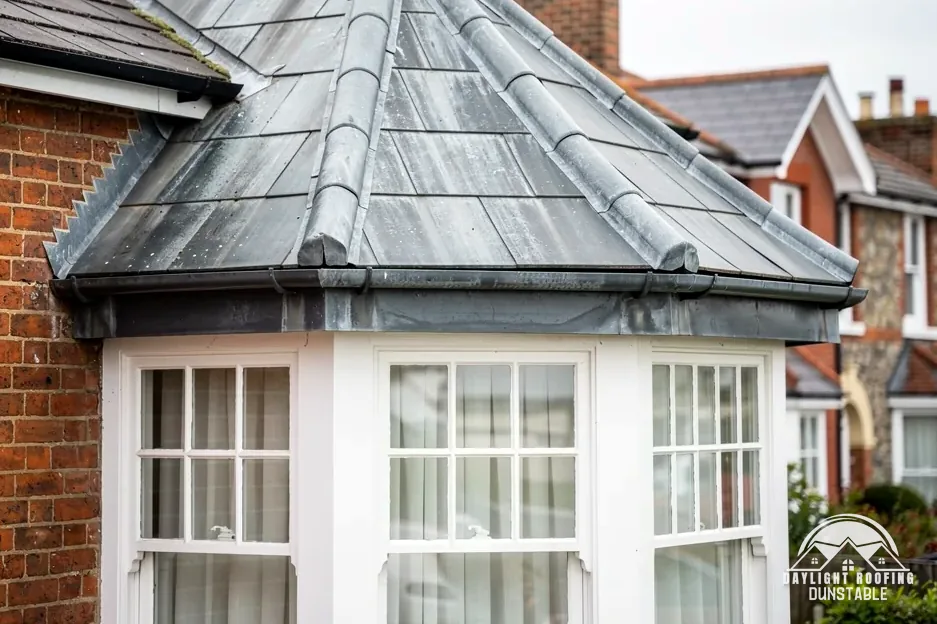
The short answer
A lead saddle is a single piece of sheet lead dressed over the point where roof planes meet a wall or chimney, so that rain is carried off a junction that flat flashings cannot cover. It is shaped by hand to fit that one spot, and it works together with the flashings beside it.
What a lead saddle covers
Straight edge details on a roof can be covered with long strips of lead, which are cut to length and bent along straight lines. A saddle is the exception. Where a ridge or a hip runs into a wall, or where two slopes and a vertical face all meet at a single point, a straight strip leaves a gap at the corner. A saddle is cut and folded from one sheet so that it lies over the peak and runs down both sides, with its edges tucked under or lapped by the lead around it.
Roofers use the word for more than one junction, so the drawing or the quote should say which one is meant. At a chimney, the raised area behind the stack that sheds water round it may be covered with a piece described as a saddle. At the top of a wall where a ridge butts against it, the lead dressed over that end of the ridge may be called the same thing. The name follows the shape of the piece, not a single fixed position on the roof.
The lead roofing hub explains the other lead details a roof can carry. A saddle belongs with the family of leadwork that turns a change of direction into a watertight corner.
Where a saddle sits and what it joins
The junctions below are the places a saddle can be named. Which of them a particular roof has depends on how that roof was built.
- The head of a chimney stack, where the lead behind the stack meets the ridge or the roof slope above it.
- The end of a ridge that stops against a gable or party wall.
- A point where a hip meets a wall or a parapet.
- The corner where a valley meets a wall.
In each, the saddle does not work alone. It is lapped by the stepped or cover flashings running along the wall, and it laps the lead coming down the slopes. The order of the laps matters, because each piece must sit over the one below it so that water runs from upper pieces onto lower ones. A saddle fitted in the wrong order leaks at the lap even when the lead itself is sound.
Cutting chases into a wall that is shared with a neighbour can bring in the Party Wall etc. Act 1996, and questions about that go to a party wall surveyor, not to building control. Where the wall belongs to one house alone, the point does not arise.
Lead thickness and how a saddle is judged
Rolled lead sheet is made to BS EN 12588 in codes 3 to 8. Code 4 is 1.80 mm thick and code 5 is 2.24 mm, and a saddle is cut from whichever code the specification names for it. A thicker sheet is stiffer to fold into a tight corner, and a thinner one folds more easily, so the shaping and the code are linked. Each detail gets its code from the specification, and the page on what code lead is used for flashing takes that question further.
MyJobQuote says correctly installed lead flashing can last for over 80 years. That statement is about flashing, and a saddle is not named in it, so it is not a lifespan for the saddle itself. A saddle is a place where the lead is folded hard, and folded lead is where a split can open, so it is one of the pieces a survey looks at closely.
Signs that a saddle has failed are the same as for other leadwork: a split along a fold, an edge that has lifted, a stain spreading across the ceiling or down the chimney breast below, or damp timber in the loft after rain. The guide to signs of failed leadwork describes what each looks like and what to photograph before anything is moved.