
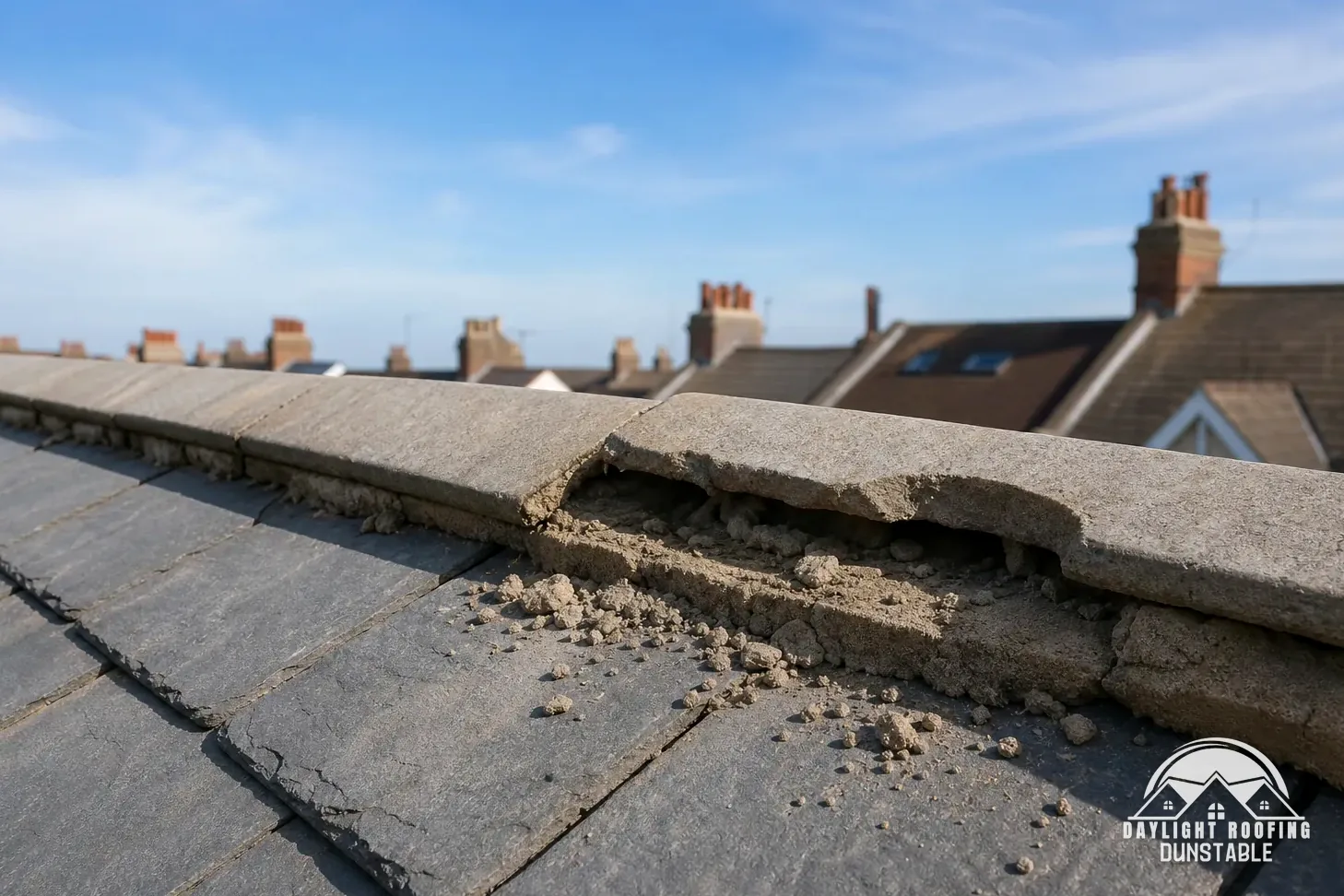
The short answer
A dry ridge system holds the ridge tiles in place with mechanical fixings, such as clips, screws and a ridge batten, instead of a bed of mortar. BS 8612:2018 is the standard behind dry-fixed fittings along the top line, down the hips and beside the gables. The aim is a ridge secured against the wind without relying on mortar alone.
How a dry ridge is put together
The ridge runs along the highest line of a pitched roof, where two slopes meet. The tiles that cap it are ridge tiles, and for generations they were bedded on mortar. A dry ridge swaps the mortar for mechanical fixing. Ridge units sit on a batten or a ridge board and are held by clips, screws or nails, with the manufacturer's fittings bridging the joints between them.
- A ridge batten or board fixed along the apex.
- Ridge units laid along the batten, each one clipped or screwed down.
- Joining pieces, end caps and a flexible seal made for the system.
- Fixings chosen to suit the tile profile and the roof's exposure.
The word dry refers to the fixing, not to the roof. Nothing needs to cure or set, so the work does not depend on a mortar mix being right on the day. Because the ridge tiles are held mechanically, they do not depend on mortar bedding, which can split and fall away as the roof moves with the weather.
Some dry ridge kits include a ventilated element that lets air pass through the apex. How that works depends on the product and on the roof underneath it. Whether a vented ridge suits a particular roof is for the survey and the system's own instructions to settle, not a general description.
Hips, the sloping edges where roof planes meet outward, and verges, the exposed edge beside a gable wall, have dry-fixed versions of their own. The mortar and ridge tiles answer covers whether mortar can still be used on a ridge.
The standards and the wind
Two British Standards sit behind this. BS 8612:2018 is current, and it is the specification covering dry fixing in those three places. BS 5534:2014+A2:2018 covers slating and tiling as a whole, and is also current. Under it, ridge or hip tiles should be mechanically fixed to resist the calculated wind uplift force, which the roof's exposure sets.
Marley, the tile maker, states that since the 2015 amendments to BS 5534, mortar could no longer be relied upon as the only means of securing the roof covering. Marley also says that installing to BS 5534 isn't required by law. Those two lines sit side by side. The code is not an Act of Parliament, but it is the reference the trade works to, and ridge and hip tiles are among the places where it asks for a mechanical fixing.
The number of fixings, and where they go, is calculated for that particular house, since exposure varies from site to site. A dry ridge system is one way to meet that. A mortar bed combined with mechanical fixings is another, so a dry ridge is not the only compliant route.
The re-tiling and building regulations guide sets out how a re-roof is treated under Building Regulations.
What ridge work costs and when it comes up
Ridge work can be set against third-party ranges before anything specific to a roof is known. Which? Trusted Traders, in a survey of 11 traders in November 2025 on prices that exclude VAT, gave £80 to £300 for putting in a new ridge tile. MyJobQuote, on a page updated 1 October 2026, gives an average of between £225 and £550 for ridge tile replacement. The two ranges come from different sources and different job descriptions, and neither is a price from us.
Hips are a different matter, and the ridge figures above do not carry across. They are priced after a survey, with the length, the access and the type of tile all in view.
A dry ridge comes up at one of two moments: when the ridge shows split mortar, loose tiles or bedding that has fallen away, or when the entire roof is being re-covered. In a full re-tile the ridge is part of the same job. For a ridge alone, a photograph of the problem sent to 07880 284133 on WhatsApp is a fair start, though the survey is what settles the diagnosis.
Once the roof has been surveyed, Daylight Roofing gives one written total. How long a covering lasts is covered in the how long roof tiles last guide, and the rest of the trade is under pitched roofing.