
The short answer
Yes, sound ridge tiles can sometimes be reused when a ridge is re-bedded or changed over to dry-fix. Cracked, crumbling or badly worn tiles are replaced. Whether a tile suits a dry-fix system's fittings depends on its profile, and in a conservation area the council is the place to check a replacement.
What decides whether a tile goes back
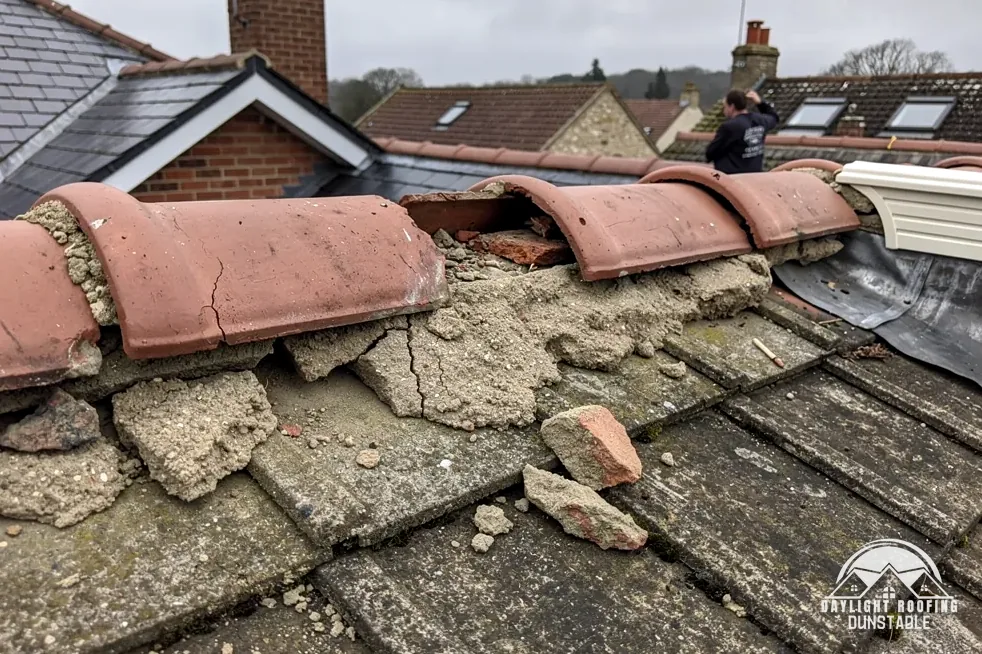
When a mortar ridge is taken apart, each ridge tile comes off with old bedding stuck to it. A tile that is whole, with no cracks along its length and no chipped edges where it sits on its neighbour, may be cleaned and put back. A tile that has split, lost a corner or crumbled at the surface is not worth refixing, since it will not hold its place or shed water as it should.
| Look for | If found |
|---|---|
| Cracks along the length | Replace the tile |
| Chipped or broken ends | Replace, or use at a less exposed spot |
| Surface crumbling | Replace the tile |
| Whole, clean, true to shape | May be reused |
Age by itself does not rule a tile out. Marley, the tile maker, says that "Typically, roof tiles are expected to last for around 60 years", with the caveat that "This is not a guarantee or warranty of its longevity." The Building Research Establishment (BRE) determined a minimum life expectancy of 60 years for clay tiles in particular. These are figures for tiles in general, so the condition of the tile in hand is what counts.
Cleaning needs care. A blast of high-pressure water can scar the face of a tile, and Marley advises against jet washing for that reason, so old mortar is taken off by hand and not by hosing the tile.
Reusing tiles with a dry-fix system
A dry-fix ridge holds each tile with clips or screws on a batten, and the fittings are made for particular tile profiles. An existing tile that matches the system can sometimes be fixed straight onto it. One that does not match, perhaps because the shape differs from what the fittings expect, cannot be forced into place, and a tile made for the system would be used instead.
BS 8612:2018 is current and sets out the specification for dry fixing. Marley's wind guidance asks that ridge and hip tiles be held by mechanical fixings against the calculated wind uplift, so a reused tile has to be held in that way. Setting one back on fresh mortar alone would fall short, because Marley says mortar "could no longer be relied upon as the only means of securing the roof covering".
Practical points shape the decision. The ridge tiles may be a different batch from the rest of the roof after years of weathering, and a new tile can look brighter beside them. Matching the colour and profile to what is already there is part of the survey, and a WhatsApp photo to 07880 284133 gives a first view of the tile in question. The types of ridge tile guide describes the common shapes.
Conservation areas, listed homes and cost
On a listed building or in a conservation area, a replacement tile may need to match the old ones closely, and what a repair needs is a question for the council. Check with the council before work starts whether listed building consent or an Article 4 direction applies to the work you have in mind. The planning permission guide explains the planning side of roof work.
Reusing sound tiles can reduce how many new ones are bought, though the saving is not simple to state. Cleaning, sorting and refixing take labour, and a ridge with many damaged tiles may cost less to redo with new ones. Which? Trusted Traders gave £80 to £300 for one new ridge tile in a November 2025 survey of 11 traders, excluding VAT.
A separate source, MyJobQuote, on a page updated on 1 October 2026, gives £225 to £550 as the average for replacing ridge tiles. The two describe different jobs, so neither stands for a reuse price, and what Daylight Roofing writes down after surveying is one total.
Daylight Roofing surveys the ridge and gives one written total price after it. The wider topic is under ridge and verge repairs, and re-bedding versus dry ridge weighs the two routes where reused tiles come up.