
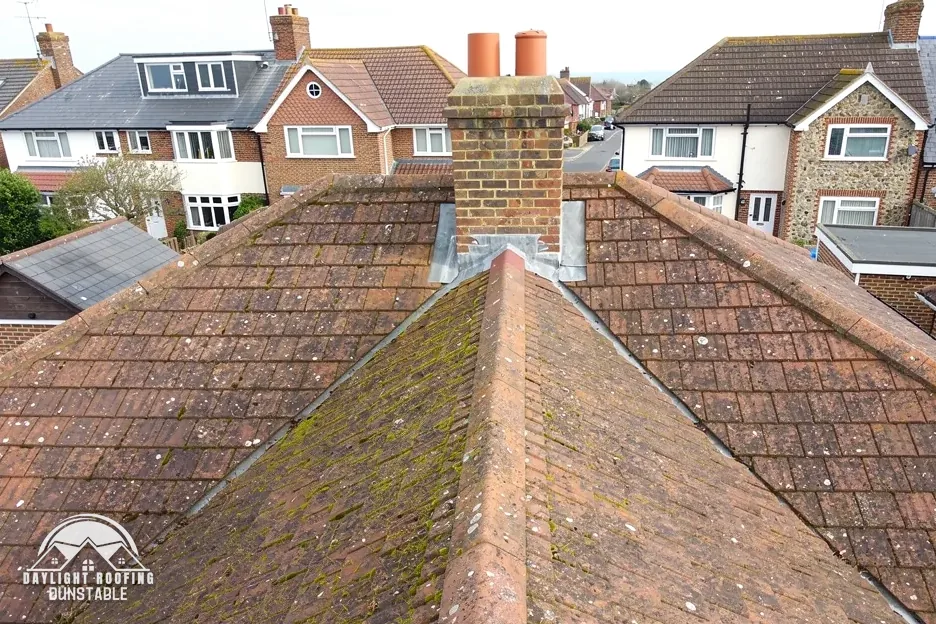
The short answer
Repointing ridge tiles is worth it only when the mortar bed under the old pointing is still sound and the tiles are firm. If the bedding has crumbled or a tile moves when pressed, fresh pointing only covers the fault. Re-bedding that adds mechanical fixings, or a dry ridge, is the sounder route.
What repointing does, and what it leaves alone
A bedded ridge has two layers of mortar. The bedding is the thick layer under each tile that sets it in place along the ridge line. The pointing is the thin finishing layer along the joints and the exposed edges. Repointing means raking out the weathered pointing and filling the joints again, which tidies the line and closes hairline gaps.
It does not replace the bedding. A ridge whose bedding is sound but whose pointing has worn can be repointed, and the work is small. A ridge whose bedding has gone soft, hollow or powdery is another matter, because pointing is a skin and has nothing firm to hold to.
From the ground, a few signs point towards the bedding rather than the surface:
- Grit and pieces of old mortar lying in the gutter or below the eaves.
- A ridge tile that has dropped, slipped or tilted along the line.
- Daylight or a dark gap showing under a tile at the edge.
- A skyline where the ridge has started to wave or dip.
Any of these suggests the problem is deeper than the finish. The why ridge tiles come loose guide explains how bedding gives way.
When pointing is enough and when it is not
The decision turns on what a close look finds, and only a look on the roof settles it. Pressing each tile and inspecting the joints shows whether the bedding is intact or hollow, and a photo from the ground cannot show that. Where the roof is tiled in clay or concrete, the same test applies, because the bedding sits under the ridge tile whatever the covering is.
| What is found | Likely route |
|---|---|
| Sound bedding, worn pointing | Repoint |
| Loose or hollow bedding | Re-bed, with mechanical fixing |
| Tiles moving, bedding failed along the run | Dry ridge system |
Repointing buys time on a ridge that is basically sound, and in that case it is a sensible, modest repair that keeps water out of the joints for the time being. Repointing over failed bedding is the version to avoid, since the new mortar can look neat for a short while and then lift with the rest. The roof can look repaired when it is not.
The re-bedding versus dry ridge guide compares the two longer-term routes, and the mortar and ridge tiles answer deals with whether mortar may still be used.
What the standards and the price ranges add
Marley says that installing to BS 5534 "isn't required by law". Even so, Marley adds that since the 2015 amendments mortar "could no longer be relied upon as the only means of securing the roof covering". For ridge and hip tiles, it states that they "should be mechanically fixed to resist the calculated wind uplift force". Repointing alone adds no mechanical fixing, so a ridge that relies on mortar stays reliant on mortar.
Outside ranges help with scale. Which? Trusted Traders, surveying 11 traders in November 2025, gave £80 to £300, excluding VAT, for fitting a new ridge tile. MyJobQuote, on a page updated 1 October 2026, puts the average ridge tile replacement between £225 and £550. Neither range is a price from us, and neither describes the cost of a whole ridge run.
Hip tiles are a separate matter, since the ridge ranges above are not hip prices; a hip waits on an inspection of the roof. Access and length shape the cost on any ridge, and so does the amount of failed bedding that has to come out. The written quote from Daylight Roofing is one total, set when that picture is clear.
The ridge and verge repairs hub covers every ridge route. A WhatsApp photo to 07880 284133 of a crumbling ridge from the ground is a useful start.