
The short answer
Sometimes. A ridge is the highest line of the roof, so reaching it safely depends on the house's height, the pitch and the ground below, not on how few tiles are loose. Any scaffold the job needs sits in the written quote, and a licence applies once it reaches the public highway.
What decides the access for ridge work
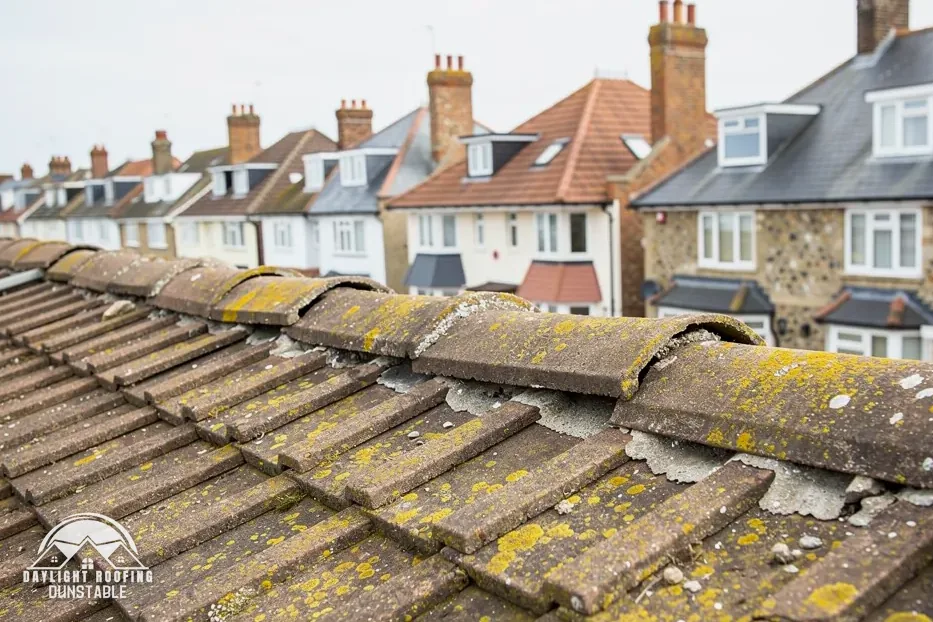
The ridge is the highest point of a pitched roof, which puts it out of a ladder's easy reach and makes it the place where a slip has the furthest to fall. Repairs there are decided by safety first, and the number of tiles involved comes second. One loose ridge tile on a three-storey house can call for more than a long run of ridge on a low bungalow.
Access here is a work-at-height question: reaching the roof in a way that is stable and that protects the people working on it. Judging that is a task for a surveyor looking at the actual building. A general answer can only list what moves the decision, and each of these points can push a job towards more equipment rather than less:
- How far the eaves and the ridge sit above the ground.
- How steep the slope is, and the state of the covering that has to be crossed.
- Whether the ground below is level, paved, stepped or occupied by a conservatory.
- How many metres of ridge, hip or verge are involved.
- Whether work is needed at both ends of the roof.
A ladder may reach the eaves without being a safe way to work along a ridge. A tower, a platform or full scaffold can give a stable base and an edge to work behind. Which of these suits a house is for the survey to settle, and nothing here describes a particular roof.
When scaffold comes into a ridge job
Scaffold can come into ridge work when the run is long, when it reaches the hips or the gables, or when the house is tall. It also arrives when the whole roof is being re-covered, since the ridge is then one piece of a larger job and the scaffold serves all of it.
Scaffolding that obstructs a public highway is licensed under section 169 of the Highways Act 1980, by the authority responsible for that road. Central Bedfordshire Council licenses scaffolding on its roads, which covers Dunstable, and we arrange the licence with our scaffolder. Trunk roads belong to National Highways instead, and a scaffold wholly on private ground raises no licence question, though the access question stays.
That licence is a scaffold licence, issued by the council that looks after the road. It is a separate matter from planning or Building Regulations, and neither is settled by the scaffold.
Any scaffold the job calls for is inside the written quote. The total from Daylight Roofing is set once the survey has shown how the roof must be reached. For sourced third-party ranges on ridge work, see the ridge tile repair costs guide.
What to look at before anyone climbs
Climbing up to look is not recommended. A ridge looks close on a clear day and is a long way up when a foot slips on a mossy slope, and an unsteady ladder is a well-known way for a homeowner to get hurt. A set of photographs taken from the ground gives a surveyor a good deal to work with.
- Photograph the ridge line from the front, the back and both gable ends.
- Note where tiles look dropped, tilted or missing against the skyline.
- Look for pieces of mortar in the gutters or on a path below.
- Note any steps, outbuildings or planting close to the walls.
Those photos can go on WhatsApp to 07880 284133, and they show access problems as well as damage. The survey then looks closer and decides how the roof is reached. If the ridge is also behind a leak, the hip tile repairs guide covers the sloping lines that meet it.
The ridge and verge repairs hub gathers the other ridge, hip and verge answers in one place. A nest or a bat roost found at the ridge changes the order and timing of the work, because wildlife law then applies.