
The short answer
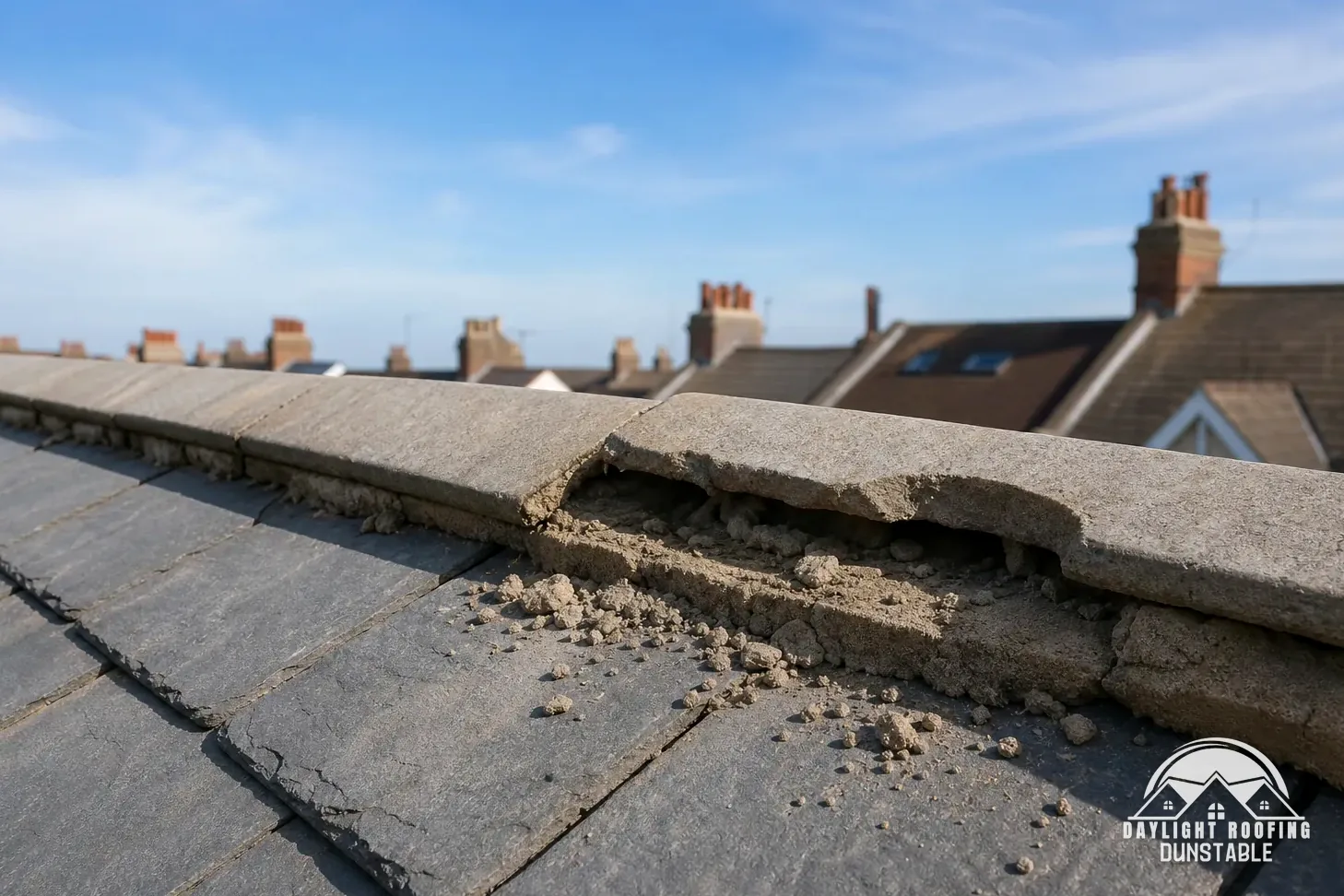
Yes. Marley's advice is to fix ridge and hip tiles mechanically against the calculated wind uplift, and since the 2015 amendments to BS 5534 mortar alone is no longer relied on. The standard is not law, yet a ridge held only by its bed falls short of it.
What the guidance actually says
Two statements from Marley, the tile maker, sit behind the answer. The first is that installing to BS 5534 "isn't required by law". The second is that the 2015 amendments made it clear that mortar "could no longer be relied upon as the only means of securing the roof covering". Together they describe a code of practice that carries weight without being legislation.
On ridge and hip tiles the guidance is more direct. Marley adds: "In all cases, ridge or hip tiles should be mechanically fixed to resist the calculated wind uplift force." The words "calculated" and "in all cases" matter. The fixing is meant to be worked out for the roof being worked on, and no exemption is written for a ridge that looks sound.
BSI lists BS 5534:2014+A2:2018 as the current edition. Its older +A1:2015 edition is withdrawn. A tiler working to a written specification can name the standard, and a homeowner can ask for fixings to be described in the quote. The BS 5534 and ridge fixing guide takes the standard apart in more detail.
None of this makes an older mortar ridge illegal, and a ridge that has done its job for years has not suddenly failed. What the guidance changes is what counts as a complete repair when a ridge is being redone.
How a ridge is mechanically fixed
A mechanical fixing is a part that grips the ridge tile and holds it to a part of the roof that stays put, like a batten or a board along the apex. It is the fixing, not the mortar, that resists the lift of the wind. Three arrangements are in use, and they differ in what the wind has to overcome. Each can be spotted on the roof itself, though what sits beneath the tiles is known only when the ridge is opened up.
| Arrangement | What resists the wind |
|---|---|
| Bedded in mortar alone | Grip of the mortar |
| Bedded, with fixings added | The fixings, with mortar as bed |
| Dry-fixed system | Clips and screws, no mortar bed |
BS 8612:2018, which BSI lists as current, is the specification written for dry-fixed kits along ridge lines, hips and gable edges. The first row is the arrangement the 2015 wording moves away from, because it relies on mortar and nothing else. The other two add a fitting that takes the lift.
Which of the second and third rows suits a roof is the subject of the re-bedding versus dry ridge guide, and the dry ridge system answer describes the kit itself.
Who sets the number of fixings
Marley says BS 5534's minimums "will always be superseded by the generation of a Fixing Specification, which is site specific". So no table in a guide gives the right fixing for a given house. A site-specific fixing specification under BS 5534 allows for how exposed the roof is, and the figure is worked out for that roof.
One result follows. Neighbouring houses can need different fixing even with identical tiles, since the specification takes each site into account. A quote naming the fixings and the system lets the reader compare like with like; one that only says the ridge is redone does not.
Where the work is a repair rather than a new roof, the same principle applies to the part of the ridge being replaced. A ridge that has been repointed has had its finish renewed and has not been given a fixing, and that difference is what the question here is about. The ridge and verge repairs hub sets out every route.
On price, MyJobQuote's page of 1 October 2026 gives an average of £225 to £550 for replacing ridge tiles. In November 2025, a survey of 11 Which? Trusted Traders produced £80 to £300, excluding VAT, for a single new ridge tile. Those are outside ranges, not our prices, and a photo on WhatsApp to 07880 284133 is the first step towards a written total.